|
Safety
Fishing with a disability provides unique ways for accidents to take place. A lack of motor control while walking can pitch you into a lake while you are fishing along a perfectly sculpted beach. Improperly tightened wheel brakes on a wheelchair can send you quickly rolling toward an unwelcome dip in a cold river. These things cannot be foreseen, but, hopefully, through careful planning they can be minimized, both in their occurrences and outcomes.
Know Your Limitations It is vitally necessary for a disabled person
to know his/her
limitations and capabilities in the real world. Walking across the
living room
is much easier than walking across uneven ground and this should be
acknowledged. Much as many disabled people would like to forget about
their
problems, it is much better to accept what you are saddled with at the
time.
Improvement may be on the horizon, but you’ll never get there without
taking
care of yourself in the present. If your primary limitations are related to pain, you may easily be able to fish like an able-body just by choosing the right equipment and locations. These will be discussed in detail later on, but for now a general statement can be made that you should start at the bottom and work your way up. You have probably become quite attuned to your particular maladies in going about the daily routine of your life. Listen to that same inner voice when you leave the house for the riverbank and you will do fine. Remember to rest frequently. (Easily accomplished if you catch fish at the rate I do.) Remember to always wear a personal flotation device (PFD) if in a boat. Start slow and bring along someone, even if all they do is watch. You don’t want to be alone if or when you encounter trouble.
Relying on Assistive Tech If, like me, you rely on an assist like a cane or walker, location becomes very important to your safety. Edges of rivers, with mud or drop-offs, are not good choices for a quiet afternoon. Moving slowly and resting frequently are orders for the day, as is a comfortable folding chair. You should be very cautious of approaching the edge of the water, even if you can still swim in a pool. Remember, you don’t normally just fall into a pool while still fully clothed. True, the water may be shallow, but the fall - and the subsequent getting out - can easily injure you further. The water may not be shallow, though, if you are fishing from a boat. In this case it is impossible to not be too close to the water, but two simple precautions are very important. First and foremost, remember to wear a good PFD. Secondly, do not stand on any raised portion of the boat or where there are no rails. Many lakes, especially those maintained by state conservation departments, have piers jutting into the lake that are designed with the disabled in mind. Parking is close by to reduce walking distance and the walkways are nice and flat. Fishing is usually quite decent from them as quite often the nice conservation guys make sure that there is good fish habitat within casting distance. Also, since many problems with lower legs are echoed in the arms, using the proper equipment can greatly improve your fishing trips and keep you within safe operating guidelines. A companion is vital, especially for carrying equipment and that chair. Wheelchair users should take special precautions whenever around water. Brakes should be checked for proper functioning before setting out. It is still a good idea to chock the wheels with a suitable stick or rock, too. The greatest danger with a wheelchair, even a powered model, is the ability of it to gain speed without any help from the passenger. Even small slopes can pose a problem for those with limited upper body strength or movement. A buddy at this time can save your life. Whether or not you should wear your seatbelt should be decided by conditions. If you are going down a steep slope (hopefully with your buddy), you should wear your seatbelt to keep you from sliding forward. Once parked, however, having your seatbelt undone will make it much easier to separate from your chair should you go in the water. If you are in a boat and are able to transfer, it is much safer to ride in one of the boat seats with the seatbelt on. And, of course, you should be wearing a PFD with the proper Coast Guard rating. I think you should seriously consider a PFD while on any dock or in any location where the possibility of rolling into the water is great. You are not stupid, so use your judgment in these matters. Another obvious problem with wheelchairs is their lack of offroad prowess. They simply don’t roll near as many places as you’d like. While this doesn’t sound like a safety problem, it certainly becomes one if you exceed the capabilities of your chair. Tipping over or breaking a component will ruin your day as well as your chair. Always have an able-bodied companion along. They come in very handy. (For those of you who are wondering, yes, I’ve spent time in a wheelchair.) Many people, especially seniors, use what are known as scooters. These are great for malls and sidewalks, but have some serious drawbacks for fishing. Most of the scooters that I see are three-wheeled. My dad had one of these and I became quite familiar with how readily these tip on uneven surfaces. Also, most I have seen have one minuscule parking brake on the front wheel that is readily overpowered. The four wheeled versions are much more stable and have two front brakes normally. They both go fewer places than most wheelchairs, even with the four-wheeler. Its primary drawbacks are the dinky little tires and low ground clearance. They can hang up in the front yard and spills can be nasty. They would be wonderful and quite safe around fishing piers that have good side rails. Their safety range and traveling range can both be extended by using common sense and following the guidelines relating to wheelchairs.
Personal Flotation Devices Several issues that are important for the able-bodies are even more important for the disabled. PFDs are among these. NO DISABLED PERSON SHOULD EVER BE IN A BOAT WITHOUT A PFD. It is preferable that this be the wearable type, however, I do sit on one when I am in a boat that is not moving. I do always put one on and zip up before the boat moves and anytime I have to stand in a boat. (Rarely, but nature does call.....ugh.) I own two PFDs that fit me well and are rated to support my body weight. If you’re disabled and go out on a boat often, or will be going out on a boat often, you owe it to yourself to buy this cheap insurance and use it properly. If you have a wheelchair and really like it, you can even buy a junior size vest and strap it to your chair to give it as much protection as you have and save a couple thousand bucks in the event it takes a splash in deep water.
Be Prepared Another important issue is the weather in all
its forms. Many
disabled people are not accustomed to being outdoors for extended
periods. They
run a greater risk, then, of heatstroke, sunstroke, severe sunburn, and
are more
susceptible to catching colds. While these last two may be just minor
annoyances
to the able-bodied, they can be deadly to the disabled. Extra caution
should be
taken I certainly haven’t covered every aspect of the safety issue in these few paragraphs, but I hope I have got you to thinking about your safety. Some may even read the above and think "Oh my, I never realized fishing could be so dangerous." Well, it isn’t. Unless, of course, you so something stupid and risk your personal safety foolishly. Many, many more people are injured seriously in their own home than are ever injured while fishing.

|
 As
with anything, it is necessary to begin at the beginning. The beginning
of this
discussion is the importance of safety. You have a
responsibility for your own
safety and for those who are fishing with you. Never take your safety
for
granted.
As
with anything, it is necessary to begin at the beginning. The beginning
of this
discussion is the importance of safety. You have a
responsibility for your own
safety and for those who are fishing with you. Never take your safety
for
granted.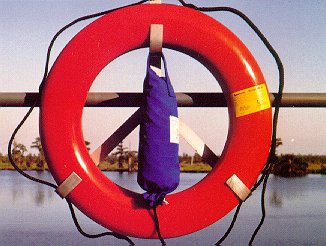 by the disabled person to stay as cool or as warm as possible,
depending
on conditions. During even moderately overcast days, the risk of sun
and
heatstroke and sunburn remain very high. Sitting in a shaded location
or fishing
early in the morning or late in the evening will greatly reduce the
likelihood
of these three conditions. Wearing light colored clothing and a
lightweight cap
can also help greatly. Sweat-proof sunscreen should be applied
liberally and
then some more. At the first sign of trouble, immediate action should
be taken
to prevent the situation from worsening. It may sound like wimping out,
but
frequent breaks to sit in a warm or cool vehicle are preferable to
overexposure.
by the disabled person to stay as cool or as warm as possible,
depending
on conditions. During even moderately overcast days, the risk of sun
and
heatstroke and sunburn remain very high. Sitting in a shaded location
or fishing
early in the morning or late in the evening will greatly reduce the
likelihood
of these three conditions. Wearing light colored clothing and a
lightweight cap
can also help greatly. Sweat-proof sunscreen should be applied
liberally and
then some more. At the first sign of trouble, immediate action should
be taken
to prevent the situation from worsening. It may sound like wimping out,
but
frequent breaks to sit in a warm or cool vehicle are preferable to
overexposure.