Article stolen from the Springfield, MO News-Leader with some bits about little ol' me.
Original link at
http://entertainment.news-leader.com/outdoors/_archive/0729-Disabiliti-143977.html
July 29, 2004
 Disabilities don't stop enthusiasts Fishing, hunting and other activities are within reach, they just require more planning and effort.
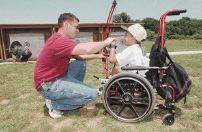
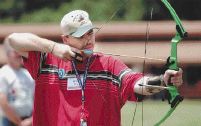
For the News-Leader Fishing is a tradition in Scott Smothers' family. He was 6 weeks old when he was taken along for the first time. "Dad and Grandpa thought that was appropriate," Smothers, who lives in Springfield, recalled. "They wanted to take me when I was 3 days old, but Grandma and Mom put the ixnay on that." Fishing, mostly along the banks of the Kankakee River in Illinois, was the Smothers family's major form of recreation. "We didn't have family barbecues or anything like that, we just all went to the river. There would be 10 or 12 of us lined up and down the river with 30 or 40 poles, whatever was legal at the time, and we would fish." When Smothers was 14, he began to develop symptoms of a condition doctors now believe he was probably born with. "It was symptoms very similar to a stroke: dragging the leg, dragging the arm. That side of my face didn't respond to facial movements." It wasn't until Smothers was 29 that doctors finally diagnosed the nerve condition called idiopathic small fiber sensory polyneuropathy. "My small fiber nerves are dying off, and they don't know why," Smothers said. "It is degenerative. They don't know; I could live to be 70 years old and continue to have problems, or I could accelerate and be dead in two months." On some days Smothers uses a cane to assist him to the banks of a fishing hole, and on other days he is forced to use a wheelchair. Chris Oberhansly always uses his wheelchair. A work-related accident nine years ago rendered him a quadriplegic. Like Smothers, he had always enjoyed the outdoors. "Before I had my accident, I enjoyed being involved in the outdoors," Oberhansly, also of Springfield, said. "I love to hunt and fish; I have hunting dogs and I love to go out and hunt birds. When I acquired this new disability, it looked pretty dim as far as the opportunity to continue to do those things. It has been through my own efforts to try to go out and do what I can in the outdoors, combined with having some facilities there that are useful, that has made that possible." 'Just a part of what we do' There are almost a million people with some form of disability in Missouri. To many, the outdoors is available only through special facilities provided by the Missouri Department of Conservation, the U.S. Park Service, the Forest Service and some municipalities. Oberhansly has taken an active role in helping to develop such facilities as the chairman of MDC's Disabled Accessibility Advisory Council. He and others with disabilities use the state's facilities and offer advice on their effectiveness. "One of the main things we do is visit the facilities around the state, and we actually test and try out the different accessibility features that have been incorporated into the project," Oberhansly said. "We get to find out what works and what doesn't work. Then we all get together and throw out our ideas and issues. The conservation department has representatives there who listen to our concerns and to help come up with some of the solutions." The council includes volunteer members with a range of disabilities. "So when we get to go to these facilities we are not just focusing on whether or not a facility is wheelchair-accessible. A lot of the displays and so forth that the Department of Conservation puts together are made accessible for the hearing- and sight-impaired also." There is also an accessibility committee of professionals within MDC that helps plan facilities and programs. "In the five years I have been involved with the department, I have seen them put a lot of time and a lot of money into these particular items for accessibility," Oberhansly said. "There aren't many things that they build that they don't come and consult first with us. It is so important, because these things are actually useful to us, and I like the idea that I can go up to Jefferson City and visit the visitors' center and actually use the facility as well as possible for a person with a disability. Therefore, it makes it inviting." MDC officials like to stress that their mission includes all people. "The outdoors can be enjoyed by people with disabilities as well as they can by anybody else," said Francis Skalicky, spokesman for MDC Southwest Region. "Our effort for people with disabilities is not extra effort, or above what we normally do, it is just a part of what we do." Making adjustments "I have a pontoon boat that I like to go out on," Oberhansly said. "At some of the access areas, it has been real helpful that there are docks that have been made accessible for people with wheelchairs. Some of the docks in the area have been set up with loading ramp areas where people can get into their boat before it is launched." When Smothers is using his cane to fish, he can travel but a short distance: "in sight of the truck." At other times he uses facilities such as those available at Lake Springfield. "They have a pavilion that is all paved; it's pretty even, and it is very easy to get to. If you go fishing in a wheelchair, those are real nice because it is really tough to get a wheelchair through rough ground." Smothers has a wheelchair that he ordered with special features, such as hill-holder brakes, which help him get to his favorite fishing spots. "It is hard to explain to somebody who doesn't use a wheelchair, just the little things you can do to make a wheelchair better at off-road," he said. For example, rigid wheelchairs are better over rough ground than fold-up chairs, Smothers says. The lack of flexing makes traveling easier and allows him to sit comfortably for a longer period of time. He also has special-order front casters that perform better on rough ground. The wheelie bars have been left off because "they get hung up." Accessible hunts, classes The MDC Web site lists areas with facilities designed for those with disabilities, and the site also includes information about special hunts, regulations and programs. "At the Bois D'Arc conservation area we are going to have a disability-accessible deer hunt," Skalicky said. "It is going to be for shotguns or muzzleloaders." The department holds these managed hunts in order to maintain deer population. Skalicky stressed that disabled hunters would need to enter a drawing for the hunt, then winners will be chosen. Besides the one planned at Bois D'Arc, there will be a number of other such hunts. Special exemptions also exist that allow disabled people to participate in some draw hunts without having to be drawn. Oberhansly urges those who have special needs to just ask for what they need. "I have had real good luck with the local conservation agents and with the local facility directors," he said. "If you have an issue, and you want to do something or you need help from them, they almost always do anything they can for you. I go to Bois D'Arc quite a bit. It is an area where there is a lot of hunting. To be able to get back into the property, they have given me a special permit so that I can drive my van into the area where I like to hunt." A recent event for those with disabilities held at the Andy Dalton Shooting Range in Bois D'Arc is a good example of the programs available. Sponsored by the National Wild Turkey Federation's Wheelin' Sportsmen program, the MDC, The Southwest Center for Independent Living and Ozarks Prosthetics, classes were offered in shotgun shooting and handling, archery, fishing, camping skills and other outdoor activities. The programs are designed to provide both fun and education. "Yeah, we have the facilities out there; the next step is not only educating people with disabilities, but also people without disabilities," Skalicky said. "Unfortunately, there is still a belief out there that people with disabilities are limited, they can't do this or they can't do that ... a lot of times that is not the case. It may be a matter of needing some adaptive equipment ... the adaptive equipment is out there." 'Not as hard as you think' Smothers has a Web site called "A Disabled Fisherman" and regularly hears from people with acquired disabilities. "In some families, they want the disabled person to be disabled," Smothers said. "They want them to watch TV and not disturb them any, but be a disabled person." He says these people just need a little support. "I get that from a lot from e-mails, that they couldn't find somebody to take them (outdoors), and then somebody at church said, 'You need to come down to my pond.' Bam, they are fishing." Helping a disabled friend or family member is less effort than many would think, and probably more rewarding than some would imagine. Often the reluctance of a person with a disability to accept such help keeps them from enjoying the outdoors. "It's not as hard as people may think, but you have to get out there and find out. You don't know if you can go fishing if you've never tried." This is a common theme among those who communicate with Smothers through his site. "I've had e-mails from people that say things like, 'I've been disabled for 12 years and I never went fishing. After reading your Web site I gave it a try and it wasn't as hard as I thought it would be.' You know, they just missed out on 12 years of fishing." Learning to cope with his own disability prepared Smothers for later helping the family member who introduced him to fishing. "My dad had Lou Gehrig's disease — ALS. He got to the point where he could barely hold a fishing rod. Considering that I had been putting up with not being able to hold a fishing rod at various times, we knew that taking him fishing was no big deal. So if he wanted to go out, he went out." Direct questions or comments for freelance writer Steve Brigman to [email protected].
|