|
Finding Partners
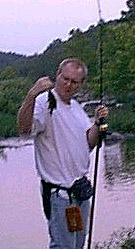
This section is written with ideas for both disabled folks looking to find able bodied partners and able bodies looking to hook up with disabled folks. For most of us disabled folks, family members are available who are fishermen and who are a ready source of partners. Many, though, do not have this resource available to them, so I will put forth my ideas on the best way to go around locating suitable partners. By the way, that is a genuine Missouri Whale I am holding. And I caught it on an ultralight rod.
Independent? Most disabled people nowadays are striving for independence. Even those who can only function at a minimum independence level are constantly being bombarded by media sources and "experts" in the field who tell them to strive to be completely independent, free of any outside help in all arenas, proud to be what God has made them. This is all a bunch of hogwash. People like the idea of the disabled being independent merely because then they do not have to feel they are needed to take care of any individual but themselves. Often, they would prefer not to even take care of themselves. No handicapped person I know of wants to be taken care of any more than a cat wants to go for a long ocean swim, but their conditions are such that many need some type of help at some point in their life. This is not something to be ashamed of and certainly does not cut down their desire to be independent, nor should it impinge upon their pride. Some folks simply cannot be completely independent in everyday living, regardless of what the media may tell you. Add in the decision to participate in an outdoor sport and many times even more independence is given up. So now we have before us the precepts that disabled folks want to be independent, want to maintain their pride, and that they accept the fact that they may need help getting along in the world. It should be readily apparent to everyone that disabled people are just like everyone else in these regards. We are not special or unique, even though our physical handicaps may be. Now we’re set to begin a discussion on some issues in finding a suitable partner.
Or Prideful? Most folks, no matter what their physical capabilities, do not want to admit that they need help. This simple statement was taken to the extreme in the Gilbert Islands of the Southern Pacific. A man’s "honor" was so important that to ask for help was so disgraceful that many men died with help only yards away. They simply believed that to ask for any assistance would shame them forever in the eyes of their villages and they preferred "death before dishonor." Neat concept unless you’re the one who needs help while your canoe is sinking and the sharks are circling. While most folks are certainly not that extreme, they do deny themselves pleasure for fear that it would be too embarrassing to ask for anything from anybody. Well, wallflowers, the only people you are hurting are yourselves. Following my fundamental precept that most people are relatively nice, my advice is to start out with something simple. If you know someone who fishes, ask them how they’ve been doing and where they have been. It’s a conversation most fisherman love to engage in. They may not say 100 words to their wives all week long, but they’ll talk about fishing for hours on end. These people may not even be people that you’d like to go fishing with, but you’ll learn a lot and you’ll become more comfortable with the whole concept of getting out on the shore and landing some lunkers. You might even catch bass fever, which is a good thing to get and a hard thing to get rid of. Eventually, you’ll get up the courage to ask someone if you could go along one day. For those of you who are able bodies and are asked how the fishing is, don’t assume right off that the person is hitting you up for a fishing trip. Talk to them about fishing and ask them questions. It’s called a conversation. Many times you’ll find that the person is looking just to talk to someone. They may have brought up fishing because they saw your boat or your Bass Pro hat. (Fishermen tend to give themselves away in public.) Especially if you have never met the person, realize that a lot of disabled people don’t get out much and we suffer from cabin fever the same as everybody. Sometimes we just want to talk to somebody that doesn’t live with us. If you get to know the person and this becomes a regular topic, assume they are interested in fishing and ask them along some time. If they say no but continue to ask about fishing every time they see you, bring up the subject of them coming along every now and then. They may simply not want to go but enjoy the subject, but they may be saying no because they do not want to feel like they are imposing. By continuing to ask them without pushing the idea, you let them know that you actually want them along and are not asking simply because you feel you must. There’s a lot of foolish pride in many men, able and otherwise, and sometimes it takes a bit before the defenses come down.
Fishing for Partners
Now if you’re disabled and not bashful about needing an able body partner, there are some places to look which are rather obvious. Wherever you work there is certainly to be a fisherman or two. In your school, church, synagogue, historical society, or wherever you go, fisherman lurk everywhere. You can even ask the local librarian about who checks out fishing books and try to hook up that way. The librarians at my library know me well enough to tuck back new books on fishing for me. Those of you who are able bodies and are reading this probably already have someone in mind and are here to learn about what it takes to go fishing with someone with less mobility and dexterity. You may even be thinking of actively hunting someone out to take fishing. For either group, there are some guidelines to follow. Get to know each other. Yeah, I know, this a no-brainer. But I don’t mean learn each other’s name and favorite color. Learn what the handicap involves and how much mobility is present. Learn at least some of the limitations and the strengths of your partner before going out. A good way to do this is by starting out slow. Go to a fishing dock or an easily accessible shoreline before tackling anything with a hint of challenge. You may find out it will take two able bodies to get that wheelchair to a hot hole. Able bodies should learn what to do in case of emergency. Many disabled folks have emergency meds that need to be administered quickly and correctly. Learn about these. Don’t be afraid that you’re going to do something wrong if the time comes. Doing nothing is nearly always the wrong thing to do. Disabled folks may learn that they need more help than they originally thought. Instead of stopping there, though, they should work with their partner and find a way around any problems. Those who have been in the Army know the buddy system well. Apply it. You able bodies might want to sneak behind your partner’s back and check with spouses or parents to make sure that you know everything. I hate to admit it, but I know I have a tendency to hold back on telling people some of the difficulties I have. That foolish pride thing. Just remember that you’re doing this for safety’s sake. Anything personal that doesn’t involve safety isn’t any of your business. There’s a fine line there, but it’s necessary to approach it. But better safe AND sorry. It is always a good idea to invite someone from the family along, at least for the first few trips. Make sure that it is someone unobtrusive who won’t badger or interfere. You need to establish a relationship between disabled and abled so you can learn to depend on one another. Get to know the equipment. Backyard casting practice can show any problems a disabled person is going to have in casting and retrieving. If problems show up, find ways to adapt, whether it be a simple change of rods or rigging up a handle system. The idea should be to allow the disabled guy to do as much of his own fishing as possible, including casting and retrieving and baiting up. Remember that baitcasting and open-face spinning reels require hand dexterity often beyond the limits of a handicapped individual. Also, it is easier to cast a medium weight pole than it is to cast an ultra stiff heavy one. Remember, too, that manufacturers rate their rods differently, so a "medium" Eagle Claw rod might be as stiff as a "heavy" Daiwa rod. If you’re going for a species that often needs a heavy rod, you can compensate by using heavier line on a tougher reel. This allows the reel to take up some of the slack that a medium weight rod will produce. Able bodies should always be ready to help, but should avoid trying to help constantly. Instead of jumping right in, ask if help is needed or show them how to do it and then let them try. Independence, remember. If the disability prevents something from being done, the able body should do it willingly and without comment, be it casting or tying on a hook. Get to know the hot spots. Most disabled folks are not able to fish everyday, or even every week. This makes it even more necessary to keep up with where the fish are biting and what they are hitting on. If catching fish is the goal (and it isn’t always), you want to be in the right spot at the right time. Since you won’t have the luxury of being out everyday, the right spot becomes paramount. Talk to any fisherman you come across and ask how they’re doing. Hang around the bait shop. You’d be amazed at what you can learn. You’d be even more amazed by the new words your kid can learn there if you let him listen to old fishermen. Of course, there is a lot to be said for trying out a new hole that you have heard nothing about. Like Columbus sailing across the Atlantic, you feel like an explorer, reaching out to a new land. You may not catch anything, but you can still have a good time.
|