 |
| The Climate of Toyooka |
|
| Now I'll engage in one of Japan's favorite pastimes -- talking about the weather. Word on the street is that Toyooka has the widest range of temperatures in all of Japan. Sure, Hokkaido is much colder in the winter, and Okinawa hotter in the summer, but between the extremes of its cold, snowy winters, and its hot, humid summers, Toyooka runs the gamut of Japan's climatic potential. |
 |
| �� You'll be arriving in summer, which is usually hot and very muggy. Although most of Japan is hot and humid during the summer, apparently the river basin in which Toyooka is located traps the humidity and jacks up the temperature to around 36 or 38 degrees Celsius (over 96 degrees Fahrenheit). I believe the humidity in Toyooka lingers around 85% (or even higher). To deal with the humidity, most people carry around handkerchiefs (or small towels) and a fan. Luckily, the apartment has a very good (and relatively new) air conditioner. The schools, on the other hand, don't. �~ Winters are fairly cold, with temperatures around 0 degrees Celsius (but rarely too far below freezing). Usually it snows for about 2 months (January and especially February), with at least a foot of snow on the ground most of the time. However, the past two winters were relatively mild, and the snow never really hampered transportation (my first winter here was another story!). As my predecessor advised me, bring thermal underwear, a few jumpers (sweaters, sweatshirts) and a good fleece/waterproof type jacket. I purchased a snowboarding jacket here and wore it to school, much to the amusement of the teachers and students. ("Hey Greg-sensei, going skiing?!") |
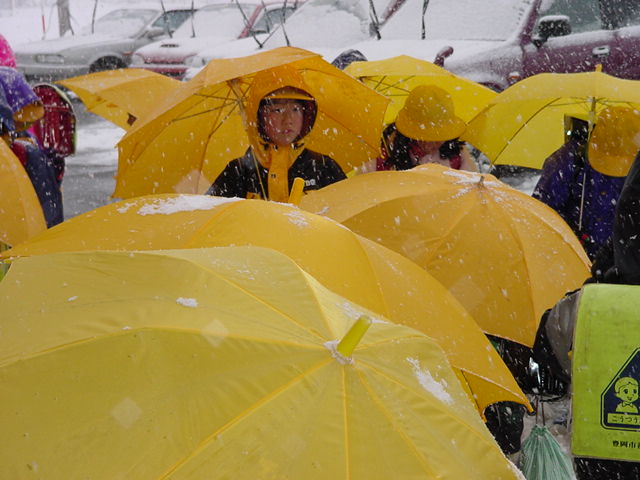 |
| Students at Koto Elementary School, getting ready to walk home in the snow... |
| �t�ƏH Spring and autumn are mild and quite beautiful, but with spring comes high pollen levels (which usually peak in April). I was sneezing and sniffling like crazy all through the �ԕ��� kafunshou (hayfever) season. April, the beginning of spring, is �Ԍ� hanami (flower viewing) season, during which people have picnics and get drunk under the cherry blossom trees. Early June to mid-July is �~�J tsuyu, the muggy rainy season, with seemingly constant rains that can sometimes get pretty heavy. Japan's typhoon season runs from summer into autumn, although Toyooka evidently is less affected by typhoons than areas facing the Pacific Ocean. |
 |
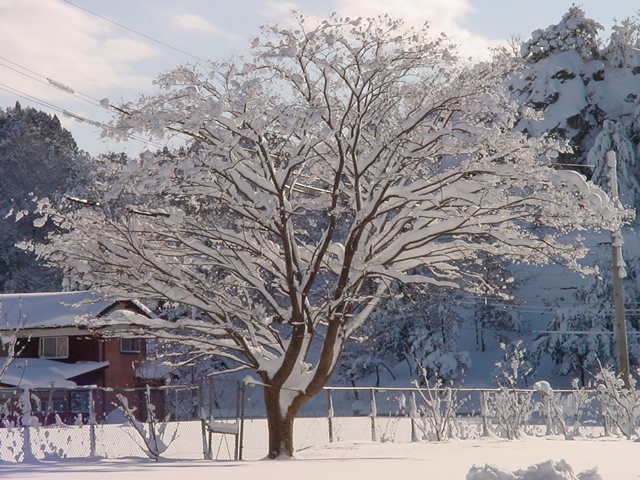 |
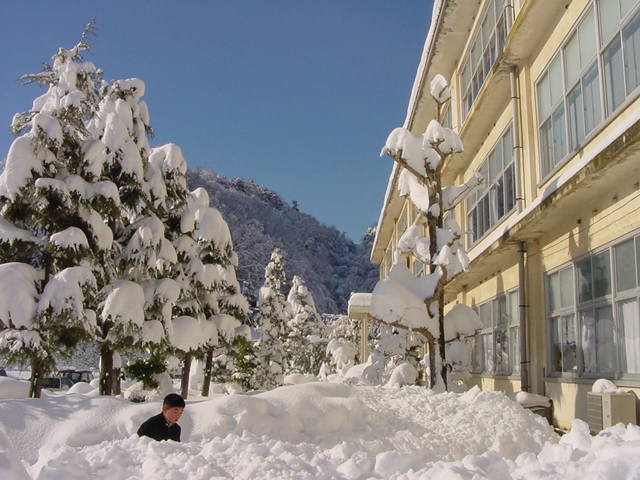
| Snow at Minato Junior High School. This winter a few feet of snow were dumped on Toyooka, but it didn't last too long... |
 |
| There's more!! (Page 2) |
 |
| Back to the Toyooka Guidebook (Table of Contents) |
| �L���̓V�� |