Elsewhere on this front a dangerous situation was developing as well. After several unsuccessful attempts to push our units out of the villages on the left bank of the river, at 1700 the enemy pierced the defenses of the 99th TB and entered Vasilevka. The tank of the brigade's commander Colonel L.I. Malov was knocked out, he was wounded and sent to the medical battalion's field hospital. Major Osipov took over the brigade's command. To restore the situation a counterattack was conducted with the reserve tank battalion. The attack was so determined and bold that the Germans, without significant resistance, retreated. However, some time later they attacked again at the sector of the 287th RR. After heavy fighting the 3rd battalion was thrown back and dispersed, and the 99th TB was encircled near Andreevka where it continued to fight until 1000 of the next morning. After the entrance of the 42nd GRD into the battle the situation somewhat improved, the enemy in this region was halted and somewhat pushed back.
In the course of the whole day, with only short breaks, bloody battles raged near v. Storozhevoe. The 169th TB, supported by the battalions of the 58th MRB and the elements of 183rd RD, successfully defended its positions using the uneven terrain, and the deep forest nearby. During the whole day the Germans managed to advance only 1 km into the forest. They did not manage to capture the key strong point of the defense - Storozhevoe.
By the end of the day the situation had stabilized in the Psel's bend. The attempts to transfer the tanks of the "Totenkopf" over the newly constructed pontoon bridges were unsuccessful. Because of the swampy shores the heavy tanks could not climb the high banks of the right shore. The advance through the hill 226.6, captured the previous night, had to be postponed. Its continuation was made possible only the next day.
After arriving to Prokhorovka in the evening, A.M. Vasilevsky ordered P.A. Rotmistrov to deploy units of the 29th TC to the most threatened directions, and in the case of a continued enemy advance to deliver a counterattack at 2100.
But the Germans were not very active.
"I ordered the commander of the 95th GRD Colonel Liakhov and the commander of the 9th GAD Colonel Sazonov to throw the enemy back with a night attack and to restore the previous situations," - reported the commander of the 33rd GRC Major-General I.I. Popov to the General A.S. Zhadov at 2000. Fighting raged throughout the whole night and ended right before dawn. The fighting did not, however, have the desired outcome. Nonetheless, under this battle's cover the brigades of the tank army and units of the 42nd GRD reached the frontline ready to enter the fighting in the morning.
This way, by the end of July 11th the situation near Prokhorovka remained very complex and unstable. During the two days of fighting the Germans advanced 5 km, captured key strong points: farms "Komsomolets," "Oktiabrskii," hill 226.6; pushed back our units near v. Storozhevoe. The forces defending Vasilevka, Andreevka and Mikhailovka were encircled. There were only 2 km left before Prokhorovka, but most importantly, we did not have any major engineered defenses beyond the line already reached by the Germans on that day. It was clear - the Germans were preparing for a decisive breakthrough. The only hope was General P.A. Rotmistrov's tank army. According to the Front's command, exactly this army was to drastically change the situation.
 The plan's basic logic was to
counterattack the enemy on July 12th along two directions converging on Iakovlevo:
from north-east from Prokhorovka - 5th GTA and 5th GA, from north-west - 6th
GA and 1st TA. The enveloping blow was to be delivered by General M.S. Shumilov's
7th GA in the direction of Razumnoe-Dalnii Peski. All the preparations were
to be conducted on the 11th and during the night of the 12th.
The plan's basic logic was to
counterattack the enemy on July 12th along two directions converging on Iakovlevo:
from north-east from Prokhorovka - 5th GTA and 5th GA, from north-west - 6th
GA and 1st TA. The enveloping blow was to be delivered by General M.S. Shumilov's
7th GA in the direction of Razumnoe-Dalnii Peski. All the preparations were
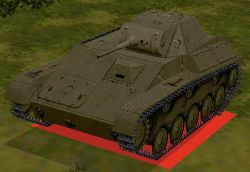
to be conducted on the 11th and during the night of the 12th. This was the second counteroffensive of our forces in the July 1943. But all the miscalculations and mistakes, and in the end, its result were almost identical to the first one. Some scholars see the source of these mistakes, and not without evidence, first of all in the commander of the Front N.F. Vatutin himself. Both the 8th and 12th of July operations were conducted by the Front's headquarters under his personal leadership. He visited the forces personally on numerous occasions. The mission of the 2nd TC as of 8th of July was personally described by the commander to the headquarters near Prokhorovka, who very well knew that most of the brigades were still on the march and so a properly coordinated attack was not possible. The actual orders were delivered to P.A. Rotmistrov on July 12th personally by N.F. Vatutin in the presence of the member of the Military Council (Soviet) N.S. Khrushchev. According to Rotmistrov's memoirs, the Front's commander knew well that one third of the 5th GTA was made up of light T-70 tanks, which could not effectively fight against most German tanks in an open battle. This means that heavy losses were expected from the very beginning.
 By the way, just a few days before, N.S. Khrushchev convinced I.V. Stalin, for
the sakes of saving armor at the early stages of the defensive operation, to
dig the tanks of the 1st TA into the ground, like was also suggested by N.F.
Vatutin himself, and not to deliver counterattacks against the advancing enemy,
as was suggested by G.K. Zhukov. This tactic was successful, the Germans were
stopped. Such a mistake - to counterattack with the operational reserves of
tanks, which did not have a qualitative advantage over the advancing enemy's
vehicles, was now made by the commander of the Front at Prokhorovka himself.
By the way, just a few days before, N.S. Khrushchev convinced I.V. Stalin, for
the sakes of saving armor at the early stages of the defensive operation, to
dig the tanks of the 1st TA into the ground, like was also suggested by N.F.
Vatutin himself, and not to deliver counterattacks against the advancing enemy,
as was suggested by G.K. Zhukov. This tactic was successful, the Germans were
stopped. Such a mistake - to counterattack with the operational reserves of
tanks, which did not have a qualitative advantage over the advancing enemy's
vehicles, was now made by the commander of the Front at Prokhorovka himself.