Expert System Software

| ENERGY PRODUCTS | ENERGY SOLUTIONS | ENERGY SERVICES | ENERGY & ENVIRONMENT |

HEAT BALANCE AND SYSTEM DESIGN
The
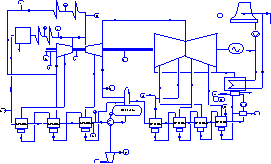
term “heat balance” is generally applied to a schematic flow diagram for a
thermal power cycle, on which thermodynamic properties and mass flow are
indicated, for all major flow streams in the power cycle. This diagram is the
result of a detailed calculation, which applies the laws of conservation of mass
and conservation of energy, along with manufacturers’ expected performance, to
each component in the power cycle. In addition to determining flow and state
properties (pressure, temperature, enthalpy, and entropy) for all flows in the
cycle, the calculation also presents the overall performance (efficiency and
output) of the generating unit is predicted.
However,
the term “heat balance” also refers to that specialized area of mechanical
engineering, which deals with thermodynamic performance of power cycles. It
involves efforts in which such diagrams are prepared, along with studies for
sizing, selecting and optimizing the equipment in the cycle.
Heat
balance studies do not end with the construction of a plant. Heat balance and
system design software is often used upon to perform analysis of test data where
there is a suspected loss of efficiency in the cycle. It can also simulate a
variety of alternatives operating modes for a plant so that the plant operators
can select the most economic alternative for a given situation. It also has the
capability to predict how a proposed modification will affect plant performance,
so that equipment purchases can be justified to management.
Early
in the development of the heat balance, it will also be necessary to begin
preparing purchase specifications for major pieces of mechanical equipment, and
for major motors. Process data from the preliminary heat balances will be
provided to vendors for preparation of bids. For example, condenser duty, site
ambient conditions (or water temperature, it is a once through design), and
desired operating parameters such as back pressure and load will be provided to
the condenser and/or cooling tower manufacturers for their information in
preparing proposals; feed water and condensate flows and head requirements will
go out to pump vendors; and so on. The heat balance is the reference document
for the sizing of all the equipment in the power generating cycle.
Since
most projects are developed and bid on a lump-sum turn-key basis today, it is up
to the heat balance and system design software to select a cycle design which
will allow for a winning design. This will typically be the cycle, which
minimizes the total life-cycle cost for the station to be built.
It
is often up to the heat balance and system design software to determine how
overall unit performance (efficiency, capacity, part load operating flexibility
and at times availability) will be affected by changes to the fundamental cycle
configuration. Then, capital cost and operating costs for each alternative can
be determined by contacting vendors, and by experience with previous projects.
Although
simplified heat balance calculations can be performed by hand, they are
typically performed on a computer. This is because of the numerous references to
steam property tables and manufacturers’ tabulated performance data. Also, the
complex nature of the calculation precludes a closed form solution, so that it
is necessary to iterate in order to achieve a “balance”. (The term heat
“balance” implies just that. Conservation of mass and energy around each
component, as well as for the cycle as a whole must be achieved for a valid
result).
Several
computer programs are commercially available for calculating heat balance for
electric generating units. In addition, equipment manufacturers and large
engineering corporations will maintain proprietary heat balance software,
although these are typically not available for commercial distribution.
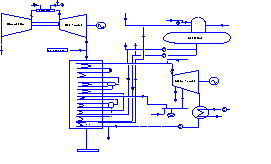
Heat
balance diagrams are generally prepared in several stages, which reflect various
levels of refinement in developing the cycle design. A steam turbine
manufacturer will provide a heat balance for the turbine and feed water system,
in which the performance for balance of plant components not in his scope of
supply are estimated using nominal values. This is usually referred to as a
“turbine vendor balance.”
While
these estimates (for such items as feed water heater performance, pump
performance, condenser back pressure, auxiliary steam and water flows and
variations in controllable parameters at off-design loads) are reasonable when
considering the turbine portion of the conceptual project, they must be prepared
in greater detail later in the project.
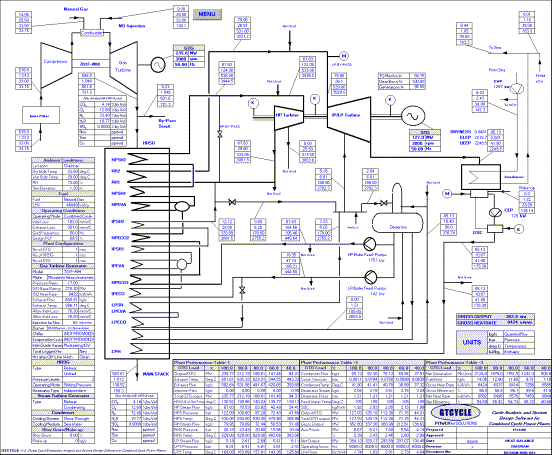
The ESS products will refine the heat balance by integrating the actual performance for such components as pumps, condenser, cooling tower, boiler and feed water heaters and also more realistic values for steam line pressure drops, auxiliary steam and water flows, and auxiliary power consumption. If several modes of operation are being analyzed, it is not uncommon to present a series of diagrams to demonstrate the effect being studied.
ESS -The Heat balance and system design software
ESS
can play an integral role in the development of a project from conceptualization
of the fundamental cycle configuration, through to the final testing and
commissioning of the unit. In addition, ESS can be used upon during the
operating life of a unit to analyze potential impacts in performance for
equipment retrofits and changes to operating procedures, as well as for periodic
performance testing to determine if there is a need for corrective action in
order to improve efficiency or output.
The
ESS has thorough understanding of the physical equipment in the plant, its
design and operation. It is also proficient in thermodynamics, heat transfer and
fluid dynamics. In addition to these fundamental engineering disciplines, it
also has firm knowledge of engineering economics, since nearly all equipment
selection studies will involve optimizing the total analyzed cost of various
alternatives.
The
ESS products are based on the working knowledge in operating plants and are
familiar with the general practices and procedures of a generating station.
The
role of ESS
does not end with the design of a unit. The ESS
can
also be a valuable asset to an operating plant. Prior to commissioning, a new
unit must go through a rigorous performance acceptance test, in order to
demonstrate the contractually agreed upon levels of a capacity and efficiency.
Since these targets will be defined with respect to certain nominal set of
conditions (such as ambient temperature, relative humidity, an assumed fuel
composition, a nominal process steam flow, power factor, river water temperature
etc.) a set of correction parameters must be prepared to adjust the performance
during the day of test, so that, it can be compared to the contract conditions.
It
is likely that during the life of the plant, equipment will degrade and cause a
loss in efficiency and/or plant. ESS
would
be able to collect a set of readings from then plant process data computer, and
compare these to the expected process data for the same operating point. The
component(s) causing the problem can be identified, and the expected potential
for improvement calculated.
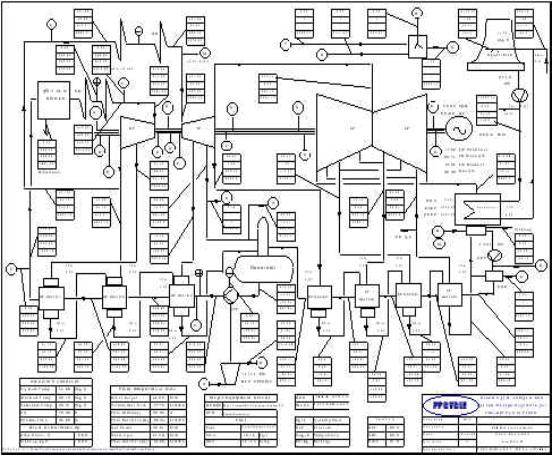
ESS
could
also be used to determine the effect of changes in steam turbine efficiency,
which could provide the justification for performing a major overhaul. The value
of added generation (or reduced fuel expenditure) would be compared to the cost
of labor, materials and lost revenue during the extended outage.


Mail your enquires to -
Copyright © 2001 aessoft. All rights reserved.