Establishing a data capture facility involves:
The Ascension Flock of Birds and the Polhemus FastTrack motion-sensing systems have the benefit of providing real-time feedback at 15 to 100 samples per second with six degrees of freedom, they also have limitations because they use low power, magnetic fields.
| The magnetic field generated by both systems is not dangerous. |
The talent's movements are computed by sensing the strength of the magnetic field. The magnetic field is measured by sensors placed on the talent's body. Each sensor contains several sensing points so that both the position and the orientation of the sensor versus the magnetic field can be computed and captured many times each second. The sensors send the information about their position and orientation through cables to the central control computer.
The range of the magnetic field is approximately 2.5 to 3 meters if no conductive metal is within 5 to 6 meters of the magnet. In other words, the accuracy is either 1/2 the distance to the nearest conductive obstruction or 2.5 to 3 meters, whichever is shorter.
Objects that alter the magnetic field can severely affect the accuracy of the sensor measurements. Small conductive objects such as doorknobs and nails do not have a significant effect on the accuracy of the motion captured. However, larger metal objects, such as steel pipes, can significantly bend the magnetic field. Therefore, magnetic motion capture systems do not operate to their peak effectiveness in buildings with metal construction or containing significant amounts of metal.
Since commercial office buildings are typically constructed with steel rebars in the floor that can significantly affect the accuracy of the data captured, building data capture stages in new office buildings is not recommended.
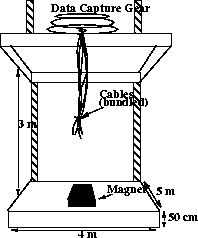
The following diagram represents a data capture stage in an old building with very little metal in the building's structure.
Polhemus and Ascension motion-sensing systems give the best results when the distance from the magnet to the sensors is roughly equal. This means that a magnet on a platform at waist height will provide better results than one suspended from the ceiling or installed in the floor.
Ideally, motion capture studios should provide several alternatives for the magnet's position and at each session you should reposition the magnet to find the best location to obtain the best data.
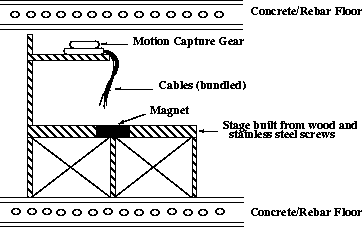
In cases where the system must be located in a modern steel office building, choose a room with the highest ceilings possible and construct a stage several feet above the concrete floor. Remember that the best results are obtained when the distance from the magnet to any sensor is less than half the distance to any large metal object.
The following diagram represents a typical data capture stage constructed in a modern steel office building:
| Acceptable results can sometimes be obtained with a very simple setup. For example, at Siggraph'93 in Anaheim, the magnet was simply placed on the concrete floor in the midst of all of the steel structure of the Alias booth and still captured fairly accurate data. If motion is captured in a situation such as this, calibration can compensate for some error. |
Magnetic systems attach 15-25 foot cables to the person or animal whose motion is being sampled. Therefore, the system is not appropriate for sampling data if the talent is moving in space larger than the length of the cables.