This is the List of scientific works of MININ & MININ.


Prof. O.V.Minin Prof. I.V.Minin

onographys


  • Baibulatov F.H., Kayukov A.P., Minin I.V., Minin O.V. et al. Quasioptical radiovisional methods in mm-waves//Ed. by Prof. V.F.Minin and Baibulatov F.H. - Moskow: "Tsniinti", - 1982, 175 p.

  • Minin I.V., Minin O.V. Fresnel Zone Plate - Moskow: "Tsniinti", - 1988, 150 p.

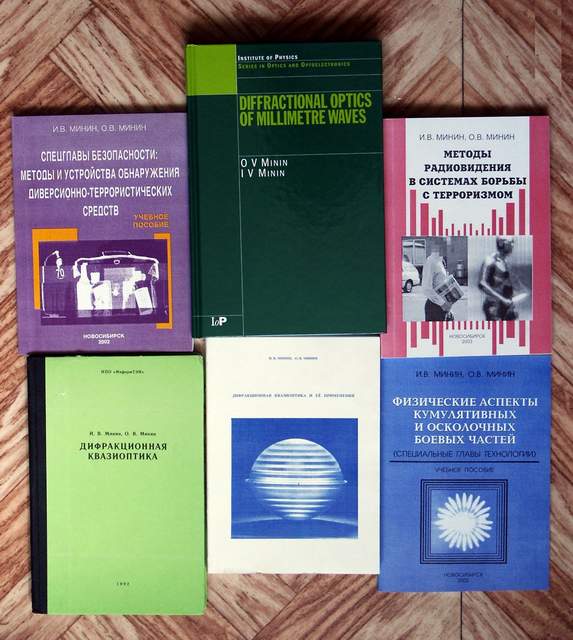
  • Minin I.V., Minin O.V. DIFFRACTIONAL QUASIOPTICS - Moskow: NPO "Inform TEI", - 1992, 180 p. Content in Russian

  • Minin I.V., Minin O.V. DIFFRACTIONAL QUASIOPTICS AND THEIR APPLICATIONS - Novosibirsk: "SibAGS", - 1999, 308 p. ISSBN 5-8036-0026-1 Content in Russian         Award

  • Minin I.V., Minin O.V. Physical aspects of cumulative and fragmentation warheads. - Novosibirsk, NSTU, - 2002, 80p.

  • Minin I.V., Minin O.V., Legkii V.N. Physical methods both searchers and detection of explosives and explosive devices. //Ed. by Prof. V.F.Minin - Novosibirsk, NSTU, - 2002, 153p. Content in Russian

  • Minin I.V., Minin O.V. Radiovisional methods in the systems of terrorism struggle devices. - Novosibirsk, NSTU, - 2003, 198p. Content in Russian

    P.S. The books are in Russian.

    Minin I.V., Minin O.V. Diffractional Optics of Millimetre Waves. - IOP Publisher, Sept. 2004. 394p.

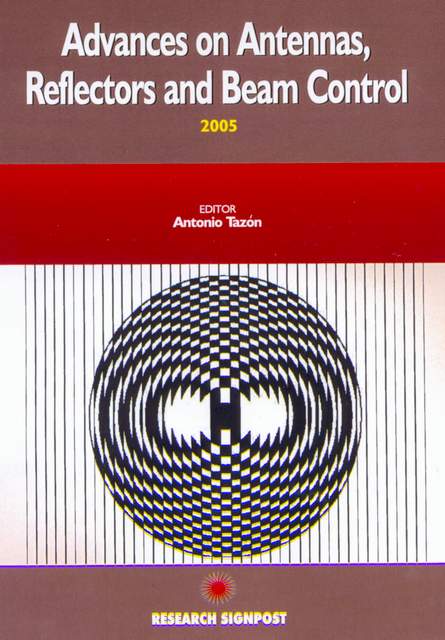
    Advances on Antennas, Reflectors and Beam Control. - Research Signpost, Kerala, INDIA, 2005
Minin I.V., Minin O.V. Diffractional Optics of Millimetre Waves. - IOP Publisher, Sept. 2004. 394p.

ISBN: 0750309075

Synopsis
This book combines those elements of diffraction theory normally associated with optics (Gaussian beams, lenses, mirrors, etc.) and extends them into the micro and millimetre wavelength range. In this regime there are a number of applications in devices such as automobile proximity sensors, satellite-TV receiving antennae and non-destructive testing systems and researchers working in these areas would benefit from greater understanding of the diffraction phenomena involved.

Series in Optics and Optoelectronics

This international series includes books on all aspects of theorectical and applied optics and optoelectronics. Titles in this series range in level from advanced textbooks for graduate students to research monographs on specialized subjects including: Nonlinear Optics and Laser Radiation, Interferometry, Waves, Crystals and Optical Materials. These titles will also meet the requirements of scientists and engineers working in optics, optoelectronics and related fields in the industry.

Series Editors: E R Pike, King's College, London, UK; R G W Brown, University of Nottingham, UK

Millimetre waves exhibit many of the properties usually associated with waves in the optical regime. They can provide excellent image identification and resolution, and their low attenuation in atmospheric conditions that would significantly affect optical transmission means that they can provide remote measurements while operating through smoke, dust, fog or rain. This versatility has resulted in millimetre wave devices finding increasing application throughout the industrial, commercial and military sectors, including terrorism struggle device.

Diffractional Optics of Millimetre Waves combines those elements of diffraction theory normally associated with optics and extends them into the micro and millimetre wavelength range. The first two chapters of the book offer a review of the theory of diffraction followed by a complete and in-depth treatment of zone plate lenses. Chapters 3 and 4 consider conventional and alternative methods of construction of elements of diffractive optics on arbitrary curvilinear surface, and chapter 5 describes diffractive antennas in the microwave range. Chapter 6 briefly discusses the main fields of application of elements of diffractive optics from optical and THz waveband up to microwave, and chapter 7 considers the use of man-made dielectrics in the fabrication of diffractive elements.

A translated and essentially updated version of the authors� 1992 book �Diffraction Quasioptics�, this book presents results formerly unavailable in the general literature, which will be of great value to researchers working with devices in the millimetre wavelength regime.

FOREWORD

This book is an important contribution to the field of diffraction optics, including zoned lenses and reflector antennas. Drs. Igor and Oleg Minin have brought together much information, both analytical and experimental, that has largely been unavailable to the non-Russian speaking portion of the world. Their two earlier books and numerous journal publications (in Russian) have not been readily available to researchers in the Western world, although the authors have personally made significant contributions in this area. In addition, they have included the results of many other Russian investigators. The Drs. Minin have probably made more millimeter-wave measurements on Fresnel zone plate antennas than anyone else, and made rigorous comparisons with the theory. They treat the curved versions of the zoned lens as well as the more frequently used flat zone plate, and include such cases as multifocal and multifrequency zoned lenses. The book is an excellent summary of the state of the art and contains much valuable information. The text is very comprehensive and thorough, and undoubtedly contains more information than any other current source.

Most of their work is broadly applicable to the large angle zone plate, with focal lengths comparable to the plate diameter, as well as the small-angle examples developed m the past for optical use. It is interesting to note that although the Fresnel zone plate concept has been used at optical wavelengths for over one hundred years, only the small-angle configuration (that is, with large focal length compared to diameter) has been employed, and the analytical expressions that have been derived previously are often not accurate for millimeter wavelengths.

The technology of millimeter-wave diffractive optics has seen great activity in recent years. The first millimeter-wave phase-correcting Fresnel zone plate lens antennas were developed in 1960, but there was little activity until about 1985. Since then nearly 100 publications about the subject have appeared in the literature. The field of millimeter-wave optics has been used in many system applications, including radar, radiometry, point-to-point telecommunications, missile terminal guidance seekers, and field instrumentation tests of atmospheric effects, generally where ease of manufacturing, low attenuation, low weight, low volume, and low cost are considerations.

The first chapter gives an introduction to the theory of diffraction, starting from the Huygens-Fresnel principle of radiation of electromagnetic waves, with an application to zone plates. Appendix I includes some of the complicated equations that support Chapter 1. Chapter 2 deals with the properties of high-aperture zone plate lenses, including numerous results measured at millimeter wavelengths. Although millimeter waves are emphasized in this volume, the methods and analysis and even some measurements are valid at normal microwave frequencies. Chapter 3 deals with the principles of construction of diffractive optics for either planar or curved or conical surfaces, and the advantages of each are discussed. As before, the material includes general analysis, detailed calculations, and supporting measured results. Chapter 4 includes alternative methods of synthesizing diffractive elements for specialized focusing applications, such as a line focus instead of a point focus. Chapter 5 extends the options to scanning antennas or multiple-beam antennas, and considers applications such as the use in automobile anti-collision radars or or omnidirectional telecommunication systems, including cases for microwave frequency ranges. Chapter 6 deals with unusual applications of diffractional elements and Chapter 7 covers the use of synthetic dielectrics.

The book is unusually good and should see wide application.

James C. Wiltse

Georgia tech Research Institute

Georgia Institute of Technology

Atlanta, Georgia, USA


Advances on Antennas,

Reflectors and Beam Control


http://www.ressign.com/UserBookDetail.aspx?bkid=69&catid=37


Invited authors:


Reflector Antenna Crosspolarisation and polarisation and arrays

by Peter Balling (Denmark)

Self-Oscillating Microstrip Antennas and Arrays

by Juraj Bartolic (Hungaru)

Printed Reflectarray Antennas

by John Huang (USA)

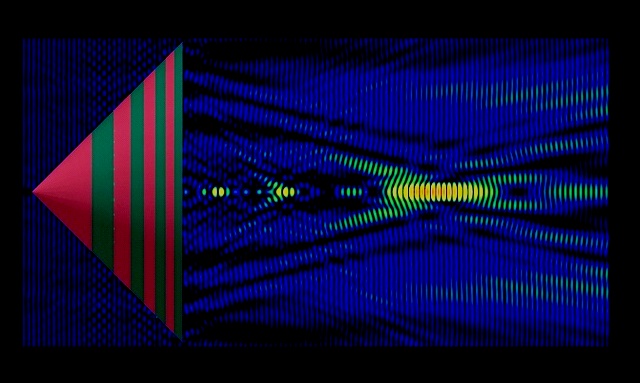
Three Dimensional Fresnel Antennas

by Igor Minin and Oleg Minin (RUSSIA)

(Abstract)

Printed Array Antennas for Base Stations

by Mariano Barba, Juan E. Page

Analysis, design and applications of multi-layer printed reflectarrays

by Eduardo Carrasco-Yepez, Manuel Arrebola, José Antonio Encinar (SPAIN)

Technological Aspects of Fresnel Zone Reflectors

by Juan Vassal�lo (SPAIN)

Active radiating structures based on FET devices

by Lorena Cabria, José Ángel García, Antonio Tazón, Ángel Mediavilla (SPAIN)


Managing Editor

Dr. S. G. Pandalai


Publisher:

Research Signpost

Kerala, INDIA

http://www.researchsignpost.com


2005

Novel publication!

Basic Principles of Fresnel Antenna Arrays

Series: Lecture Notes Electrical Engineering , Vol. 19

Minin, Igor V., Minin, Oleg V.

2008, Approx. 310 p., Hardcover

ISBN: 978-3-540-79558-2

About this book

Antennas represent a critical technology in any of these wireless systems. Not only do they directly affect the received power of the system, they are also typically the largest and most visible part. Recently, the need for low-cost, low-profile, and lightweight antenna in the frequency range of the microwave/millimeter wave/THz band has regained momentum.

"Basic Principles of Fresnel Antenna Arrays" provides us a with the basics of the various Fresnel Antenna approaches, in order to achieve low-cost, low-profile, and lightweight antenna in the microwave/millimeter wave band. A potential solution of the antenna problem lies in using lens technology in an array. The Fresnel zone plate lens (FZPL) antenna is in particular an interesting candidate for the array element. The limiting focusing properties of FZPL including subwave length focus are described in detail. The book further presents a novel hexagonal FZPL antenna which can be more effectively packed in an array due to its shape.

Before considering the hexagonal FZPL antenna in an array, the authors investigate two ideas, described as methods to potentially improve the radiation characteristics. The first idea is to change the reference phase of the Fresnel zone radii - a novel free parameter in the usual design of zone plate�s lenses and antennas. To further improve the radiation characteristics of the hexagonal FZPL antenna, a technique involving Fresnel zone rotation is investigated.

The book is of interest for designers of optical systems because taking scaling effects into account, the characteristics of diffractive quasioptical elements are valid for diffractive focusing elements of integrated optics.

Written for:

Scientists, Postgraduate and Graduate Students

http://www.springer.com/engineering/electronics/book/978-3-540-79558-2

Hosted by www.Geocities.ws

1