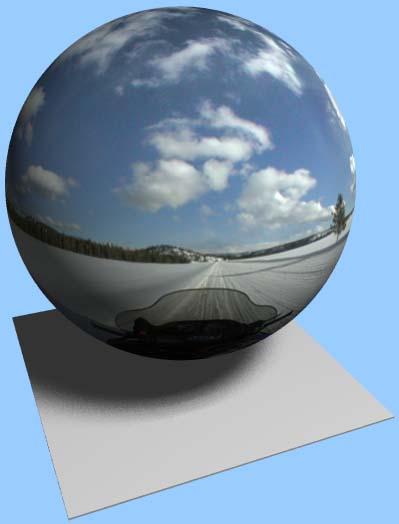
The observer is in the center of a virtual sphere onto which the image is projected. Interactive viewing software displays only the part of the image in front of the observer since the entire image can not be displayed without distortions. The viewer can pan, tilt, and zoom into the panorama. Example panoramas are in the gallery. The viewing software on this site is the java-based PTViewer from Helmut Dersch. It is downloaded automatically for each panorama.
The drawback of spherical panoramas is that they provide limited resolution. High resolution panoramas soon require large storage space. Also, in many cases, only a small part of the sphere is of interest. In outdoor scenes, for instance, the ground below the observer and the sky above him is often not important for the picture. The part of the panorama towards the sun is back-lighted, so objects are cloaked in shadows. In these situations, a cylindrical panorama might be a better choice.
Since no lens can cover the entire sphere, spherical panoramas have to be stitched together from several images. Although any kind of input image can be used, wide-angle images are preferred because fewer of them are needed to cover the sphere. The panoramas on this site have been made from three fish-eye pictures. Helpful equipment and shooting technique is described in the equipment page. The images also have to be re-mapped (warped) into the coordinate system of the panorama and oriented relative to each other. The software page describes the details of this process.
 |
Panorama home | Travel Gallery
| Beach Gallery
|
Panorama home | Travel Gallery
| Beach Gallery