| 931 Equasonne RF Amplifier | |||||||||||||||
| The RF amplifier of the Sparton Equasonne is contained in a black metal box located in front of the power converter and beside the selector unit. It houses six 484 or 485 tubes. Five of the six tubes serve as low gain amplifiers for the radio signal, while the final tube serves as the detector. The Equasonne differs from more 'conventional' TRF radios, in that the 5 stages of amplification used are 'un-tuned'. All tuning is performed beforehand by 4 ganged tuned circuits inside the selector unit. Of the 3 modules of which this radio is comprised, the RF Amplifier will most likely require the most effort to restore. The RF Amplifier of most Sparton Equasonne models appear to be very similar. Models 103, 111A, 235, 301, 301A, 564, 570, 578, 589, 600, 610, 620, 737, 740, 750, 870 and 931 have identical amplifiers. Models 930 and 89A have a slightly different RF Amp. circuit, but is interchangable/compatible with other Models. |
|||||||||||||||
![]() |
|||||||||||||||
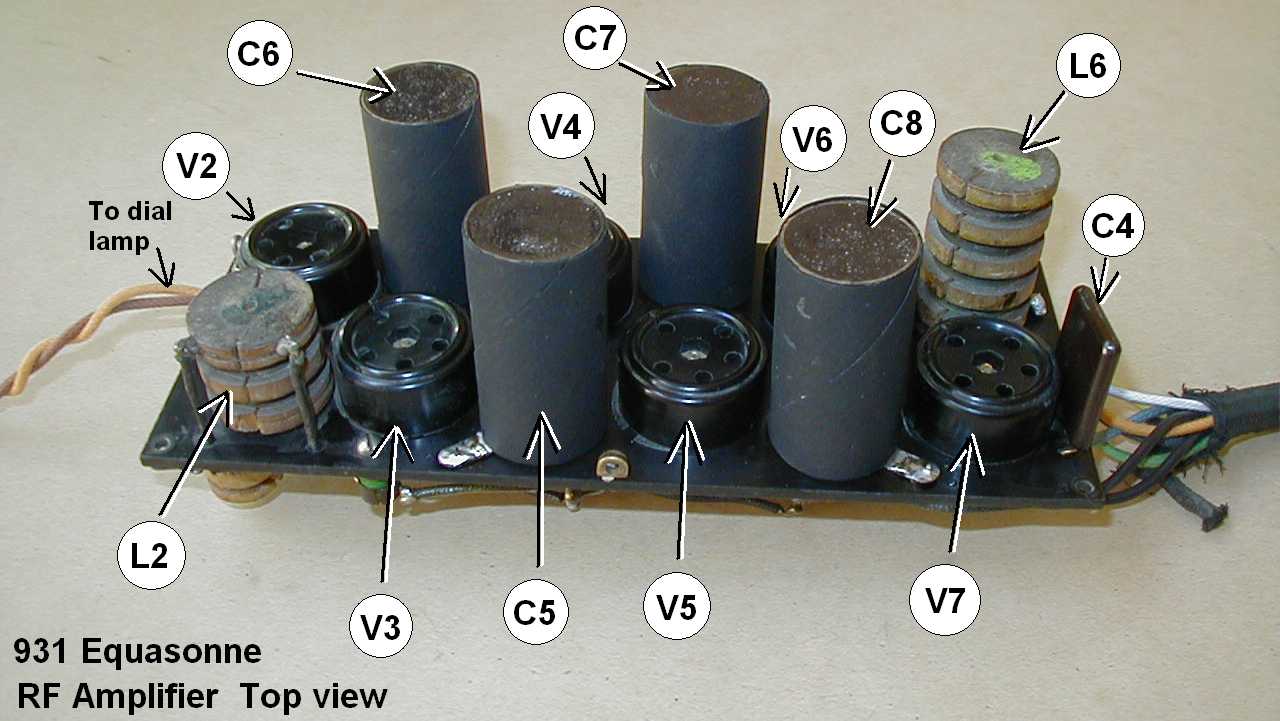
| RF amplifier circuit board removed from its shield can. The tubes have been removed from sockets for clarity. The connector cable to the terminal strip of the power supply extends off to the right. See schematics for values of labeled components. The four black paper capacitors (C5-C8) have been emptied out and rebuilt using | |||||||||||||||
|
|||||||||||||||
![]() |
|||||||||||||||
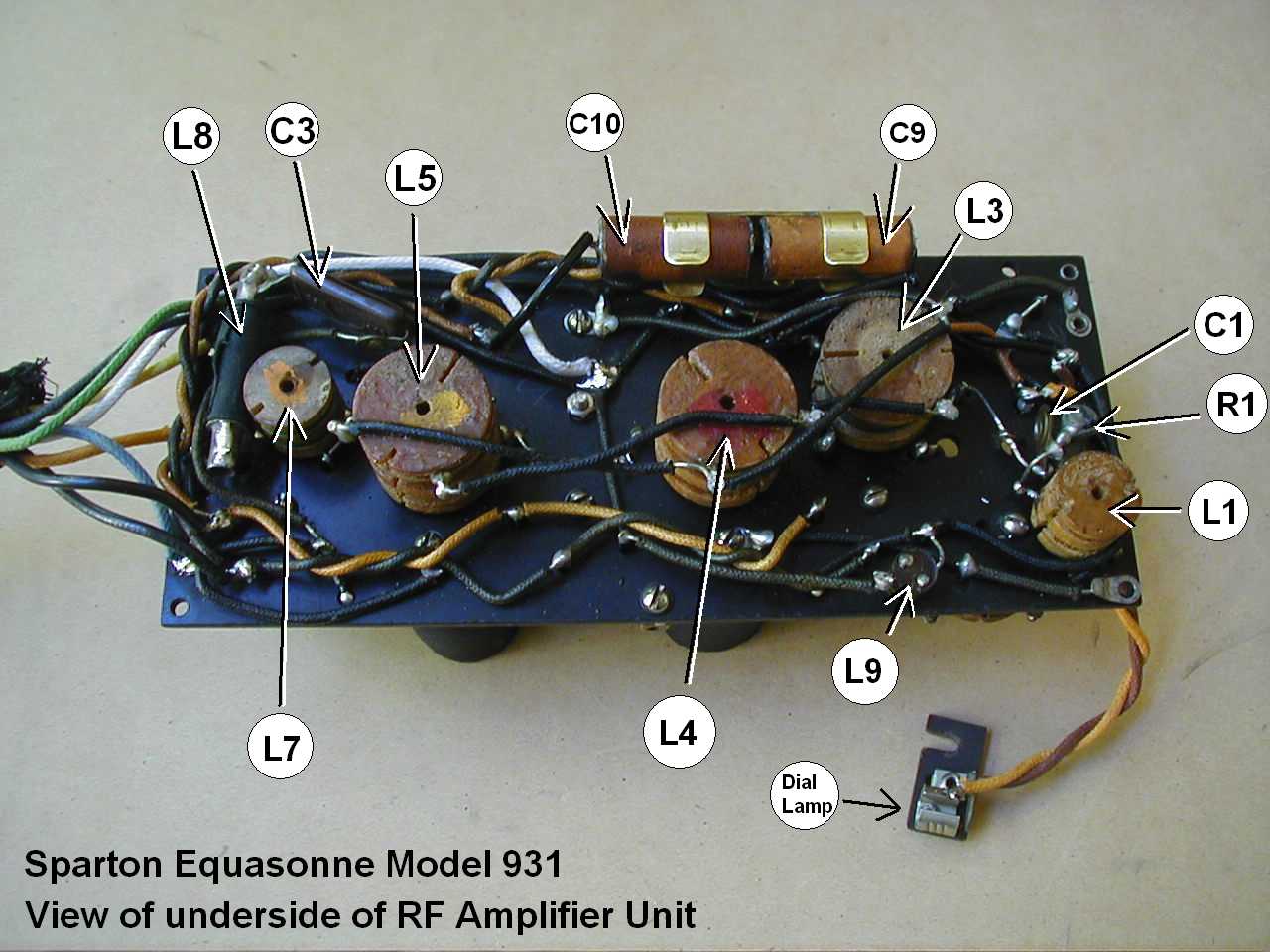
| The underside of the RF Amplifier circuit board. The main features are numerous coils on bakelite or wood spools and 4 capacitors and a resistor. The paper capacitors (C9 and C10) have been hollowed out with a drill, and modern metalized polypropylene replacements have been inserted inside them. This repair is virtually invisible. The two picofarad value capacitors (C1, C3) are more durable than their paper companions, and are original. The resistance of the single resistor (R1) should be checked with an ohmmeter, this can be done without removing it from the circuit board. Its value should be 2800 ohms. The value of this resistor seems particularly prone to drift with age. Coil L8 is also prone to failure. Measure the resistance between its two ends to ensure continuity. | |||||||||||||||