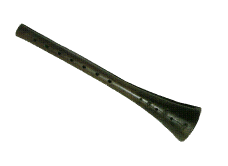
ZURNA
Although similar to the music of the other Bulgarian regions, the
folk sound of Macedonia has its specificity. To a great extent, this
is a result from the different cultural influences and the
heterogenous ethnography of the area,especially before the wars of
1912-1918. There is the discernable influence of the Middle Eastern
music which is demonstrated through the characteristic
instrumentarium employed by the Macedonian folk musicians.Good
example is the wide usage of the zurna, an instrument borrowed from
the Turks and not played on by the performers from other Bulgarian
folk regions.
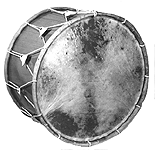
TAPAN
The classic combination of tapan and zurnas constitutes the very
core of the Macedonian sound. Traditionally, the zurnadjii perform
dance music on different social occasions, such as weddings. The
most interesting dances are performed exclusively by men. They are
usually very slow and imbued with a sense of masculitnity and
dignity.The authentic folk group formed by members of IMRO-YO has a
number of such dances in its repertoire, some of which are Ginka,
Boinoto, Gaida Avasi,Ispaiche etc.
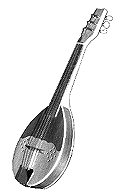
TAMBURA
The so called chalgiiiski songs represent one of the most
interesting genre in the rich musical tradition of Macedonia. Their
most characteristic feature is the complete unison between the vocal
and the instrumental parts.The voice and the instruments follow an
identical melodic line that each one reproduces in the octave best
suited for its range.The chalgijski ensemble includes instruments
taken from the West (violin, clarinet), typically Middle Eastern
ones (tarambuka, known also as dumbek, out), and the ubiquitous
tambura, which is probably one of the most common instruments in the
Macedonian folk music. Tamburas have a rhythmic, as well as leading
melodic function in the mixed folk ensemble which may include other
instruments, such as kaval (a kind of flute), gaida (Bulgarian
bagpipe which has a bit different tuning in Macedonia, as compared
to the gaidas coming from the other folk provinces, chiefly the
Rhodope mountains). Just like in Dalmatia, the tambura ensembles are
quite typical. Usually, they comprise various kinds of string
instruments, such as brach, bisernica etc. The Sofia based folk
ensemble Goce Delchev has one of the largest collections of unique
string instruments brought to Bulgaria by the refugees who came from
Aegean Macedonia in the 1920s.
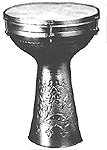
TARAMBUKA
The folk music of
Macedonia is very diverse in terms of melodic forms, but also it
boasts a considerable variety of keys (one can encounter even
pentatonic scales),and it is especially rich rhythmically. The most
interesting feature, in that respect, are certainly the so called
uneven rhyhtms. They are measured in 7/8, 9/8,7/8+5/8, 12/8 etc. The
complex rhythm of a song or an instrumental piece is framed usually
by a tapan or tarambuka.
By: http://imro.hit.bg/
|