|
Domain |
Remarks |
|
Geomancy
風水學 |
- Geomancy or Feng Shui is the Chinese art and science of environmental observation, relational analysis and harmonious enhancement
|
|
The origins
起源 |
- The roots of geomancy lie within the Chinese philosophy, beliefs, way of living and customary traditions
- It has been observed that the Chinese are the typical bulk of humanity, being neither too pro-actively nor too passive
- The Chinese are the everyday commoners, preoccupied with daily routines
- As such, the Chinese are well-suited to observe their surroundings, experiment with themselves and form deep bonds with the environment
- There's a Chinese saying, "Current affairs make heros" and in Geomancy, "The environment make us"
- We are born into the environment, live in the environment, continually being shaped by the environment and pass on
- We are the environment, the environment is us
|
|
Niche
定位 |
- By observing the environment, we further understand ourselves
- By looking into ourselves, we further realize the environment
- Through continuous observation and experimentation, Geomancy as a technique of understanding the environment and ourselves evolves
- With regards to all things Chinese, Geomancy is strongly influenced by other Chinese thoughts and practices as its influence
- All understanding has roots in observation and all understanding is fueled by needs and motivation
- Understanding can help
- The Chinese way towards Geomancy is focused on the technique and less on the critical questioning of the roots and hidden events - what matters are the processes and the outcomes
- Giving Geomancy its critical scientific basis is secondary to its environmental observation, reasoning and outcomes
- In line with the Chinese way of indirect expression and humour, Geomancy makes thorough use of symbols as embodiment of ideas and principles - animals, deities, plants, shapes and colours are some examples
|
|
Symbolism
代表性 |
- Geomancy is heavy in symbolism, but we should not be misled
- It is not the symbols that underlie the environmental influence, but the relations and representations that the environment has with these symbols
- With these fundamentals thoughts in mind, we proceed into the basics of Geomancy
|
|
The five elements
五行 |
- In Geomancy, as a faculty of studies, to adequately observe and analyze the environment, there must be sufficient differentiation to separate its components
- Yet in differentiation, the whole must still be retained
- As such, Geomancy evolves into the studying the environment as an interaction of five distinct elements, each with its own unique characteristics, nature and properties
- These five elements are both beneficial yet simultaneously detrimental to one another
- The motivation is not difficult to comprehend - the world is full of ironies, sometimes favourable, sometimes not, events are both within and out of our expectations
- Number: five elements describe all components of the environment and they provide enough differentiation yet not too difficult to remember and bond with
- Properties: the five elements have to be distinctive and unique, each with its own niche and representation, just like successful grouping
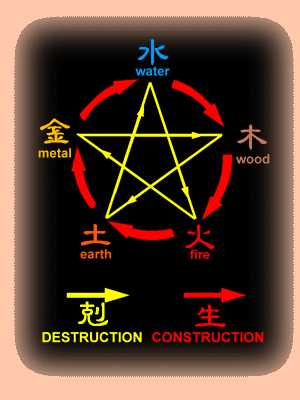
- These five elements 五行 are (in no prescribed order as the head would end its tail):
- Metal 金
- Water 水
- Wood 木
- Fire 火
- Earth 土
|
|
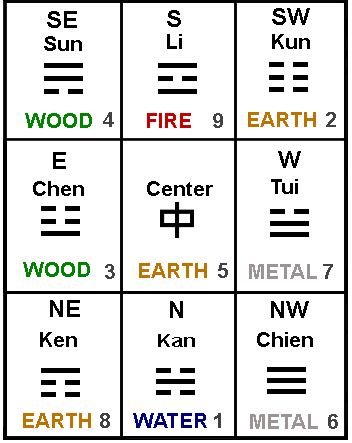
Also related is the Eight Trigrams depicted below:
|
|
Interaction of the elements
五行運行 |
- Any state within the environment can be represented by infinite weighted combinations of the five elements with the combined characteristics
- Since the proportions are weighted, some elements would dominate others
- That is, the environmental state considered is affected more strongly by the dominant element(s)
- In addition, each element is connected to others like a web
- A simple model is as follows:
- [consumes]
 [element] [produces] [element] [produces]
- This element consumes, use up or absorbs from its source
- In turn, it produces, gives rise to or nourishes its sink
- Another model is:
- [enhances] [element] [drains out]
- This element is enhanced in its influences and properties by its source
- In turn, it is drained out of its power and influence by its sink
- Yet another model is:
- [destroys] [element] [lessens attacks]
- This element is destroyed or harmed by its source
- In turn, it is destroys its sink & lessens its attack on the element
- By the these simple models, an interaction network can be set up to approximate any environmental state
|
|
Cyclic nature
循環機智 |
Metal Water Wood Fire Earth Metal
- Reasoning: minerals and materials (metals) are dissolved into water; water gives live to trees (wood); wood is burnt in and gives rise to fire; fire reduces things into earth; earth stores, generates metaphysically minerals and materials (metals)
- The cycle of destruction:
Metal Wood Earth Water Fire Metal
- Reasoning: metals being harder, stronger and can be made sharper, chops down trees (wood); wood use up earth; earth drains off water; water extinguishes fire; fire melts metal
- Notice that the cycles are composed of links between the element before (source), the element considered and the element after (sink) which is our simple model
- Direction of arrows: the arrows indicating the connections between elements are fixed and no jumps can be made - that is, in the cycle of birth, metal influences & gives rise to water only, metal is not related favourably with wood, but in the cycle of destruction, it does destroy wood
- Exercise: draw the two cycles in cyclic forms and within each cycle, draw lines for the other cycle, see what you get and interpret accordingly
|
|
Heavenly and Earthly stems
天干地支 |
- The environment is composed of external influences from the cosmos (Heavens) and internal influences from the interior and the ground (Earth)
- Heavenly and Earthly stems
|
|
Eight characters
身辰八字 |
- With one character from the Heavenly stems and one character from the Earthly stems, a point in time can be represented by the two characters
- The time period considered should be long enough for differentiation, yet mostly achievable by the commoners
- In Geomancy, this fundamental time period is 60 years
- Within this cyclic 60-year period, 4 cyclic time periodic asynchronous time periods are composed
- They are as follows:
- Year: 2 characters
- Month: 2 characters
- Day: 2 characters
- Hour: 2 characters
- Together, 8 characters are derived for an environmental event - whether living or non-living
- As the eight characters are based on the Heavenly and Earthly stems due to the environmental influence from the cosmos and the ground, they can be related and explained by the five elements and the cycles of birth and destruction
|
|
Analysis of environmental influence
運用風水學例子 |
- In the year 2002:
- Heavenly stem: Yang water
- Earthly stem: Yin fire
- Firstly, water destroys fire (not the other way around, as indicated the direction of the arrows), thus this is a year of conflict
- Secondly, by representing any entity of the environment whether in family, work, life, studies etc. by its dominant element, analyze the overall yearly environment as follows:
- Fire: destroyed by water, no earth to produce, attacked both ways, 2002 not favourable
- Metal: destroyed by fire, but able to produce water, thus able to contribute in times of hardship, not too favourable
- Wood: not destroyed by metal and able to produce fire & absorb water, enhancing both ways, 2002 favourable
- Earth: not destroyed by wood and absorbs fire, ride along the wave of the environment, 2002 favourable
- Water: destroy fire (lessen attacks), but adds to itself (more intense competition), slightly favourable
- In the year 2003:
- Heavenly stem: Yin water
- Earthly stem: Yin earth
- Firstly, earth destroys water (not the other way around, as indicated the direction of the arrows), thus this is a year of impending conflict, yet decoupled
- Secondly, by representing any entity of the environment whether in family, work, life, studies etc. by its dominant element, analyze the overall yearly environment as follows:
- Fire: destroyed by water, but able to produce earth, thus able to contribute in times of hardship, 2003 not too favourable
- Metal: not destroyed by fire, able to consume earth & to produce water, thus 2003 highly favourable
- Wood: not destroyed by metal, not able to produce fire, but able to absorb water & able to destroy earth (lessen attacks), nurturing with conflicts, 2003 slightly favourable
- Earth: not destroyed by wood, not able to absorb fire, destroys water (lessen attacks), but adds to itself (more competition), 2003 slightly favourable
- Water: no fire to destroy, no metal to absorb, no wood to produce, but destroyed by earth (attacks), 2003 unfavourable
|
|
Advice |
- In the above example (this is not an oracle), Geomancy is illustrated in its fundamentals using the five-element concept
- There are many other schools of thoughts in Geomancy, which adds variety and confusion (as embodied by the roots of Geomancy)
- It is timely to highlight that Geomancy is starts from, is about and is only about the observation, analysis and interpretation of the environment
- It serves to remind us that we are part of the environment and the environment is us 人人抑是環境, 環境抑是人人
|