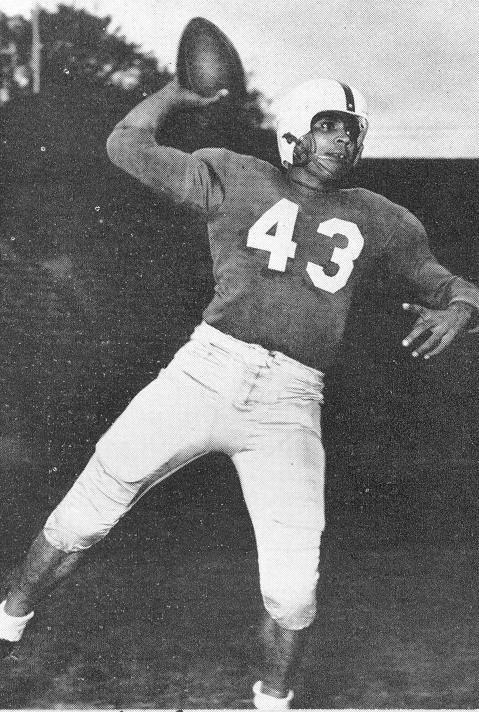
| Remembering Drake's Best [October 20, 2001] Johnny Bright, 190 pound Negro left halfback from Fort Wayne, Ind...Sportswriters already have knocked themselves out punning on Bright's name in heralding his exploits for the Bulldogs. Those puns may be pretty far fetched before long because Bright looms as one of the best all-round performers in Drake history. He polevaults over 12 feet, was the leading scorer for the Drake freshman basketball team and is an excellent softball pitcher. --Drake News Bureau, 1949 From the beginning, everyone knew Johnny Bright was special. The star of Drake's single wing offense, he led the NCAA in total offense in 1949 and 1950. His 2,400 yards in 1950 (1,232 rushing, 1,168 passing) set what was then an NCAA record. He also played in an era when African-Americans weren't always welcome at Southern universities. Because of what happened 50 years ago--October 20, 1951--Bright is remembered more as a martyr than as a football player. As the Bulldogs traveled to Stillwater, Oklahoma for their October 20th game against Oklahoma A & M (now known as Oklahoma State), Bright was again leading college football in total offense and had a chance to become the first black Heisman Trophy winner. The Aggies had a different plan: take Bright out. Early in the game, A & M's Wilbanks Smith slugged Bright in the face. Bright threw a touchdown pass soon afterwards, before another blow from Smith forced him to leave the game with a broken jaw. A series of Pulitzer Prize-winning pictures taken by Don Ultang and John Robinson of the Des Moines Register showed Bright was struck while standing in backfield, away from the play. [Ultang was later a photojournalism instructor at Drake.] When the Missouri Valley Conference failed to take disciplinary action against A&M, Drake withdrew from the conference in protest. Although Drake eventually rejoined, the Bulldogs did not resume a conference football schedule for 20 years, leaving the MVC with as few as four football teams during parts of the 1960s. Bright played sparingly the remainder of the season and finished fifth in the Heisman Trophy voting to Princeton's Dick Kaizmaier. After the incident in Stillwater, the NCAA began requiring players to wear facemasks and passed additional restrictions on the type of contact allowed in blocking and tackling. The NFL's Philadelphia Eagles made Bright their first-round draft pick in 1952. Wary of becoming the Eagles' first black player, Bright instead signed with the Calgary Stampeders of the Canadian Football League. After two seasons, Bright was traded to the Edmonton Eskimos, a team he led to Grey Cup titles in 1954-56. Bright was the CFL's leading rusher three consecutive seasons and was named the league's outstanding player in 1959. During his off seasons in Canada, he started a teaching career. He became the principal of a school in Edmonton following his retirement from football in 1964. Bright remained popular in his adopted hometown. And his connection to Drake helped the Bulldogs recruit players from Edmonton as late as the 1970s. He was inducted into the CFL Hall of Fame in 1970. When Bright died in 1983, his story resurfaced in the national media. Partially as a result of that exposure, he was chosen for the College Football Hall of Fame the following year. BACK |