$250,000 A YEAR ... FOR STARTERS - 24 Jul 1993,
The Sun Herald.
After a week of thinking so hard his head hurts, Paul Harragon is poised
to reap enormous benefits by re-signing for three years with the Newcastle
Knights. It is estimated that by staying in Newcastle, the Test prop will
earn nearly $250,000 a year. But less than half of that figure involves
his basic playing fee. Marketing opportunities from outside the game will
make up the bulk and indications are that the above figure is merely a
starting point. Harragon and his agents, Newcastle journalists and businessmen
Neil Jameson and Phil Neat, will meet Newcastle officials tomorrow. It
is expected the Knights will show they are prepared to honour oral promises
regarding certain aspects of the contract, allowing an agreement to be
reached. Harragon promised Newcastle the first and last shot at him. But
if officials go into the meeting and drop the ball, so to speak, they may
not get another chance to pick it up.
All the "Chief" wants now is confirmation. Newcastle chief executive
Mike Armstrong says he expects the deal to be finalised at the meeting.
Harragon is the most sought-after player in the game this year and could
earn considerably more than the Knights will pay him from 1994 by simply
playing football with another club. But in Newcastle, big business beckons.
Harragon already has several deals virtually sealed to promote the products
of companies either based in the Hunter or with a good market there. More
are being negotiated. Once the representative season had ended and Harragon
signalled the start of negotiations, his agents asked him to list his requirements
in order. He wrote: 1. Winning the premiership. 2. Maintaining rep status.
3. Financial security. 4. Lifestyle. Harragon was happy living in Newcastle.
Would he be as happy living elsewhere?
Negotiations have been solid for three weeks now. The last week has
been particularly nerve-racking. It started with Penrith, Canberra, Illawarra
and Eastern Suburbs all still in the running with Newcastle. Parramatta
was poised to enter the race. As we chronicle the developments, Harragon
gives us an insight into his own fluctuating feelings.
SUNDAY: The phone has been ringing off the hook from the media at home,
but Harragon has escaped it for the weekend. Seeking refuge at his parents'
house, he is joined by his brother, Mark, and they "chew the fat" over
Paul's future. He listens to radio reports of Newcastle's game against
Easts and can't believe the circumstances in which the Knights lost. Leaves
for Melbourne that night to film a Battle of the Codes episode of Sale
of the Century. "I needed that weekend away from everything. I was starting
to get stressed out."
MONDAY: He completes television commitments, returns to Newcastle.
"Sale of the Century was a bit of fun and at least it occupied my mind
for a while, but all the time I knew what I would be coming home to. I
had to make a decision pretty soon." TUESDAY: Canberra drops out of the
race. Harragon meets Newcastle president Mike Hill (chief executive Armstrong
isn't due back from New Zealand until the next day) and coach David Waite
after training. The Knights have firmed in the betting. "We talked about
the contract side of things. I got a few answers." Harragon later speaks
by phone with a representative of one of the other clubs.
WEDNESDAY: Harragon and agents travel south to speak with representatives
of two clubs. Media reports incorrectly suggest one of those is Penrith.
Harragon comes away knowing there certainly are viable alternatives. "It
was worth the trip. The other clubs are very serious about me. Now it's
all laid out in front of me."
THURSDAY: Training in the morning, golf in the afternoon. And second
thoughts. "Two years ago I thought very seriously about accepting an offer
from the Broncos, but I stayed at Newcastle and became the first bloke
to go all the way through the juniors and play for Australia. It was an
incredible feeling. It would be even better to win a premiership with my
hometown club, but am I really convinced we can do it?"
FRIDAY: Training in the afternoon serves as a welcome interruption
to a day in which Harragon does a lot of thinking. "I'm about to enter
the most important years of my football life. I've got to be sure about
things."
SATURDAY: The Knights head to Sydney to prepare for today's game against
Wests. Harragon is much more settled. "I was hoping all this wouldn't affect
me against Wests and I don't think it will. We've had an ordinary season
but we made the five last year and we can do it again next year. The ball's
in Newcastle's court. They know what's necessary to keep me".
Harragon explains his first meeting
with Mal Meninga
"I made my comeback against the Raiders in Canberra.
When Macca threw me into the game all I did was tackle. One of those tackles
felt like a collision with a tank because it stopped me in my tracks. Was
he wearing a number on his back or a number plate? Untangling myself from
underneath the wreckage, I looked up and saw two thick, black hairy tree
stumps towering over me. Each one was wrapped in a lime green sock. It
was my first official meeting with Mal Meninga." |
Marty was my Bella of the brawl
IN the final Origin match of 1993 at Lang Park, there had been plenty
of niggling in the scrums, mainly between rival hookers Steve "Boxhead"
Walters and one Benny Elias. One particular scrum started the same way
as all the others, with Boxhead and Benny taunting, sledging and shoving
in the front row. Martin Bella was my opponent at prop and we were jostling
for the position of loose head. It quickly escalated to the next stage
and we were butting heads for that advantage, then a barrage of childish
sledging spouted forth. "It's my loose. Get your f---ing head out of the
road," I said. "You make me," was his response. I said: "Yeah, you want
a go, do you? Keep going and I'll make you all right." "Come on, make me!"
he replied. We could've been mistaken for a couple of five-year-olds. Marty
and I reared up out of the scrum, arms cocked and ready to go, while somewhere
from behind me came the call: "Hit him! Hit him, Chief! Smash him!"
An explosion of punches was traded, a few haymakers were thrown and
there was the odd miss before we really got into it. I unleashed a surging
flurry of combinations. Then followed a few more short, sharp punches.
We argued a bit more, threw a few more straight ones then were finally
pulled apart. It was the catalyst for a famous Origin all-in, which provided
Boxhead and Benny with another opportunity to get their hands on each other.
Order was eventually restored and Boxhead, Benny, Marty and I were all
banished to the sin-bin. As we ran off, we were hardly shaking hands and
making up. There were still some choice words being delivered and there
was plenty of feeling there.
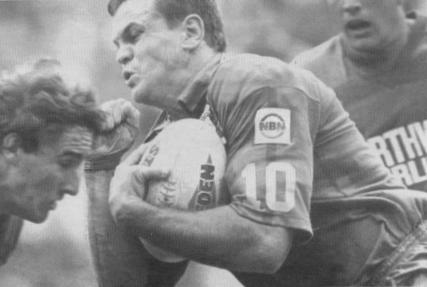 HOW A PATCHY CHIEF BECAME SHINING KNIGHT - 18
Jun 1994, The Sun Herald
HOW A PATCHY CHIEF BECAME SHINING KNIGHT - 18
Jun 1994, The Sun Herald
MAYBE the reason people have stopped remembering how Paul Harragon
got the nickname Chief is that, in this neck of the woods, he's now better
known than the character he was named after. If you've seen the mid-70s
movie One Flew Over the Cuckoo's Nest you'd recall the towering Indian
who barely uttered a word. Well, he was the gargantuan who inspired teammates
to christen Harragon "Chief".
These days Harragon is arguably the chief Chief. More famous even than
the legendary Chief who was Maxwell Smart's boss. In fact, as we head into
the deciding match in this year's Origin series, I reckon Chief is just
about the face of Origin 1994. Head bowed, hands on hips, wearing his crushed
heart on his blue sleeve he became the symbol of NSW's unutterable loss
in Origin I. Then, after 80 minutes of explosive, brain-rattling body contact,
he accepted man-of-the match honours with ridiculous composure and humility
following Origin II. Combining clean-cut pin-up boy glamour with a reputation
as a fearsome enforcer, the Chief is a first for rugby league in the AT
(After Tina) marketing era.
Sure, we've had clean-cut pin-up boys before, some even from the forwards
like Wayne Pearce or Brad Clyde. But, to my way of thinking, no-one has
been able to marry the ferocious side of the game with the glamour like
Harragon. Earnest, honest and emotional, he's able to deliver the big hits
on the field and avoid the big cliches off it. Add GI Joe good looks and
imposingly athletic frame and you have a product so marketable it makes
sliced bread look like yesterday's lunch. It's so easy to forget that just
two years ago it was all heading in the opposite direction totally.
By mid-1992 Paul Harragon had been earmarked as a suspension waiting
to happen. High tackles on Gary Larson in an Origin and Ian Lucas in a
Test against Great Britain had put him in the "bad boy" category. When
he eventually fronted the judiciary for a club game high tackle on David
Fairleigh, he got four matches and huge headlines claiming he had no intention
of changing his tackling style. "He was on the cusp," says Harragon's former
manager Neil Jameson. "If he'd kept going the way he was he would've ended
up with a Mark Geyer or Les Boyd image."
Jameson, who is based in Newcastle but works in Sydney regularly, says
people were always commenting about "that loose cannon you've got on the
deck up in Newcastle". "In the media, Mick O'Connor was lining him up and
wasn't going to leave him alone," he said, referring to the strident complaints
the former Test player was making. "We had a meeting to discuss how we
could turn it around. Paul was hurt deeply. He never meant to sound unrepentant
so we decided on a letter to John Quayle to try to at least clear his name
at the top level." The last three paragraphs of the letter read: "John,
like many people, you may have been concerned that a player was apparently
placing himself above the game. This was never the case. unfortunately,
people may have drawn the wrong impression ... Until this season I have
had an unblemished playing career and I am eager to put these recent events
behind me. As a development officer for the Knights, and a NSW and Australian
representative, I am greatly indebted to rugby league and regard myself
as a guardian of its image. I cannot undo what has happened. But it is
important to me that you, as the game's chief executive, be acquainted
with how these events occurred. John, if you wish to discuss any of the
above please feel free to contact me at home or care of the Knights office.
Sincerely, PAUL HARRAGON"
Of course, Harragon also had to find a way to avoid any more contentious
tackles. He takes up the story himself: "Waitey (David Waite) had a couple
of good yarns with me about it and Allan Bell (Newcastle assistant coach)
got me on the tackling bags and did some work. I found I was trying to
go in too hard and put them on their backs. I was going for tackles, setting
myself early and probably shutting my eyes a foot or so before I connected.
If the player ducked or went the other way I couldn't pull out. I learnt
to take the extra step, go that extra metre before committing to the tackle."
Technique corrected, Chief says his image started looking after itself.
Although he now sounds as if he's been taking speaking lessons, the poised
prop says he earned his media stripes on Newcastle radio. "Jumping on air
with the NEW-FM boys has helped. Two hours each weekend taking calls, interviewing
people and so on and I learnt on the job."
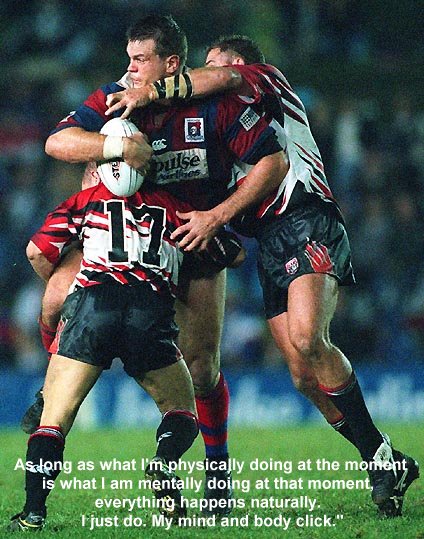 LUNCHING TACKLE, 27 Aug 1994, The
Sun Herald
LUNCHING TACKLE, 27 Aug 1994, The
Sun Herald
When you look at it," said Paul Harragon, "footballers are pretty boring."Asked
what he did for recreation, the Newcastle and Australian rugby league forward
had difficulty answering. The truth is, rugby league players find
little time for recreation, especially when their team's headed for the
semis. So when Harragon's mates are out all night, he has to rest. Instead
of a wild night on the town, he often settles for a night in front of the
TV. Yet, when Harragon and his girlfriend, Pam Visscher, have a home-cooked
meal in front of the tele it's not your normal TV meal but it's not baked
beans on toast either. For instance, the other night they worked their
way through half a kilo of prawns, steak Diane and vegetables. Not bad,
eh? While it wasn't his favourite that's chicken schnitzel with avocado
and crab mornay served at the Cricketer's Arms Hotel in inner Newcastle
they still demolished it. "That's probably how I best spend my time now,"
Harragon said. "Because we don't have a lot of spare time I stay at home
a lot with my girl, we'll have something to eat and watch the tele. I'm
not one of those blokes who rushes home to watch the footy, but if it's
on I'll watch it. Occasionally I'll watch the footy and have a beer with
the boys or Pam will cook something up. We'll eat whatever she feels like
cooking."
As a kid bumming around Belmont, a suburb of Newcastle, Harragon hung
around the local surf club, played bass guitar while his brother Mark played
lead. These days Mark and a friend still do the Newcastle pub circuit.
Until a few years ago Harragon would occasionally follow Mark on stage
and stand up back plucking the chords. But through his football fame he
has lost that anonymity. "I'd just make a fool of myself," he said. After
giving away football at 16 to concentrate on the bass and then returning
a year later, his music is just another sacrifice littering the road to
football stardom. Like a lot of things.
For one or two months a year you can find Harragon at Swansea-Belmont
Surf club, training with the guys. "Whenever I get the chance now I head
straight back to Belmont but, to be honest, during the football season
it's just football, football, football.
Other than the football his favourite shows include The Simpsons and,
when programmers feel like showing repeats, Happy Days. When it's time
for the movies, Big Wednesday, Dead Poets Society and a new movie, the
western Tombstone, also rate highly. And if he ever finds it difficult
spending his recreation time resting, then he can listen to the southern
drawl of Tombstone legend Doc Holliday. "Why my man," Holliday boasted,
"I'm in my prime." Could have been Harragon himself.
FORWARD'S "SCRUM-TIOUS" TV DINNER - HARRAGON
HEAVEN
4 chicken schnitzels - pan- or deep-fried,
Two avocados, halved, Fresh crab meat, 50 gr butter,
50 gr plain flour, 500 mls warm milk, 100 gr parmesan cheese,
salt and pepper
1 cup cream, 1 cup grated cheddar cheese.
1. Cover cooked chicken with avocado slices
2. On low heat, melt butter in a saucepan. Add
flour and mix until sandy in texture.
3. Add warmed milk and parmesan cheese and stir
over low heat for 15 minutes.
4. Add salt and pepper, cream and crab meat.
5. Spoon over avocado and cover with grated cheese.
6. Grill until cheese bubbles.
7. Serve with crisp salad. |
So what does former Chief critic, Michael O'Connor, think
of Harragon '94? "
All credit to him. He's taken the criticism and learnt from it. I know
he was very upset at the time but I had to say something. It (head-high
tackling) was happening every week." O'Connor explained the tension between
him and Harragon was sorted out during last year's Origin series at the
instigation of Laurie Daley. The two of them got together and O'Connor
came away impressed. "He's a nice kid with a clean-cut sort of image. Not
a big drinker, conscientious about his diet, focused. It's the wholesome
image sponsors love to put their name to." O'Connor believes Harragon needs
only a good performance tomorrow night to take the man-of-the-series award.
What's more, he expects a big game from his former whipping boy. "He's
such an intimidating player. Queensland fear him. They know he'll never
take a backward step. And he's definitely a front-rower. He's most dangerous
first off the ruck." So, like the original Chief in the movie, who started
off scary and turned out to be the good guy, Paul Harragon has also turned
out to be the good guy. But don't think for a moment that he's not still
scary.
Mal Reilly - One Perfect Day
When I arrived at Newcastle, Mark Sargent was the Knights captain but
straight away I could sense the natural leadership qualities present in
paul. He was a current prop forward playing international football for
Australia and there was, and is, an aura about him. You could almost see
it in the dressing room before and after games or at training, something
about the way he carried himself and communicated with the other players.
Ascending to the captaincy was an achievement on his behalf as well. In
that first season, my views were that I couldn't have Chief and Sarge on
the field at the same time, Sarge was an excellant impact player when he
came on fresh. Being such a big unit he had a considerable effect on the
team and the game but having them both on the field together exposed weaknesses
around some of the tight spots. Tactically, Chief's not the same as people
like Andrew or Matthew Johns but his leadership qualities were evident
right from the outset. So when it came time to consider that candidates
when Sarge fell by the wayside, to have selected someone as captain ahead
of cheif would have been a terriable injustice to him. Even in 1996 when
we had a bad year and performed below our capabilities to miss out on the
semi finals, we knew there was so much more improvement in us. I remember
Chief would often say, "If we can just get into these plays offs, we can
do it, I know we can do it. " Chief is very clear and precise in what he
expects and what he wants from himself and his teammates. i have an enormous
amount of respect for him as a player and a person.
Chief suspended for four Matches - 23 Aug
1994, Sydney Morning Herald
Newcastle appear unlikely to appeal against the four-match suspension
of Test prop Paul Harragon on a high-tackle charge. The ARL's chief executive,
John Quayle, said last night that while Harragon's selection chances for
the first Ashes Test on October 22 were likely to be jeopardised by the
suspension, his tour chances remained strong.
Chief - First game of 1994 State of Origin
The first game of the 1994 State of origin series, Harragon, "After
putting in eighty minutes of pure effort, getting bashed and smashed in
such a hard game only to lose it in the last thirty seconds, was beyond
comprehension. That sort of finish is what makes rugby league the unpredictably
breathtaking spectacle that it is. The mental replays have never stopped
for me. I have played out those last few seconds in my mind so many times
since then. I learnt later that channel nine boys were on their way to
give me the man of the match away at the end of the game, but after Queensland
scored to win that game they changed their mind and gave it to Willie Carne.
Walking off the SFS that night, I was like a zombie. I couldn't believe
we had lost. But we had a champion team that year and I can still picture
Gus and Laurie Daley addressing us in the dressing room after the game.
That night really hit home to me just how true champions think, guys like
Gus and Lozza and how resilient they are. Their attitude taught me a valuable
lesson. Win or lose it was all the same - it just depended on your attitude.
HARRAGON ENDS TOUR ON TOP WITH TEST CALL-UP - 04
Dec 1994, The Sun Herald
Prop Paul Harragon will end his "pretty ordinary tour" on a high after
last night being called up to the Australian bench for today's Test against
France at Beziers. The world champion Kangaroos' nine-week trek through
England, Wales and France is tipped to come to a free-scoring end in Australia's
46th Test against the struggling Frenchmen. Harragon, injured in the first
Test loss to Britain eight weeks ago, replaces utility Greg Florimo, who
is unavailable with an Achilles tendon injury. Coach Bob Fulton chose Harragon
ahead of second-rower Jason Smith, saying the Newcastle front-rower's form
had made him impossible to leave out. "It's good to be back," said Harragon,
who went on tour as an incumbent Test prop. "It's been a pretty ordinary
tour for me. You're here to play Tests and I've missed two of them. "I
was happy with my performance in the first Test, with 41 tackles and 17
hit-ups, but from then on I was struggling with injury." Fulton named his
side before a light training run just outside Beziers, with winger Andrew
Ettingshausen cleared of an ankle ligament problem and confirmed as a starter
at Stade de la Mediterranee. Prop Glenn Lazarus and reserve forward David
Fairleigh can tie for player of the tour honours with big performances
in the Test. And Brad Fittler, who has admitted he let himself down on
the 1990 tour, cannot be overtaken in the vote for the first players' player
award. Fittler, one of only a few players not to play a Test in 1990, has
12 votes, with Lazarus, Fairleigh and Florimo trailing him with nine each.
Retiring captain Mal Meninga will play his 45th Test and his 24th in charge.
Against Mark Carroll -
A memory no one will
forget happened in 1995 when Newcastle kicked-off to Manly at Marathon
and Mark Carroll was bringing up the ball. Harragon came out of the line
and the two men hit in a collision that reopened cracks from the '89 earthquake.
After a small delay Carroll was up and stood over the unconscious Harragon.
Carroll screamed: "That's the best shot you can give and you're the one
who's lying on the ground." Later Carroll recalled: "I stood over
him as if to say he was my prey. It was a fair hit, it got me airborne,
but the old saying is you have to get up before the other bloke and I did."
Their Carroll and Harragon's rivalry became legend. Two years later the
Knights played Manly in the semis and Harragon went looking for Carroll.
"Oh man," Brett Grogan recalled. "The first thing I thought was: 'Chief
got him back'. As we were running back in line all the boys were going:
'Have a go at Carroll, have a go at Carroll'." Carroll got up and
staggered forward. After each step his head dropped closer to the ground.
He finally stumbled and face-planted in the turf.
Paul Harragon 1994 Series
"Chiefs done it all, played State of Origin, played and captained his
country, but its in the week to week stuff that I have respected him most.
Here's a bloke playing in the toughest game going around, in the toughest
position, and carrying a reputation that had young bucks and punch drunk
veterans all trying to be "the male who shot "Liberty Valance" every time
they played him, yet he stayed at the top of 10 years. Throw in all the
injuries he has carried and you get some idea as to what sort of mental
toughness he had." Matthew Johns
On the field, Paul Harragon was widely recognised as one of the tough
men of Rugby League - a fearless runner of the ball and capable of annihilating
the opposition with massive hits. Off the field he is one of the games
great statesmen. His charity work, appearances at hospitals and schools,
and involvement in community projects have brought him the Kenn Stephen
Memorial Award for outstanding services to the game in 1997, an OAM in
2000, and admittance to the NSW Hall of Fame in 2002.
Harragon was born in Kurri Kurri on 12 Octorber 1968. When he was one
year old the family moved to Belmont, a Newcastle suburb. The inspiration
for his Rugby League involvement was his brother.
"My brothers eight years older than me so I went and watched him play
and it was just a natural progression. I started at a sub junior club called
Valentine Eleebana. My whole family enjoyed Rugby League so there was nothing
else I was going to play. That was it. It was the family sport."
Many childhood days were spent playing backyard 'test' matches with
his older brother Mark. He surfed and played bas guitar while Mark played
lead, but Harragon's first love was Rugby League. From his first run on
the paddock for Lakes United he showed the traits that dominated his career,
passion and determination. At age 11 he was selected in a NSW schoolboys
side to tour Queensland. His father's never to be forgotten farewell was
"Remember son, you are playing for the Harragons.
By 1987, still rangy winger, Harragon had played in the U/19 state
team and that year in the Seagulls Grand Final winning team. HIs next achievement
was a contract with the Newcastle Knights U/21 side when the club was formed
in 1988. No fortunes were made playing Rugby League at this stage. A battered
yellow Falcon, strung together by pieces of wire, got him to training.
"I earned about $1800 a year from Rugby League. I'd just finished at
BHP as a fitter and turner and I couldn't get a job. At the time things
were pretty tough but money was the last thing on my mind. All I wanted
was a chance to see if I could make it in the game more than anything."
By the end of 1989 he was a regular first grader and with his strength
and size it didn't take him long to move into the forward pack and stamp
his mark on the game. He says, "Im what they call a late maturer, I just
started to fill out. I always wanted to play in the fowards. I didn't enjoy
in out wide, there wasn't that much to do, so I gradually moved into lock,
then second row, and then front row for the Knights."
The foundation member of the Knights, one of the form props of the
competitions, was a natural leader. So when Captain Mark Sargent retired
in 1995, Harragon was coach Malcolm Reillys obvious selection. He called
Harragon one of the most inspirational captains he had experienced in his
30 years in the game because of his contribution on the park, his expectations
of the side and his confidence as a leader. In September 1997, showing
all these qualities, he led the Knights to their first premiership victory
defeating archrivals Manly Warringah. For the people of Newcastle it was
his finest hour.
In the dressing room before the game Harragon emphatically promised
the players he would show them the way to win. The longer the game the
hander his hits would be, and he assured them he was not returning to Newcastle
a loser. As a result of the early punishment Harragon dished out in the
early part of the game, the Sea Eagles forwards were walking wounded.
The try with six seconds left crowned the city of Newcastle with its
first premiership. Harragon says, "There's two types of achievement, personal
and as a team or a town. Personal achievements are what drive you as a
young bloke. You want to play for Australia or you want to play for your
state or in City versus Country. To achieve all those things are wonderful
and they make you a better person. But when you win a grand final everyone
celebrates and its tenfold the feeling of a personal achievement. Its the
best highlight. Its the best celebration and you get to share it with everyone.
We did here in Newcastle anyway."
The evening of 3 June 1992 was also memorable. Harragon gathered with
the other hopefuls at the sydney Cricket Ground Members Bar to hear the
names of the First Test team against the touring Lions. He was elated to
make the 17. it was the ultimate experience. No Australian player sang
the national anthem with more gusto then Harragon before the First Test
and he went on to fine career in the green and gold. Harragon was
a vital cog in the Australian team between 1992 and 1998 and captained
his country against South Africa in 1997. He has many great memories but
his greatest is being selected for the first time. "we'd just finished
our third state of origin and we'd won it for the first time in a long,
long time and I walked over to the grandstand at the SCG and was just sitting
there waiting. It had been a lifetime dream for me. It was an amazing feeling
just sitting there waiting and waiting. Then Ken Arthurson walked in and
stepped up on the stage and called the names. Mine was last. I just turned
and looked at my dad. The end of a dream or the start of one, that was
more of a highlight than any game."
It was Harrgon's performance in the 1992 State of Origin series that
won him his first Australian jersey. In his debut he was named player of
the series by coach Phil Gould. Before he retired he was NSW's most capped
Origin forward, playing in 20 consecutive games. He vivdly recalls what
it meant to wear the jersey for the first time. "For me to make the Country
team was wonderful. We won that one. It was the stepping stone to play
State of Origin, and that is the stepping stone for playing for Australia.
But whether you like it or not, Origin is the ultimate in pace, speed and
toughness. Even before you get a jumper, everyone knows they only select
a certain type who can play that game. To get a jumper you know someone
thinks you've got that ability. Then you get thrown out into the toughest
arena and its like a blur, it goes 100 miles an hour. It meant everything
to me to get a Blues jersey on, but it meant more the fact that I could
prove to myself that I was capable of wearing it."
Two years after his first appearance Harragon played a key role in
NSW's hat trick in the 1994 series. The first Origin match played under
the 10 meter rule had one of the most breathtaking finishes in the history
of the series. Mark Coyne went over for what New South Welshmen commonly
refer to as the try from hell and snatched victory 16-12. Harragon said,
"That first game was horrendous. We absolutely busted our gut for 79 minutes
and 5 seconds. We were that honest, we were everywhere and every kick we
chased. It just rips the heart out of you. You think, I don't know if I
can give must more than that."
Harragon says, "You feel the pressure and the expectation is immense.
When you're in that dressing shed, its like you're at the centre of the
universe and nothing else matters. Players know they have to perform and
know at the end of the game they will be absolutely strung out physically.
The experience is intense and at the same time exhilarating." |
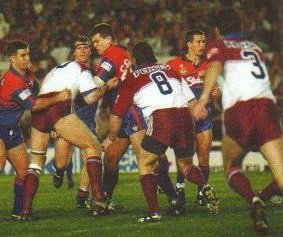
|
Harragon and Caroll go at it again, this time
at Marathon Stadium in July 1995 infront of over 32,000 supporters. |
Marathon mayhem - 22 Jul 1995, Sun Herald
THE chandeliers hadn't shaken since the earthquake of 1989. Yet they
crashed on Friday night. Mark Carroll and Paul Harragon came together.
Again and again. "Don't run at anyone else, just run at me," they taunted
each other. The two traded blows just seconds into the match. They squared
up and unloaded ferocious rights that had the 32,000 Newcastle fans biting
their lips to get the taste of blood. Referee David Manson sin-binned Harragon.
By then the blue had ended but the verbal battle continued. Manson believed
Harragon was trying to reinstigate the incident and gave him 10 minutes
to cool his heels. But instead of cooling, he stewed, and when he made
it back it was to resume. It was bound to.
Earlier this year Harragon turned out for Country and Carroll saw himself
as the enforcer for City. Carroll, who had never played for NSW, saw Harragon
as the obstacle between him and the Sky Blue. That time the points were
split, perhaps Harragon coming out slightly ahead. On Friday night Carroll
was again a blood-bin casualty. The mouse around his eye swelled until
it split the skin and pushed through in a crowd-pleasing crimson tide.
After the initial flare-up and sin-bin the two settled down uneasily, continuing
to chatter and target one another. Then came a suicidal second-half hit
by Harragon on Carroll, one that knocked the dust from the grandstand rafters.
Both players crashed onto their backs, Harragon apparently out like a light,
but Carroll soon bouncing to his feet. "That's the best shot you can give
and you're the one who's lying on the ground," the big man screamed over
his opponent. Maybe it was in poor taste, given the sickening sight of
Harragon trying to get to his feet. But Carroll's emotions were out of
control. For a moment the war looked to have been won right there but,
somehow, Harragon made it to his feet. The cobwebs fell away. Carroll said
later: "I stood over him as if to say he was my prey. "It was a fair hit,
it got me airborne, but the old saying is you have to get up before the
other bloke and I did."
Carroll heard that the Knights had been looking forward to this game
for weeks. It began in camp with NSW, when the enthusiasm of Adam Muir
and Andrew and Matthew Johns could not be contained. "Wait until round
17," they sniped. "We'll get you then." Harragon didn't say a word, and
whenever he and Carroll were in each other's company round 17 was never
mentioned. "There was no need to talk about it," Harragon says. "He's a
tough player. We always save our best for each other. We knew it was coming."
And will continue to do so. "That early stuff was probably a bit heavy
handed," Harragon says, "but it's part of the game. "But there's not a
problem between Mark and me. "People like to think we don't like each other,
and I'm sorry to disappoint them, but there's no problem." Carroll says:
"That's only round two as far as I'm concerned. We've still got the semis
to come so I'm looking forward to it. "It was a great game, that's what
it's all about. Me and him sparring, it gets people going. "The word is
passion. We're just passionate about the game. "I love it. I love winning.
And I waited until round 17 and we won."
Why we're still white Knights - Paul Harragon -
8 Apr 1995, Sun Herald
I guess you could say it started on Sunday. Since then I've had hardly
any sleep. I've been on the phone so much I've nearly got a cauliflower
ear and figures and contracts and deals and counter-deals have been buzzing
around in my head. Not only have I gone through my own negotiations with
the ARL and News Ltd, I've spent a lot of hours helping out other players
as well.
After last Sunday's game I went back to our club before returning home.
Super League talk had erupted in the papers so as a team the Knights got
together and decided that no matter which way we go we'd stay together.
No sooner had I got home than I got a call from the ARL. They were keen
to talk to me about securing my future with them so over the next few hours
we talked figures and terms. About midnight I hung up, only to get a call
from News Ltd. They must have been trying for a while because I'd been
on the phone for ages and the call came almost straight away. Again I listened
to what they had to offer and how arrangements would work. When I finally
hung up there I got another call from the ARL who went over a few more
things. It was 3am before I got to bed.
By 8 o'clock Tuesday morning I was at a meeting in Sydney with News
Ltd's Ken Cowley, David Smith and Lachlan Murdoch. My brother Mark, who
manages me, was also there. While we were throwing up figures I also got
to learn a lot about where they believed Super League was heading, what
their plans were, the whole box and dice. I left that meeting and was in
League headquarters by 10am, meeting with Phil Gould, Bob Fulton, Ken Arthurson,
John Quayle, David Leckie from Channel 9 and Jamie Packer. Mostly it was
discussing certain directions and options, going back over things and talking
to my brother about which way I'd go. About 4.30 I made up my mind that
I was going to stay with the ARL. I agreed and left about 6.30 when the
contract had been drawn up and signed.
The Chief cut in Test upheaval - 18 Jun 1995,
Sydney Morning Herald
Newcastle prop Paul Harragon was "stunned" last night after being dumped
from the Australian side for Friday night's first Test against New Zealand
at Suncorp Stadium. The Super League split forced selectors into orchestrating
the biggest influx of new players to an Australian side since World War
II, with no fewer than 10 debut caps. Queensland's 3-0 Origin victory won
the Maroons eight places in the 17-man squad, although lock Billy Moore
was a surprising omission. But without a doubt the biggest shock came when
veteran Manly forward David Gillespie was recalled after having played
no part in the Origin series - at the expense of Harragon. "I'm not going
to say anything because it hasn't sunk in yet," Harragon said. "I'm stunned
but I've really got nothing else to say."
" 'Chief' (Harragon) came very close to selection and I think we'll
see him at some stage of the series." With players at Canberra and Brisbane
unavailable, Manly dominated the first Test team. The 1995 Australian squad
has a record number of Manly players - six compared with their previous
best of five in 1983. State of Origin coach Paul Vautin is satisfied his
Queensland players have been rewarded for their series win against NSW.
"That's a great effort," Vautin said.
13 Aug 1996, Sydney Morning Herald
Knights captain Paul Harragon yesterday re-signed for three years .
In announcing his decision to stay with the Knights for the rest of his
career, 27-year-old Harragon said yesterday: "At this stage of my career
if I can't win a premiership in Newcastle, I don't want to win one."
Next page
|
