Head fears sideline Harragon - 12 Mar 1997
Sydney Morning Herald
Paul Harragon is out of rugby league indefinitely because of migraine
headaches which have plagued him for more than two weeks. The Test prop
was missing from the Knights side named last night for Sunday's North Sydney
Oval match against the Bears, with officials admitting they were unsure
when he would return. Harragon complained of numbness and pins and needles
after he was concussed during last Sunday's win over St George, leaving
the Knights worried enough to sideline him. "It's a concern to us and a
concern to the whole community up here," club chief executive Ian Bonnette
said. "He had a CAT-scan last week and it came up clear, but I understand
the doctors are now planning to conduct more tests. Knights coach Mal Reilly
said: "We don't know what's stimulating or inducing the migraines."
During the first game of the season, 1997. The Chief was hit heavily
again which brought on seizures and head aches, and was prescribed a long
rest from football. in 1997, Having recovered from the serious illness,
Harragon played City - Country, three state of origins and his fitness
shot back up to full strenght. Harragon lead Newcastle to their first premiership
that year.
16 March 1997 - The immediate playing career of inspirational
knights captain Paul harragon hung in the balance when he was ruled out
of football indefinately because of a series of debilitating migraine headaches.
Harragon suffered a heavy knock during the knights opening round 11 - 6
win over st george which caused numbness, spasms and vomiting. The
NSW and australian front rowers had been suffering the migraines for three
weeks and consulted a neurosurgeon for specialist treatment. "Right
now I am out of football for three, four or maybe five weeks." Harragon
said. "Really, I wont be able to come back until I get
this problem sorted out."
20 April 1997 - Paul harragon was finally cleared to make his
comeback against manly. There was even speculation the chief was
considering quitting the game for good because of concerns from his family
about his health. Harragon was used off the bench while he worked
his way steadily back into match fitness but was still named to captain
country origin in the annual representative season opener against city.
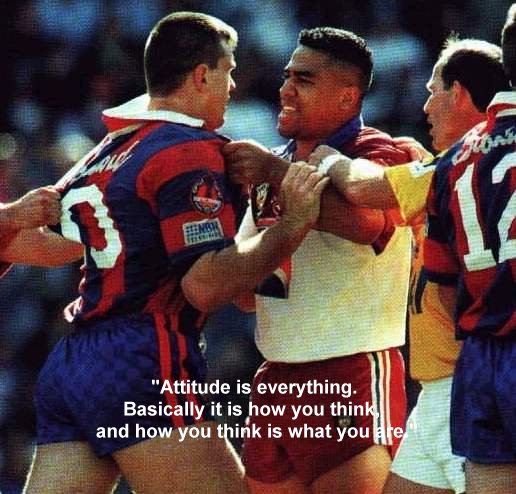
Matthew Johns - "There's nothing wrong with primitive stuff."
When the moment came for the Knights to put it on the line, the man
who does it better than anybody stepped up again. The score was 12-all
and Paul Harragon had just come back from the interchange. The Broncos
had just kicked a drop-out and Harragon had the ball in his hands, charging
at the line. Brisbane prop Shane Webcke ran forward in the defensive
line and Harragon picked him out.
The two came together in such a collision even their mothers would
have felt ill. The Knights then attacked for six tackles and, after the
turnover, Webcke came charging into the line and Harragon measured him
up. Like, say, an undertaker might. The collision was such that the
bolts in the grandstand rattled and Webcke lost the ball. Luckily for the
Broncos - but not for Webcke - Brisbane kept control of the ball and played
on. That's because after Andrew Johns came in heavily on second-rower
Gorden Tallis next tackle, stirring another rumble in the crowd, the ball
found Webcke again and so did the Chief. Crash time again.
This time the Knights picked up the ball and, before the six tackles
were up, fullback Mark Hughes flirted with the Brisbane defensive line
before finding winger Darren Albert. Albert wrong-footed opposite Michael
Hancock and scored in the corner. "It was just the trick we needed,"
lock Billy Peden said, speaking on behalf of all his forwards. "Chief
went mad and made a few hits. It was an integral part of us winning the
game." When the Knights were looking for something extra, because
Brisbane were threatening to unload their weapons, Harragon's search and
destroy mind-set was perfect.
Matthew Johns was glowing in his praise for the Chief. `When people
think about the Newcastle Knights they immediately think of the Chief.
Even though he has retired he still has a great presence about the club.'
During his career with the Knights he has unintentionally injured many
team mates during enthusiastic gang tackles; Andrew Johns - broken cheekbone,
Mark Sergeant - bruised kidneys, Adam Muir - exploded ear, Tony Butterfield
- concussion and broken wrist, Robbie McCorrmack - lacerations, Daren Treacey
- back and neck problems, Paul Marqueets - eye.
Chief at Coogee Bay Hotel, Coogee. The night before
the 1997 Grand Final against Manly.
"On the way down today, I'm sure we all felt that energy there - just
seeing all those faces and knowing how much it means to all those people
and how much happiness we can bring them. The bottom line to everything
we do in life is to try and achieve happiness and this is not just for
us. We can do that for hundreds of thousands of people, maybe more, so
don't underestimate what this is all about. There's something very noble
about what we're doing. this is our chance at a noble pursuit on a grand
scale. this is our chance to make thousands of our own people feel proud
and pleased with themselves. In fifty years time, wherever we may be, if
we bump into each other we'll be able to look into each others eyes and
see a little sparkle or a wink and know that this occasion is tucked away
in the black box of our minds. "As your captain, i guarantee you that come
what may I refuse to be overrawed tomorrow. I refuse to have any excuses,
Whatever it takes, I promise you I won't give up. I'll be there for you.
With all that in mind, I'm not walking off the field until the jobs done.
I'm just not leaving and nothing can change my mind. I refuse to lose."
1997 Optus Cup
For ferocity, especially in the opening exchanges, the game could hardly
be parallelled. This was war. Both teams had big artillery to fire. But
it was opposing props Mark Carroll (Manly) and Paul Harragon (Newcastle)
who chose this moment to continue a personal conflict which has blazed
for several seasons. Harragon was the main aggressor. He was cautioned
twice in the opening five minutes for suspect tackles. One was on
Carroll while the other was on rival captain Geoff Toovey. The Toovey tackle
provoked Carroll to start throwing punches at Harragon, but Manly got the
penalty. This was joined by several other sensational incidents as the
two sides staged one of the most bloody deciders in memory.
Harragon one hit away from quitting - 17 May 1997,
Sun Herald
Paul Harragon - an automatic selection for State of Origin - is just
one terrifying step away from retirement. Three months after suffering
his first agonising migraine attack, Harragon says he is unsure just how
much time he has left in the game. Even today, experts who helped him through
the traumatic period are mystified about the cause of his attacks. Harragon
says the recent sickness of Parramatta's star young forward Adam Ritson
only added to the worry for his family. "I knew it was nothing like that
but my family was concerned," the 28-year-old front-rower said from his
Newcastle home during the week.
"I really had to look at my future. I'm still only taking it one game
at a time. "My wife Pam gave birth to our second baby three weeks ago.
It was just added pressure on the both of us. I must admit I was really
concerned things would never be the same again." Harragon is expected to
cap off a remarkable comeback tomorrow when he is named as NSW skipper
in the absence of Brad Fittler who has been ruled out of the first Origin
match with a broken thumb. He returned to the Newcastle starting line-up
against Balmain yesterday and resumed his responsibilities as captain after
playing his past two games off the bench. It was his first starting game
since round one against St George after he had to seek the help of a neurologist
to help him overcome the migraine attacks.
"I had seven headaches in three weeks. They were really intense," Harragon
said. "They first started when we were away at was playing golf. Later
that night I just buckled over in pain. I went numb, I couldn't talk and
I couldn't see properly. It was a worry. I ended up playing the next day
but the pain from the headaches was enormous. "I kept playing for three
weeks, just taking aspirin and hoping for the best, but it was in the game
against St George that I really knew I had a problem. "I copped a knock
off Barto (Wayne Bartrim) and my legs just went on me and my arms started
twitching and turning up at the elbows. I couldn't talk. I was as crook
as a dog. "It's made me look forward to the Origin series. "I'm not counting
on being named captain. I've been disappointed before so I'm not going
to get my hopes up. It would be an honour and I know I could do the job.
"Things like this you just can't ignore - you have to think about your
family and you have to think about your own health. If the headaches do
come back...I don't know, I think the decision would make itself. "If it
came to my melon I would definitely give football away."
Harragon gets past his pain to realise a grand final dream
- 25 Sep 1997, Newcastlee Herald
The big man, tough as they come, was suffering pain that even for him
was unbearable. Flat out on his back, floored by the meanest opponent he
had ever faced. For Paul Harragon, the pain was even worse because he did
not know why he was suffering so badly. The migraine headaches that put
his career on hold earlier this year are now just a memory . . . thankfully
for the Chief. But they are still a painful reminder of just how fickle
life can be.
Here was a man in peak physical condition, a player who would dish
and cop as much legal punishment as any in rugby league. This is no sob
story about the pain he endured and the frustration of not being able to
play rugby league, or of the worry about not knowing why the migraines
would hit him so powerfully out of the blue. Rather, as Harragon says with
a shrug of the shoulders: `It just goes to show you how things work out'.
Harragon will not only lead Newcastle into battle in Sunday's grand
final, he will do so with an enthusiasm and zest that he has trouble explaining.
That awful bout of headaches did produce some good. It is like the old
story about the bloke bashing his head against a wall. Why? Simple, he
explains, because it feels so good when you stop. For Harragon, the pain
was immense but when it did stop, for whatever reason, it gave him even
more desire to want to play rugby league. `I admit that I am really enjoying
my game more now, simply because it is so good to be able to play it hard
and tough like I love and to do without the threat of these rotten headaches
hitting me,' Harragon said this week. `They were very bad and it was frustrating
but once I had a bit of a rest from the game it seemed everything worked
out.' `It is very satisfying the way things have gone since the headaches
stopped,' he said. `I am not trying to be boastful in saying that I am
very happy with my own form. `I do think I have played my part in getting
us this far, and that has to make you feel good.' That is a point that
many fans seem to agree with.
Nobody could ever doubt Harragon's courage or commitment, but if fans
have criticised him it was because they believed that at times his club
form was not up to the level of his representative football. `I would not
agree with that,' Harragon said. `I have always tried to give my absolute
best to every side I have played in.'
For Harragon, a player who scaled the highest of high mountains in
rugby league, this grand final is just another challenge. `This (playing
in the grand final) is something very special,' Harragon said. `Everyone
says it, you know, about playing in a grand final as being the thing they
have always dreamed about doing in rugby league. `Well, it is. There is
not one of these players here at Newcastle who haven't. It is a great week
and it will be even greater when we win on Sunday.'
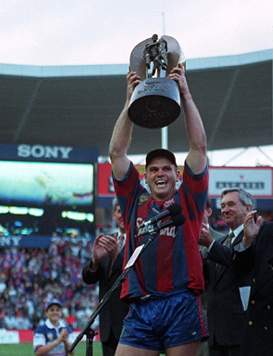
NEWCASTLE KNIGHTS CAPTAIN - 25 Sep 1997,
Newcastle Herald
Knights captain Paul Harragon was stuck for words at yesterday's Australian
Rugby League (ARL) grand final breakfast when he was presented with the
Ken Stephen Memorial Award for sportsmanship and citizenship. Harragon
had just finished an on-stage interview with Sydney radio personality and
former Balmain and Souths coach Alan Jones and returned to his seat at
the Knights' table to finish a feed of bacon and eggs. The 28-year-old
NSW and Australian veteran, who will lead the Knights into battle against
Manly in Sunday's Optus Cup decider at Sydney Football Stadium, had no
clue that he was to win the award despite the presence of camera crews
and photographers hovering around his table at Sydney's Regent Hotel. When
ARL chairman John McDonald announced Harragon as the winner, he had to
hurriedly swallow a mouthful of food as he made his way to the microphone.
ARL media officer John Brady said Ken Stephen was the NSW Rugby League's
longest-serving secretary, was `a thoroughly decent bloke' and the award
named in his honour recognised the recipient's status as a role model in
the community as well as their on-field achievements. `Too often people
forget there is so much more to rugby league than just sport,' he said.
Carrol, Harragon fired up for battle; Sydney
Morning Herald. Sep 25, 1997.
IT WAS meant to be a harmless throwaway line; a spot of post-match
banter between player and reporter in the after-glow of victory. "So what
time's the `concussion tackle' next week, Spud?" asked the jovial journo.
The fact that Mark Carroll loves a laugh and a good time as much as anyone
simply reinforced the steely significance in his grim reply of "no comment"
as he departed the Manly-Warringah dressing room after last weekend's enthralling
17-16 eclipse of Sydney City. It's just that the so-called "concussion
tackle" has become a dark ritual of Manly's meetings with Newcastle ever
since Carroll first clashed with his Novocastrian counterpart, Paul Harragon,
just over two years ago. As much as both these pumped up prop-forwards
prefer to play down the hype of their rivalry, there's little doubt that
they're in the midst of an ongoing personal war, which invariably sees
one of them dazed at some stage of battle, courtesy of the other putting
on a legal "hit". Given that a season of hard work is at stake in
Sunday's grand final at the Sydney Football Stadium, why should it be any
different this time around, even more so now that Carroll will be seeing
red over the one-match suspension of his scrum partner, hooker Jim Serdaris?
The boys are unlikely to go easy on each other now, especially as there's
five months of off-season to spend recovering. The only headache that Carroll
wants to wake up with on Monday morning is one induced by another night
of heady celebration generated by the Sea Eagles' first successful premiership
defence since the double of 1972-73. Besides, like most of his team mates
on the tail of a tough campaign, he already has his share of aches and
pains, particularly after two rigorous semi-finals. "Most players have
some kind of niggling little injury at this time of the year but you're
running on adrenalin so you don't really feel it too much," said Carroll,
dismissing any suggestion that the Sea Eagles might not back up too well
for the last
Sunday in September.
"It's funny how you only wake up sore when you lose."
At least Manly knows that their grand final opponents aren't any better
off physically, having played one match fewer than the Knights in the past
month as their only reward for claiming the minor premiership. The Manly
player who gets the biggest "high" from adrenalin this week will be a contest
between fullback Shannon Nevin and half Craig Field, who booted the maroon
and whites into the Optus Cup decider with a late drop goal against City.
Both young men spoke about their maiden grand-final appearances as the
realisation of "every footballer's dream". "Now I'm just 80 minutes
away from accomplishing one of the main reasons I joined Manly for," ventured
a starryeyed Field, putting the seasons of struggle at South Sydney well
behind him. Nevin has also had to climb some kind of personal mountain
in recent months just to convince Manly folk of his worthiness as a replacement
for Matthew Ridge and then Craig Hancock. Many observers doubted this local
product's mettle, but his goal-kicking and general composure has given
the side stability, if not brilliance, in two vital areas. Overall, the
Sea Eagles are building an impressive fortress to the pressure of finals
football. Bozo's boys have won seven of their past eight assignments in
September after floundering for much of this decade's earlier years when
the finals blowtorch was applied. Instead, it's the credentials of a North
Sydney club that seems to be jinxed that must come under questioning after
falling one game short of the grand final for the fourth time in seven
years. If you had been anywhere near the SFS dressing rooms last weekend,
you could have been forgiven for thinking that time had stood still. The
atmosphere hadn't changed one bit from the equivalent weekend 12 months
ago: Norths solemn on a Saturday, Manly celebrating on a Sunday. Forget
the deserts in Africa or Arctic glaciers, there was no lonelier place in
the world than the Bears' sheds after being edged out by Newcastle in the
dying minutes. Once Peter Louis had gathered his thoughts and emotions,
he hung them out to dry by declaring through gritted teeth: "The players
couldn't have done anymore or tried any harder. I'm very proud of their
effort - I think the Bears just need an ounce of luck along the way. "If
someone says to me that there's always next year, I'll . . ."
He didn't say exactly what he would do but you could only imagine. After
all, he was the spokesman for 75 years of frustration and despair after
another season that had promised so much.
Harragon: leading his men into the frontline of fire -
26
Sep 1997, Sydney Morning Herald
Paul Harragon and Mark Carroll are the men with the might in tomorrow's
grand final. The two men come together when the dressing-room has grown
quiet. Most players have showered by this time, many are gone. Still in
their jumpers, stained with mud and effort, the two men find time to plop
down next to each other on a bench, shake hands and congratulate each other.
Sometimes they share a line or two about the game, mostly they just sit
together and appreciate what the other man has gone through. There is understanding
in the silence. After all, they share a violent world. "The position we
play," Tony Butterfield says, "you need to dominate. We take the team forward,
and we take that very seriously."
In the world of rugby league, there is no more violent role than that
of the front-rower. A game can end, a scoreboard can tell you a score,
but only the man in the front-row can tell you if he is willing to fight
one more round. Or if his opponent is. It is private, ruthless. Recently,
though, the role of the front-rower has grabbed attention. Not exactly
in black headlines, mind you, but the impact of Paul Harragon and Mark
Carroll coming together has awoken many to the violence and heroics of
the front-row. Two weeks ago, when Carroll hit it up for the Sea Eagles,
Harragon moved across in defence and crunched him. Carroll got up with
his brain in a fog, then stumbled face first into the turf. A year before,
almost the opposite had happened, when Harragon finally got up. For reasons
as private as the war themselves, the two men never quite get around to
talking about their battles, or of the pride on the line or of the joy
in it. Perhaps a better way to try to understand is to realise that Harragon
is a leader. Not only in his job on the field but in his position in the
team. And in his own way Carroll is, too. "When I first saw him he was
big, not too smart-looking and young," Butterfield says of his partner.
"But you could tell even then he had leadership."
It is something Harragon never consciously worked on. But it was something
he was aware of, all the same. "Being a leader is not telling anyone how
to do their job, they know how to do their job," he says. "It's standards
that have to be set and kept. Making sure everyone is going to keep to
those standards. "On the field I suppose a leader is if you're going to
go somewhere that isn't good, or do something hard so the blokes behind
you are going to be behind you. "That's probably a bit dramatic, but that's
the game and the role I see I play. The general running of the set of six
you leave to your halves."
Harragon realises he is not blessed with a Johns touch, or a Brad Fittler
step. He'll never play the game like Allan Langer. "For me it's a great
go-forward, a big hit," he says. "It's definitely harder for me to turn
a game. But a game can be swinging on a pendulum and a couple of big hits
can change everything."
It was always assumed, rather than hoped, that Harragon would one day
skipper the Knights. When he leads Newcastle out tomorrow it will be the
fulfilment of one dream, of leading Newcastle into a grand final.
The Knights have a dangerously inexperienced three-quarter line, and
it is there that Manly will most likely try to exploit them. There is not
more than a full year's experience in any of them. But these kids feed
off Harragon. It is something about the big hit. It brings a surge, a lift.
Brett Grogan, who will most likely start from the bench, can feel it
all the way out in the centres. "We thrive on that as a team," Grogan says.
"It's enthusiasm, whether it's Chief or Buttsy. It gets you pumped." Grogan
was in the centres a fortnight ago when Harragon wiped Carroll. "Oh man,"
Grogan says, remembering. He becomes animated as he tells the tale. "The
first thing I thought was Chief got him back. As we were running back in
line all the boys were going `have a go at Carroll . . . have a go at Carroll'.
"Then [Carroll] had a break." Both sides of the ball, it is thankless stuff
sometimes. "We're the ones that have to jam it up off the tap," Butterfield
says. "And to a certain extent it's a nothing play, you're running into
a brick wall."
But the other players see that. And that is why, as a forward, a front-rower,
Harragon gets away with being a leader. "Tactically, and he'd admit this,
he isn't Napoleon," Butterfield says. "But he's smart enough to realise
that. It's his quality as a bloke that makes people respect him. Pressed
to name just one quality that jumps out, Butterfield cannot split two.
"He backs up what he says," Butterfield says, "and I get a laugh out of
him. His humour and his determination."
Standing in the Regent Hotel, after Thursday's grand final breakfast,
Harragon is tapping his hands against his side, clicking his fingers. Too
much is happening for a display of humour, but the passion is fairly close
to the surface. He is asked if there will be anything to be disappointed
about tomorrow. He accepts the question is not as silly as it sounds. "I
hope not," he answers. "To leave it out of your hands you have to make
sure you're at your absolute best mentally and physically. "And if you
don't get the money then, well, then at least you're proud of what you
did."
NEW CASTLE KNIGHTS CAPTAIN - Herald. Newcastle,
N.S.W.: Sep 26, 1997. pg. 1
THIS STORY RAN WITH : HARRAGON GETS PAST HIS PAIN TO REALISE A GRAND
FINAL DREAM:
NEWCASTLE Knights captain Paul Harragon was stuck for words at yesterday's
Australian Rugby League (ARL) grand final breakfast when he was presented
with the Ken Stephen Memorial Award for sportsmanship and citizenship.
Harragon had just finished an on-stage interview with Sydney radio personality
and former Balmain and Souths coach Alan Jones and returned to his seat
at the Knights' table to finish a feed of bacon and eggs. The 28-year-old
NSW and Australian veteran, who will lead the Knights into battle against
Manly in Sunday's Optus Cup decider at Sydney Football Stadium, had no
clue that he was to win the award despite the presence of camera crews
and photographers hovering around his table at Sydney's Regent Hotel. When
ARL chairman John McDonald announced Harragon as the winner, he had to
hurriedly swallow a mouthful of food as he made his way to the microphone.
ARL media officer John Brady said Ken Stephen was the NSW Rugby League's
longest-serving secretary, was `a thoroughly decent bloke' and the award
named in his honour recognised the recipient's status as a role model in
the community as well as their on-field achievements. `Too often people
forget there is so much more to rugby league than just sport,' he said.
Brett Keeble
City's pride lifts players for a grand, final effort;
THE CHIEF. Herald. Sep 27, 1997.
WE'RE finally here. One day to go. As the Newcastle Knights embark
on possibly the biggest game any of us have played in, a once-in-a-lifetime
experience, the script is written for something special. It's our 10-year
anniversary, Newcastle's 200th birthday and critical members of our team
are leaving at the end of the year.
Our eyes are sharp and focused on the goal, to complete the mission
and win the match and bring home the Optus Cup to Newcastle. Nothing else
will be acceptable until the whistle has blown and the battle is over.
In the build-up to tomorrow's grand final against Manly, I've often thought
how funny it is that in all the time I've played rugby league, since I
was a six-year-old running around at Valentine, nothing really changes.
Sure it's a huge occasion. There's been a media frenzy and a lot of hype
and pressure and importance surrounding this game, but in essence it's
the same feeling I've always had. I feel the same now as I did when I was
playing for Hunter versus Metropolitan in schoolboy football, for Newcastle
at State championship or for NSW Schoolboys against Queensland at Lang
Park as a 12-year-old. The Metropolitan team was always much bigger, more
mature and had more kids to choose from, but somehow we still managed to
win.
The comparisons are the same now with the obvious parallels between
Metropolitan and Manly. The Knights face the same sort of hurdles as we
did back then as young blokes, but we've dealt with them before and we
will again. Having been a part of the Knights from the start, playing for
my home town and sleeping in my own bed, I realise it takes more than just
one year to formulate a championship side. This week I have thought about
people such as coaches Allan McMahon, David Waite and Allan Bell, everyone
from chief executives to strappers, who have all left their mark to improve
the place to a point where everything was ready to click this year. I'd
like to thank everyone who's been through the place in the last 10 years,
everything they've done, and all the supporters who've been there and stuck
by us over the years. Every little thing gets added up and considered because
in rugby league, when you play any game, you play for one reason or another.
Whether it's for your mum and dad, brother or sister, just because you
like it, what ever your passion is. As for the game itself, it will come
down to who will be honest under fatigue for 80 minutes. Manly has players
with the same passion and intensity and desire as us, so skill will go
out the window and it will come down to who wants it the most.
I refuse to accept that I'll look back in hindsight and say the hype
or the occasion got to me and that I didn't give my best because of that.
As a team we don't want to be reflecting on those sort of negatives back
at the Newcastle Workers Club tomorrow night. We want to avoid all the
obstacles of the hype and the build-up and concentrate on ourselves, the
game and stopping Manly. We must concentrate on winning. The town's support
and expectations of our fans are sky-high and you can see in the eyes of
everyone you speak to that they're proud of us for being there. The support
is not a burden or a weight to carry, it's uplifting. We feel like we're
being carried so there is no pressure on us. As we make the trip down the
Pacific Highway for the last game of the year, I can assure everyone that
the preparation has been good.
Chief's words captured mood of our town - 30
Sep 1997, Newcastle Herald
As the newly proclaimed King of Newcastle addressed his subjects yesterday,
80,000 Novocastrians cheered the man they call The Chief. Newcastle Knights
captain Paul Harragon was treated like a rock star as he told the adoring
crowd of his `perfect day'. `It is really hard to know what to say on an
occasion like this,' he said. `They say there is no such thing as a perfect
day, but I think Sunday was a perfect day. `Today is also a perfect day
and it really is a once-in-a-lifetime experience.'
Standing on the balcony at Newcastle City Hall which has also hosted
visiting royalty, the big man held the Optus Cup high. The crowd screamed
itself hoarse. The Chief paid tribute to the bicentennial city that had
supported the Knights over the past 10 years. `I am just very happy and
on behalf of the boys that are here I want to say thank you,' he said.
`It is the highlight of my whole life . . .'.
Harragon's words were drowned out as he accepted from the Premier,
Mr Carr, a shield honouring the Knights for their outstanding achievement.
The brass and wood shield was the first of its type to be presented to
a rugby league team. Mr Carr spoke of Newcastle's great spirit and
told how it had assisted the Knights in their grand final victory. `Eighty
minutes on Sunday showed the world what we all know,' he said. `Newcastle
is the best . . . whatever setbacks have befallen this city, we knew all
along that we had a great community. It has a great future, its people
can't be beaten.'
Mr Carr paid tribute to the Knights and said they had earned themselves
a memorable place in the city's history. `Hail to The Chief, we salute
you, we extoll you and on this memorable day in Newcastle's history, we
congratulate and commemorate you,' he said. The Lord Mayor of Newcastle,
Cr Greg Heys, said the city had shown its true character despite the odds
stacked against it. `The bigger the odds, the bigger the effort,' he said.
`And they have shown money can't buy character and money can't buy a premiership.'
He added it was the city that made the Knights champions. `Without you,
the team would be just like any other football team. They do have you and
they are not like any other team.'
No sickie for party Chief; MORNING AFTER; Sydney
Morning Herald. Sydney, Sep 30, 1997.
Paul Harragon, having grabbed "a couple of hours" sleep after all-night
celebrations, had not missed many when he softened up Manly on Sunday.
But when a weeping Sandra Armstrong, a 47-year-oldWangi-bred grandmother,
who had missed only one of the Knights' matches all season, threw her arms
around him, he was as gentle as a kitten. "He is beautiful, isn't he,"
said Ms Armstrong, as the Chief, handling the media outside Marathon Stadium
earlier yesterday morning, said he felt terrific but thought everyone else
in Newcastle was "having a sickie today".
The celebrations at the Newcastle Workers' Club, following the tumultuous
arrival of the team on Sunday night, continued into the early hours. At
about midnight, the doors of the club had to be closed to prevent the premises
bursting at its seams, and the pressure against the glass doors was so
great that just about every pane was smashed. There might have been 5,000
people in the club, said the general manager, Ken Conway. Outside the club,
there might have been 8,000 more. What the crowd left behind outside took
more than eight Newcastle City trucks to remove yesterday. The Knights,
having performed on stage before adoring fans, went into a private function
for families, officials and sponsors and kicked on. A number of players,
such as Tony Butterfield, Robbie O'Davis and Matthew Gidley left just after
8 am "in good condition", according to Conway. There was talk that some
Knights had decided to indulge in a bit of nude touch football to wake
themselves up. Paul Harragon, arriving at Marathon Stadium well after the
reported nudie, nudie touchies, was jaunty about everything, including
his chances at a judicial committee inquiry into that high tackle. "I grabbed
him [the other player] round the collar," he said. "I got sore fingers
from it and that is just about it."
And what would happen for the rest of the day? A sauna perhaps, a barbecue,
a spiritual retreat? "No, drinking," he said.
And, true to his word, at about lunchtime yesterday the team went off
on a pub crawl through suburban Newcastle, first at Jesmond, then Mayfield,
with members of the media trying to track them. Radio talkback was full
of hyperbole in Newcastle yesterday and The Newcastle Herald , having published
6,000 extra copies on Sunday night, was obliged to print another 6,000
yesterday. At Newcastle's Crown and Anchor Hotel, at the end of the Hunter
Street Mall, licensee Pat Woods, having closed two hours early on Sunday
night to let his employees go to the Workers' Club, thought the Newcastle
culture of 30 years ago, with itsFJ Holdens and milkbars was back. Cars
roared up and down Hunter Street all Sunday night as they had in the 1950s
and '60s, "lapping the main" as songwriter Bob Hudson said in his celebrated
1975 hit single The Newcastle Song . The Newcastle Lord Mayor, Councillor
Greg Heys, who has presided over a community flung into despair by BHP's
announcement in May that it would withdraw its steel-making operations,
was quick to grasp the symbolism of the football victory. "Yesterday's
victory gave it a tremendous boost," he said. "It also demonstrates to
the rest of Australia what Newcastle is made of . . . its courage, its
discipline.
"It demonstrates that Newcastle can do it themselves. We can do it
with the local home-grown product. We can do it without a lot of money."
There are many stories doing the rounds yesterday, one that the Johns
brothers had been offered a $600,000 package to move on. "I would hate
to see the Johns boys go," the Lord Mayor said, "but I am confident the
depth is there to replace them."
Chief's words captured mood of our town; 1997 Grand Final
Parade: A Perfect Day; Herald. Oct 1, 1997.
AS the newly proclaimed King of Newcastle addressed his subjects yesterday,
80,000 Novocastrians cheered the man they call The Chief. Newcastle Knights
captain Paul Harragon was treated like a rock star as he told the adoring
crowd of his `perfect day'. `It is really hard to know what to say on an
occasion like this,' he said. `They say there is no such thing as a perfect
day, but I think Sunday was a perfect day. `Today is also a perfect day
and it really is a once-in-a-lifetime experience.' Standing on the
balcony at Newcastle City Hall which has also hosted visiting royalty,
the big man held the Optus Cup high. The crowd screamed itself hoarse.
The Chief paid tribute to the bicentennial city that had supported the
Knights over the past 10 years. `I am just very happy and on behalf of
the boys that are here I want to say thank you,' he said. `It is the highlight
of my whole life . . .'.
Harragon's words were drowned out as he accepted from the Premier,
Mr Carr, a shield honouring the Knights for their outstanding achievement.
The brass and wood shield was the first of its type to be presented to
a rugby league team. Mr Carr spoke of Newcastle's great spirit and told
how it had assisted the Knights in their grand final victory. `Eighty minutes
on Sunday showed the world what we all know,' he said. `Newcastle is the
best . . . whatever setbacks have befallen this city, we knew all along
that we had a great community. It has a great future, its people can't
be beaten.'
Mr Carr paid tribute to the Knights and said they had earned themselves
a memorable place in the city's history. `Hail to The Chief, we salute
you, we extoll you and on this memorable day in Newcastle's history, we
congratulate and commemorate you,' he said. The Lord Mayor of Newcastle,
Cr Greg Heys, said the city had shown its true character despite the odds
stacked against it. `The bigger the odds, the bigger the effort,' he said.
`And they have shown money can't buy character and money can't buy a premiership.'
He added it was the city that made the Knights champions. `Without you,
the team would be just like any other football team. They do have you and
they are not like any other team.'
Bentley's lore; Wal Bentley has devoted much of his life
to developing the region's sporting talent. Paul Harragon.; Nov
1, 1997.
THE tumult and excitement of the Knights grand final victory is slowly
fading, but the significance of the achievement will live on. There are
many factors that contribute to such a success and many of them go unnoticed.
One such factor is the quiet contribution that has been made by Wal Bentley,
and his unique relationship with Knights skipper, Paul `The Chief' Harragon.
Wal Bentley has a small gymnasium at the rear of his Charlestown home.
To be precise, it is a converted double garage complete with punching bags,
weights and a makeshift boxing ring. Few would know that one of the
most frequent visitors to Wal's gym is Paul Harragon. People could
be forgiven for assuming that Paul Harragon works out at only the finest
state-of-the-art gymnasiums with wall to wall equipment. But not so in
this case. Harragon first came to Wal Bentley about 10 years ago in search
of special tutelage, the kind that would give him the edge both physically
and mentally. During those 10 years Bentley has played the role of Harragon's
trainer, mentor, and most importantly, friend. In Wal Bentley's gym there
are no high-tech apparatus, Staminade dispensers, saunas or spas. There
are no echoing sounds of aerobic classes in the distance. But despite it's
meagre presentation, the gym oozes character and atmosphere. Wal Bentley
is a mixture of home spun reality, and single minded dogmatism. It is obvious
that Paul Harragon likes the way Bentley does things. The summer of 1990
was probably the low point in Harragon's career. Recurrent hamstring
and knee injuries put a temporary halt to his playing aspirations. He subsequently
missed the 1990 Kangaroo tour, and to make matters worse, was unemployed.
Thus began the daily visits to Bentley in search of peak fitness. The process
was slow and hard, and by 1992 the Rugby League world began witnessing
a new Paul Harragon. Bently is a modest man and scoffs when anyone suggests
that he is responsible for the Chief's success. `Paul is the one who had
the guts and determination to achieve his goals,' Bentley said.
`I was simply there to guide him in the right direction. Few people
know of the agony he has endured while trying to overcome injury, and the
severe effect those
times have had on his confidence. `When he wants to talk, we talk.
When we work, we work. That's how it is.'
Bently limps around his dusty gym courtesy of a bad hip pointing at
the ghost like pictures of boxers on the wall, passing comment here and
there like, `he was a
lazy bugger', and `he thought he was better than he was', or `he should
have been a champ'. Bentley is much more than a boxing trainer, he
is, as he puts it, a physical educationalist. `They've all come to me at
one time or another,' he says enthusiastically. `The Knights, Wildfires,
and Mariners . . . I tell then what I tell my boxers: Fitness! Fitness!
Fitness! Then we shall deal with the other things.' Harragon has
put in many long and arduous hours at the Bentley gym. `I just love coming
to Wal's,' Harragon said. `I couldn't put a price on the help he has given
me. When times have been tough and I've felt a little down, I just go to
Wal's for a session and it makes me feel great.'
It is the personal bond and respect for each that allow Bentley and
Harragon to work together. `I wouldn't care if the Chief were no more than
a lower grade club footballer, it's our friendship that counts, not the
fame,' Bentley said. It is more than just the regimented routine of training
that Harragon appreciates. It is the dedicated professional approach to
all aspects of his conditioning, both physical and mental that reaps rewards.
The rewards have been plentiful, culminating in the Chief's triumphant
moment of lifting the Optus cup in jubilation. Harragon sees his relationship
with Bentley becoming even more intense in the future. `My knee needs constant
attention, and it is the work in the gym which will be so important in
coming seasons,' he said. `Wal notices if my fitness is a little below
par and when he says I need more work, I don't question his judgment.'
Bentley has built his reputation on a rare ability to judge talent
and commitment in people. `Give me a fighter with 70% character and 30%
ability, and I'll give you a champion. Fighters and footballers are much
the same, some must be bullied and driven whereas others must have their
natural ability harnessed and guided in the right direction,' Bentley said.
`How many times have we seen the Chief pick himself up off the canvas injured
and fatigued and charge back into the fray?'
The Knights' grand final victory was better than any present
Wal could hope for, and in the case of Harragon, he felt the deep pride
that a father would feel for his
son. Bentley's health has suffered recently with the onset of
Diabetes, but recent events have been a tonic to him. `Next to my family,
Wal is the most important person to me,' says Harragon. `Through better
or worse, Wal has been there, and it is a relationship that has never been
taken for granted. It's not just the training, but the personal guidance
also which has been so important.'
Thanks for the bruises, Chief; Sun Herald. Sydney,
Jan 4, 1998.
EVEN in the most hectic and joy-packed week of his life Mark Carroll's
thoughts turned to his arch rival Paul Harragon. As the former Manly giant
readied himself and his family, which grew by one with the birth of daughter
Indiana on Thursday, for their move to London, Carroll said he had some
unfinished business.
"I'll definitely call The Chief [Harragon] before I go," he said. "It's
a call I have to make. We had some good clashes over the years and I want
to thank him for that and just wish him well. "I wouldn't normally call
him, but now I'm going . . . it's just the way I am. I'll miss playing
against him and I think the fans will miss it too. They always got pretty
excited whenever we'd meet. I'll tell you what, though. I'm going to find
some bastard over there [in England] to go at. It won't take me too long
to find a new target."
Carroll is preoccupied with nappies and moving house. "Can you believe
it, a baby girl," he said. "Little Indiana Carroll. I'm just so rapt. It's
been a big week. Signing a three-year deal with the London Broncos and
now this. We've got to start to worry about moving home. I've started to
sell all my stuff. I've sold my computer and a couple of other things.
I just have to try and sell my TV. It's the biggest one in the world. I
had Bozo [Bob Fulton] over to look at it and even he said: `Spud, it's
too big for my joint. I bought it a few months ago for $10,000. I'm
looking to get $7,000 for it."
Carroll says he is grateful to Manly for allowing him to leave and
extend his career. "I know that I'm getting towards the end," he said.
"I'm 31 this year and it was time to move on. Look at Glenn Lazarus. He's
had to do the same thing by joining Melbourne. I've got no regrets
about my career. I've won a grand final, toured with the Kangaroos, gone
on a World Cup tour and played Origin. How could I regret anything?"
Carroll could extend his representative career. There is English blood
in his mother's family. "Would I play for the Poms?" he said. "I wouldn't
mind cracking a few of the blokes when they go on a Kangaroo tour. That'd
be fun."
Chiefly speaking - 19 Jan 1998, Newcastle
Herald
Newcastle Herald: This time a year ago you said the Knights were going
to hang their hats on 1997, individually and as a team. You couldn't have
been more spot-on. Paul Harragon: Yeah, it ended up working out like that.
Not just on the field but off the field we've come a long, long way. All
the functions we've had, like the last one we had up there at the vineyards
at McGuigan's with (Federal Opposition Leader) Kim Beazley and all the
big guns there. It was top notch. And things like getting a leagues club
(Adamstown Rosebud), making new committees, all that shows that we're going
ahead in leaps and bounds. Off the field we're a lot more professional
and as players we've got a lot of duties to attend to, like functions and
a lot of things for sponsors; far more than most other clubs without a
doubt, but the players do it happily. On the field speaks for itself. You
can tell the blokes did hang their hats on their efforts and it's something
they can be very proud of.
NH: The way events unfolded on the field, especially during the finals
series, it seemed like there was a sense of destiny about the team and
your achievements. Did you sense at any stage of the season that something
special was happening?
PH: Not really. It was all too highly disguised as hard work. But the
way we played in some of those games there against teams like Manly, Norths,
Easts and Parramatta . . . We were always reasonably confident we could
beat everyone. Mentally, the thing that we kept saying was we would get
Manly when it counts and it's funny how things worked out. There was no
real time there where we could see the way through but by the semifinals
you could really sense a massive groundswell. With every trip down to Sydney
for the semifinals, we'd have the music blaring on the bus and it felt
like we were on a roller-coaster ride where the emotions were going up
and down perfectly. It was like a whirlwind going down and back up the
highway.
I suppose once we got there, you could say there was a sense of destiny
or something but we had to work hard to get there ourselves. Once we got
there, I do think we got looked after a little bit. Without a doubt, we
didn't play real well in the grand final as far as statistics and mistakes
go but all the boys were talking on the way home about how we got looked
after and there was almost a spiritual twist to it.
NH: How often have you watched the grand final or just sat back since
then and reflected on it?
PH: I haven't actually watched the game that many times, probably three
or four, but it's been like a cocoon ever since the game. Everywhere you
go, whether it's Darwin (where the Knights went for their end-of-season
trip) or anywhere in Australia, just from all the letters and talking to
people, it was such a major event. Especially in Newcastle, everyone recalls
where they were, what they were doing at the time and how they experienced
it; similar to man landing on the Moon. Everyone's got their own story
to tell and that's terrific but it's been pretty hard to keep it all in
perspective and not get too carried away.
You kind of say, We won the grand final, we're a championship side",
but it wasn't just a grand final. If you ever dreamed of winning a grand
final, this was the one to do it. This was perfect. Whoever wrote the script
must have had a smile on his face because it was an amazing script: right
to the very death, the last six seconds. It was the same old thing, Manly
beating us down the edge where they were a bit stronger than us, getting
a lead then us having to come back. But the crowd and the want was with
us. We just wanted it more and everyone around Australia saw the celebrations
here and how big a deal it was to us. It was just the perfect one to win.
But putting all that into perspective, we've got a lot of responsibility
riding on our backs now. We don't want to be seen, the town not just the
football team, as an underdog that got lucky for a little while. We want
to be seen as a championship team and a champion town where we're there
every year, always as champions. We may lose a grand final here and there
but we'll be there again the next year and every year.
NH: Could you have possibly imagined the events that followed the grand
final?
PH: We always said among ourselves: Imagine if we win the grand final,
the town would go off". We knew it would be huge but I think going to the
grand final and coming back from the grand final, it was amazing beyond
all belief. Then coming back to the Workers Club was just absolutely nuts
but what blew me out of the water was the parade on the Tuesday. People
were saying there was going to be 40,000 people there but we were thinking
we would only get 25 or 30 (thousand) to a match, no way we'll get 40.
I thought 10 or 20 would be all right but I couldn't believe the turnout.
At one stage there going down Hunter Street, I could see maybe a kilometre
in front of me, I don't know how far it was, but it was just a sea of heads.
There were five choppers overhead, TV cameras everywhere, (NSW Premier)
Bob Carr was flying in, all the heads of people looking back behind me,
it was like being in a movie or something. It was like a blur, like a dream.
If it wasn't 70 or 80 (thousand) standing at the town hall alone then I'm
a poor judge. The security guards have got their techniques at judging
crowds and they reckoned there was 100,000 there.
NH: History shows the Knights have followed a good year with an ordinary
one. The players are obviously well aware of that so how do you reverse
that trend?
PH: We've just got to carry that burden, that trait that we've built
into ourselves. But it's a winner's trait, not a champion's trait. Champions
are there every year and always perform and we've got a large responsibility
to carry now as champions. We've pinpointed areas where we've got to improve
and weaknesses in our mentality in the past where we've had a good one
then a bad one. We're conscious of it so you're going to see a football
side that can't try any harder. Just like the grand final, we'll be giving
it everything we've got and I think we'll be very close again.
NH: This is the first time you'll be carrying the tag of premiers into
a season so are there any differences in your preparation now that you're
the hunted rather than one of the hunters?
PH: A little bit I suppose. Before, you'd train like a competitor and
try and play like a champion. We'd train thinking about what teams like
Manly or the Broncos are doing and how we've got to pick up the standard
to be at that level. But now we're trying to work on the philosophy of
being a champion team ourselves. Last year we were very critical of ourselves,
really tough on ourselves about little things like dropped balls and not
playing to our potential consistently. We're still real tough on ourselves
but we're not gauging it against them, we're gauging it against ourselves
and taking it to the next level ourselves.
NH: Twelve months ago the club clearly identified the Hunter Mariners
as a rival in your own backyard. Is there a different feeling within the
camp now that you have the town to yourselves again?
PH: I haven't really thought about it that much. It probably isn't
that much of an issue as far as being in our thoughts after all that's
happened and what we're trying to concentrate on. But certainly if there's
any positives to come out of having a competitor (it) is we lifted our
game in a few different areas and we'll continue to improve in those areas
as well.
NH: At a personal level, on top of all your representative achievements
you've now joined an elite group of players to have captained a premiership-winning
side so what else is there for you to achieve in the game?
PH: I'll still be playing when I'm 30. I'll turn 31 a couple of months
after I've finished and that would be a good age to hang them up. So I've
got two years left in me and I want to make sure that the club is in a
really good position in terms of our playing strength and things off the
field and improve even further on what we've done. I really want to do
well again and make sure we stay as a championship club, something for
the town to be really proud of all the time. The Dallas Cowboys and Liverpool
are renowned for being that sort of club. I want something special like
that to be built here and it takes a lot of effort, a lot of willpower
and a lot of desire from all the boys but that's what I'd like to see.
I've still got some more aspirations in terms of representative footy,
especially with everything back together again. I'd like to go through
all that a couple more times and finish on the highest of highs. That would
do me and I'd be happy with that.
NH: Your injury problems over the years, especially with your left knee,
are well documented. Is there anything you can do to completely heal that
or will it continue to be a burden?
PH: There's not much I can do about my left knee. It's a problem but
hopefully it won't shorten my two years too much. It has restricted me
as far as the calibre of what I can do. Without a doubt, I'd be a lot quicker
in things like sprint training and being a lot more agile but I just can't
do a lot of that stuff now because I just can't run. A lot of weeks it's
just the game then I don't train most of the week and come in for the last
bit before the next game because my knee just doesn't work. It's restricted
me a little bit but you overcome things and work on different ways. I'll
be just as fit if not fitter through boxing, in the pool, in the gym. There
are other ways to get my heartbeat up 100 miles an hour and I get my strength
from my weights. Every time I run I will be doing a practical skill specific
to the game, not long road runs or anything that will chew my knee up.
NH: So is that a similar approach to someone like Terry Lamb in his
last years at Canterbury, where he rarely trained through the week but
was always there on game day?
PH: I'm not that bad yet. I train every session and I do virtually
everything everyone else does but it has restricted me a little bit and
it's just I know I could be a little bit more agile and quicker, but that's
fine. I'm happy with the way I played last year.
NH: Some of your critics believe you save your best performances for
representative football but most judges rated last season as your finest
at club level. Was 1997 your best year for the Knights?
PH: I think earlier in my career, about '89, '90, my work-rate was
extremely high because coming from the centres I had the speed and agility
and those sort of things on my side. I used to do a lot more work then
but it's a different style of game now and you try and learn new things
like off-loads and stuff like that. But in saying that I thought it was
a real good year personally after a bit of a rough start.
NH: After the turmoil in the game for the past three years, you must
be glad to see both sides back together and the prospect of a united competition.
PH: Certainly. It had to happen. After the initial year-and-a-half
or two years of worrying all the time about what was going on I kind of
backed off a bit and tried not to be so concerned about every little twist
and turn. But like everyone else I'm glad it's all back together and obviously
it's the best thing for football. I just hope that in a year, maybe a little
bit more or less, everything will be completely back to normal and that's
going to take a lot of negotiating and skill by the new governing body.
They have to make sure they do a good job running the game.
NH: It seems that no matter what happens this year or in the foreseeable
future, the Knights could not possibly better the events of 1997. Is that
a concern for you and the team as you prepare for this new National Rugby
League competition?
PH: This time last year we weren't worrying about if we could win the
comp in our 10th year or anything like that. That didn't even enter our
minds, it was just a case of put our heads down and do our job. It's the
same thing now. We can't worry about what we'll be reflecting on in 12
months time or who does what, we'll just go in with the same philosophy
of doing our job one training session at a time then one game at a time.
I think the boys really relish and enjoy the chance of trying to back up
and defend the title for themselves and the town. We'd all love to be there
again but there's no pressure, it's a pleasure.
Next page
|
