|
DOB: 12 October 1968
|
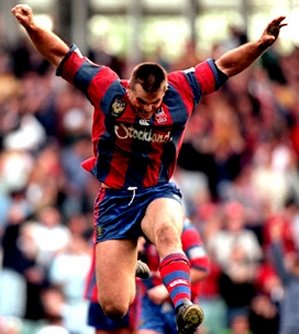 |
Paul Harragon - On the field "The Chief" earned a level of respect
uncommon in sport these days. He was uncompromising, courageous, honest
and fearless - a natural born leader whose list of achievements includes
captaining his country, playing a record 20 consecutive origin games for
the Blues, leading his beloved Knights to premiership glory and winning
countless medals, awards and trophies only saved for the games best. When
Paul Harragon took the field it was "game on". The Chief only knew the
one way to play and that way was to find your best and then try to do better.
Something that is easier said than done. It is one thing dreaming that
one day you will be at the top of the game you love, it's another to actually
live the dream - it only happens for a select group.
Today, as one of the stars of the Nine Network Paul is co host of the
top rating Footy Show as well as a regular contributor on radio and in
the press. His presentations include some hilarious recounts of behind
the scenes action and how from a total media novice he has progressed up
the ranks as a polished media performer.
MEMORIES AND MILESTONES
· Played 205 club games for Newcastle Knights: 1988-99.
· Newcastle captain 1995-99, leading Knights to victory in 1997
Australian Rugby League grand final.
· Captained Country Origin v City: 1995, 1997.
· NSW Country Origin Player of the Year: 93, 95, and 96.
· Played NSW record 20 consecutive State of Origin games
· Represented Australia in 17 Tests including Kangaroo Tour
of Great Britain and France (1994) and World Cup Tours to England (1992,
1995).
· First Knights player chosen to captain Australia. Despite
multiple cheekbone fracture, led Kangaroos to Test record win during 1995
World Cup: Australia 86 d South Africa 6 at Gateshead (England) on
October 10.
· Played 220 senior matches (first grade and representative):
1988-99.
· Won 1997 Ken Stephen Memorial Award for citizenship and services
to the game.
· Received OAM award at 2000 Australia Day Awards.
· Ambassador for 2000 Olympic Games in Sydney
· Inducted into the New South Wales Hall of Fame 2002
· Official Ambassador for the Hunter appointed by Bob Car May
2000
· Patron for the Hunter Medical Research Foundation
· Was Patron for the NBN Telethon for Kids
· Was Patron for the Family Action Centre
· Has supported the Starlight Foundation, The Red Cross, The
Fred Hollows Foundation, The Two Bishops Trust and Kids Safe in the Hunter.
· Received NSW Children's Week Award in 2003 in recognition
for outstanding service to children.
· Currently working in media and promotions, regular member
on the Nine Network's Footy Shows and Commentary Team.
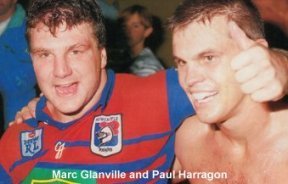
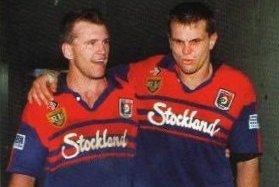
The Chief with Marc Glanville and Adam Muir.
The Chief was born on October 12, 1968, in Kurri Kurri hospital, the second son of Harold and Judy Harragon. He has an older brother Mark, who is now his manager. The family moved to Belmont when he was one-year-old and he spent his childhood playing backyard Test matches against his older brother. His mother was against him playing rugby league and tried to persuade him to take up the trumpet and guitar. She even tried to point him towards golf and tennis, but Chief was born a rugby league player. He represented NSW under-12s before graduating into the seniors where he won his first premiership playing in the centres for Lakes United in their 1987 NRL win over Souths. From there, it was the Knights and a glorious career including captaining his beloved Blue and Reds, NSW Country, NSW and playing for Australia.
Paul Harragon in his formative years made his money by busting a gut shovelling coach from trucks onto ships bound for foreign ports like Japan. When contracted by the Knights in 1988 for the princely sum of $1800 - his mode of transport from the coalfields to training was a battered old yellow falcon held together by pieces of wire. "There was no door handle, you had to pull a bit of wire to get into it."
He's a local hero, and he made it big by rolling up his sleeves and getting on with business. Harragons rise to stardom was anything but an over night success. Harragon had been tested many times through the years by injuries and setbacks, and there have been times when he could have walked away from it all.
In 1992, Former international Craig Young, stated Harragon is a good player, but he's also developed into a good leader. And under Mal Reilly he is also fine tuning his ball skills and that is impressive because by doing that paul is showing a willingness to learn... and that willingness says a lot to me of how seriously he takes the game. And because he is doing things like improving his off loading, I'm certain he is still to hit his peak. "
Knights captain and foundation survivor Tony Butterfield
said,
Chief was a special player and a great leader. `Chief was particularly
strong when things were down,' he said. `He was all about courage and taking
the team forward. The thing that really stood out about him was that he
tried so hard and really believed in what he was about.'
Phil Gould on Paul Harragon, Alot of people use the word intense about him and he is intense. but the big thing about Paul is he's just passionate. he's out there. He doesn't care what anyone thinks of him showing his emotion or what he's got to offer. That inhibits alot of people and it inhibits alot of footballers. He's got absolutely no inhibitions with his emotions and what it all means to him. Rugby league at the top level is very, very physical and can be very intimidating. Some footballers don't like it; some footballers don't like it but learn to handle it; others handle it but just get by; and some players really love it. ``Paul Harragon really loves it. He loves the physical nature of the game, he loves the intimidation aspect, and if you've got that quality in your football team it's looked upon as leadership."
Malcolm Reilly, described Harragon as ``One of the most inspirational captains I've experienced in more than 30 years in the game." Reilly wrote: ``Chief would be right up there with the best captains I've had with any international or club side, whether it was Ellery Hanley or anyone else, because of his inspirational contribution on the park, his expectations of the side and the confidence he portrays as a leader to the troops. ``He's very clear and precise in what he expects and what he wants from himself and his team-mates. I have an enormous amount of respect for him as a player and a person."
The Chief
When you think of tough men of rugby league, you think Paul Harragon.
The National Rugby League veteran of 169 first grade games for the Newcastle
Knights, 20 State of Origin appearances for NSW and 17 Australian Test
caps, Paul Harragon is one of the modern-day legends of the game. Born
and bred in the Hunter,
'The Chief' as he is known, was an original member of the Newcastle
Knights Football Club, signing on as a rangy winger in 1988. Possessing
great strength and plenty of size, it didn't take long for him to move
into the forward pack and stamp his mark on the game. His outstanding performances
were many. But perhaps his finest hour came in September 1997, when he
led the Newcastle Knights to victory in the Optus Cup Grand Final, defeating
arch-rivals Manly in a come-from-behind victory. He showed all the qualities
that day of a great footballer - inspiration, courage and determination.
Paul Harragon has been a towering figure in the game of rugby league.
His passion and committment have earned him enormous respect from friend
and foe alike, whether playing for Australia, NSW or his beloved
Newcastle Knights. In 1999, following a string of injuries, Paul
called full-time on his outstanding career. He certainly hasn't been
lost to the game. 'Chief' remains a member of the Nine Network's
rugby league commentary team and the madcap Footy Show, and he can be regularly
found at Marathon Stadium watching his old team go through their paces
at training and on game-day.
Harragon started his career in rugby league with Lakes United. By the
age of 11, Harragon was already playing representative football. It was
from the loving family atmosphere that Harragon was growing up in that
he received his first and one of the best pieces of advice. Harragon's
elation at being selected in a schoolboys tour of Queensland turned to
grief when his father Harold was admitted to a Sydney hospital to receive
treatment for a spinal disability. Summoned to his father's sick bed, the
young Harragon was given just one tip by his dad for the tour. `Remember
son, you are playing for the Harragons,' Harold told his boy. It not only
worked on that tour, but those words spoken about the high price a person
can put on family values were carried by The Chief throughout his career.
What his father did not know was that Paul was battling an ankle injury
and it was expected he would pull out of the trip away. He didn't. He wasn't
going to let anyone down. This son of a coalminer had already started reproducing
the work ethic of his father and family. He showed that from the first
time he played footy at Valentine on a ground his old man had helped build.
Only a player with self belief and a desire to display his best for family
and team-mates every time he ran out on the field could have achieved what
he did. Along the way a few things did change for Paul Harragon. The little
kid developed into a monster during his time with Lakes United. He had
already showed he had the desire but now he could harness the size, power
and ability that was getting as big as the reputation he earned with each
powerful performance.
By 1987 Harragon's first grade career in Newcastle was ablaze and the
strapping young back played a role in the Seagulls grand final-winning
team that season. He had already played for Newcastle Colts and under-19s
and the State under-19s. He was more than a hot prospect and he was already
ready to progress to the next stage. He joined the Knights in 1988. If
anything was going to stop Harragon it was to be the toughest opponent
of them all himself. It was a disregard for personal safety that ensured
he would spend almost as much time at the physio as he did on the field.
To play as long as he has is testimony not only to his physical strength,
but his mental strength.
The Chiefs first season was with the knights under 21's side in 1988,
however he stood as reserve for the reserve grade side and first grade
side. Haragon started 12 games in the under 21's, ran on for 6 starts
in the reserve side with three more as a replacement, and came off the
bench for 5matches in first grade.
After 18 months of waiting, the chief played top grade having taken
his opportunity and playing front row. The chief finished 1989
in first grade. In 1988 his playing weight was 98 kg, by 1990
he was 18 kg's heavier, stronger and maturer from speed, strenght
and fitness development. A selected hill in Belmont near the Chiefs
parents house was where he stretched and strengthen his groin and hamstrings
on his way to many recoverys, walking up the hill for hours every day.
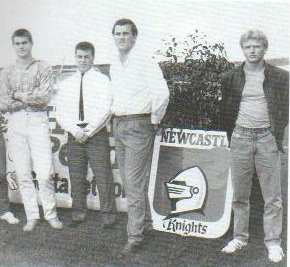 |
The Chiefs first season was with the Knights under 21's side in 1988, however he stood as reserve for the reserve grade side and first grade side. |
FLYING GIANT LEADS KNIGHTS PACK - 24
Apr 1992, Sydney Morning Herald
It's hard to believe, but hulking Country Origin forward Paul Harragon
started his career with Newcastle as a winger. The man they call the Chief,
in no small part due to his awesome 107kg frame, used to be a skinny, lanky
flanker just four years ago. "I'm what they call a late maturer, I just
started to fill out," Harragon, 23, said. "I always wanted to play in the
forwards. I didn't enjoy it out wide, there wasn't that much to do, so
I gradually moved into lock, then second row, and now the front row for
the Knights."
Built like a block of flats, the 193cm tall Harragon has made a forceful
impression on the league scene just 12 months after recovering from injuries
to his knee, back and hamstring. Many Novocastrians have linked the resurgence
of their unbeaten first-grade team to Harragon's injury-free status. In
the Newcastle game against Manly in Auckland, Harragon nearly flattened
Martin Bella in one tackle, but his keen running and ability to take the
ball up quickly are his strongest attributes. In round two, and working
in tandem with his close mate Mark Sargent, the Chief managed to shut down
the renowned Penrith pack to set up the Knights'most inspiring victory.
Despite being the biggest man in the side, Harragon has retained much of
his former pace and he uses it to devastating effect. At training, he can
compete with the backs over 20m, keep up and beat some of them at 40m and
only fades away after 60m. "The Chief's tenacity combined with his speed
is lethal," Knights trainer Joe Dunnage said. "He's a kamikaze runner-he's
flying when he runs into the opposition."
Newcastle training records show the Chief can cover 10m in 1.74 seconds.
That's faster than centre Tony Kemp (2.02s) and a smidgin behind speedsters
Jaimie Ainscough (1.61s), Adrian Brunker (1.67s) and hooker Robbie McCormack(1.68s).
"The injuries slowed me right down, and when I hurt my hamstring I was
struggling for speed," Harragon said. "Now I've got my full health back,
I'm concentrating on my sprints because I realise how valuable being fast
really is."
Harragon's former manager and Western Suburbs coaching co-ordinator,
Brian Satterley, predicts the Chief will play for Australia. "He's the
best specimen of a footballer going around," Satterley said. "He has that
natural physique and carries not one ounce of fat, and he's so big and
strong. "He's a classy front-rower, he can take the ball up hard, twice
in a set of six, and has great hands-he can pop a ball with no trouble.
"I honestly think he will wear the green and gold."
Teammates have similar sentiments after watching Harragon lead the
forward pack in the Knights' unbeaten run. While fellow prop Sargent has
been gradually finding the form which earned him a Kangaroo jumper, Harragon
has been finding the metres necessary for the new-found Newcastle back-line
to swing into action. Coach David Waite has the rejuvenated team quietly
but convincingly adapting their former up-front forward charge to incorporate
plays far wide of the ruck. "The forwards are doing the hard work, and
they're earning the right to throw the ball around," said Newcastle chief
executive Mike Armstrong.
"The team is playing with a lot of conviction."
Harragon has no qualms about backing up from the City-Country clash
to play Brisbane Broncos at Marathon Stadium on Sunday. "There won't be
any problem getting motivated for this match," he said. "We always give
the Broncos a good showing, though we've never beaten them." This clash
of the game's giants in Harragon and Sargent for the Knights and Brisbane's
Glenn Lazarus, Gavin Allen and Trevor Gillmeister will have Marathon Stadium
packed to capacity.
HARRAGON TEST CHANCE - 07 May 1992,
Sydney Morning Herald
The frighteningly mobile force of NSW prop Paul Harragon has him earmarked
for an Australian jersey, even though he used it to flatten Queensland
lock Gary Larson. Harragon escaped facing the Australian Rugby League judiciary
when a board of NSW and Queensland officials decided yesterday no action
would be taken over the tackle which left Larson concussed. Harragon, who
was the victim of an earlier crunching tackle himself, and claimed after
the game that he could not remember 30 minutes of the first half, effected
a big hit on prolific defender Larson. Larson was twitching on the ground
and was unconscious even in the dressing-room. He spent the night in hospital
and St Vincent's neurosurgeons have warned he should rest for the next
fortnight. Larson was running the ball up the outside just near the quarter-line
and was tackled by one NSW player around his waist. Almost simultaneously,
as the lock started to drop, Harragon came in from the side and over the
top. Video replays show Harragon's arm smashing into Larson's head. But
a committee consisting of NSW general manager John Quayle and his Queensland
counterpart Ross Livermore and ARL chairman Ken Arthurson decided no action
would be taken. Arthurson yesterday defended the ferocity of the match.
He said he had witnessed Origin games just as tough but admitted there
were a lot of "hurtful tackles". "I wouldn't classify the match as
brutal as some have, but the tackling was very hard and the game was extremely
competitive," he said. Arthurson said the bottom line was that the players
had no complaints about how the Origin games were played.
HARRAGON LET-OFF - 08 May 1992, Sydney Morning
Herald
Newcastle and NSW prop Paul Harragon has been involved in three controversial
tackles which have caused serious injuries since March 29, and yet has
made no appearance before the NSW Rugby League judiciary. Queensland lock
Gary Larson was knocked unconscious by Harragon in last Wednesday night's
State of Origin match. Video replays indicated Harragon's stiff and swinging
arm hit Larson's head. Larson was unconscious for more than a minute and
underwent tests on his brain. He was cleared of permanent damage, but advised
by a neurosurgeon at St Vincent's Hospital not to play for a fortnight.
A special committee comprising NSWRL general manager John Quayle, his
Queensland counterpart Ross Livermore and Australian Rugby League executive
chairman Ken Arthurson decided not to cite Harragon. On April 12, during
the first half of the Manly-Newcastle match played at Carlaw Park, Auckland,
Manly prop Martin Bella suffered concussion as a result of a tackle involving
Harragon. Bella was being wrestled by two Newcastle forwards when Harragon
launched into him with a savage tackle. Bella rose slowly, played the ball,
then wobbled for several seconds like a lopped tree about to fall. He played
on briefly, but was replaced before half-time. He played the next weekend
against Brisbane. Shortly before the tackle, Bella had aimed what appeared
to be a small head-butt at Harragon. A Manly official said privately he
believed the tackle was illegal, but the club did not lodge a complaint
with the League. The official said in explanation that he saw no value
in attempting to have Harragon cited, and that Bella did not want the matter
pursued, believing such incidents were part of life as a rugby league forward.
On March 29, in the first half of the Newcastle-Penrith match at Penrith
Football Stadium, Panthers' hooker Brett Boyd suffered a badly broken jaw
in a tackle involving Harragon. Boyd's jaw, which was broken in two places
towards the bottom of the bone near the mouth, was operated on and wired,
and he is still wearing braces on his teeth as a result of the injury.
He was told not to play football for three months. Penrith complained to
the NSWRL about the tackle, and club chief executive Don Feltis watched
the video with League executive Don Furner, who assists Quayle on citings
from premiership matches. Feltis agreed with Furner that the evidence against
Harragon was inconclusive and the matter was dropped. Livermore said yesterday
of Harragon's tackle on Larson: "We looked at the videotape, and we felt
that there was no malice or intent on Harragon's part, that it was just
one of those unfortunate things that come about. "It was not outside the
laws of the game."
Asked how a tackle that involved a player's arm striking another player's
head could be seen to be within the laws, Livermore said: "It was a swinging
arm, but we looked at the fact that Larson was falling forward (when Harragon
struck him). "If he'd been upright, the tackle would have hit him in the
chest. "We felt there was no intent and were prepared to say that's that."
Harragon, a potentially great prop and a friendly, articulate man off
the field, seems to have what could kindly be described as a flaw in his
tackling technique which has gone unchecked. That a committee did not think
his tackle on Larson deserved the judiciary's attention supports the widely
held view that the system by which players are brought to justice is haphazard.
Meanwhile, Harragon has been ruled out of Newcastle's clash with Canberra
at Bruce Stadium tomorrow because of concussion he suffered in Wednesday's
bruising interstate match.
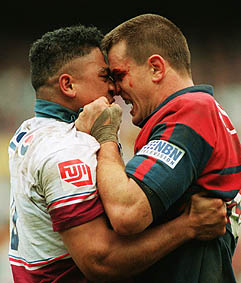 |
Nicknamed "The Chief" at 17 yrs old, the name was taken from the native american character in the movie 'One flew over the cuckoo's nest" by a team mate. |
HARRAGON IN TUNE TO MAKE JOB A HABIT - 13
Jun 1992, The Sun Herald
No Australian player sang the national anthem with more gusto on Friday
night than Paul Harragon. Harragon belted it out like he wanted to get
used to the habit. The Newcastle giant is set for a fine career in the
green and gold and fitted into his first international without any problems.
His enthusiasm for the job made him a very popular first-up member of a
very closely-knit side. Coach Bob Fulton deserves praise for the way in
which he worked the side with limited preparation. Fulton's decision to
sidestep the NSW Origin job was a master stroke. He had the job, and wanted
it, but stepped aside after discussing the ramifications of interstate
rivalry in a Test side. "I took the advice of people I care about and I
know now it was the right decision - we just picked up from Papua New Guinea
last October with no hint of interstate rivalry," Fulton said. Fulton says
having a captain of the stature of Mal Meninga makes team harmony easy
to achieve. "He insists on it and so do I," Fulton said. However, Fulton
hasn't ruled out coaching NSW in the future ... but only when he isn't
Test coach.
HARRAGON CAN GIVE FRESH HOPE TO KNIGHTS -
19 Jun 1992, Sydney Morning Herald
Newcastle are relying on their explosive Test prop, Paul Harragon ,
to produce a display commensurate with his reputation in the vital match
against St George at Kogarah Oval today. Harragon played his last game
for the Knights in late April when the club was unbeaten and he was a promising
prop. In the eight weeks since, the fortunes of the club and the man have
gone in opposite directions. Newcastle have lost four of their last five
games and slumped to ninth position on the competition table. Harragon,
through powerful showings for NSW in the State of Origin series and for
Australia in the first Test against Britain, is suddenly the menacing forward
against whom others are judged. Harragon is a better player for his representative
experience: if Newcastle gave State and national officials a stick of dynamite,
they are getting back a nuclear missile. "I expect him to have the impact
of someone who is the best prop in the world," Knights' coach David Waite
said of Harragon's return match for Newcastle. It was not coincidence,
Waite agreed, that the team's slide had come during Harragon's absence.
Although Waite has made improving Newcastle's attack a priority, their
identifying characteristic is still rugged and intimidating forward play,
and Harragon personifies this.
HARRAGON OUT FOR PNG TEST AND THREE GAMES - 13
Jul 1992, Sydney Morning Herald
Australian front-row forward Paul "The Chief" Harragon was suspended
for four matches by the NSW Rugby League judiciary last night. The Chief,
as impassive as a cigar-store Indian during the hearing, afterwards became
as emotional as an Apache who had just seen his teepee burnt. Choking back
emotion, the bulwark of the Newcastle pack, said: "I'm shattered. I'm too
disappointed to say much." The man who cries during the national anthem
then said: "I've worked so hard to play for my country."
The Chief, so named because he is as silent as the Indian character
in the movie One Flew Over The Cuckoo's Nest, will miss tomorrow night's
Test against the Papua New Guinea Kumuls and three premiership matches.
His place in the Australian squad has gone to Knights teammate Kangaroo
prop Mark Sargent. Harragon was cited to appear before the judiciary after
a complaint by North Sydney. The Bears contended a tackle by the prop on
second-rower David Fairleigh was an attack to the head. The tackle, nine
minutes into Saturday's match at Marathon Stadium, forced Fairleigh to
leave the field, concussed and with a broken nose. The evidence by the
North Sydney's medico, Dr Sorenti, proved critical. "I examined Fairleigh
on the field. He was bleeding quite profusely from both nostrils. He was
not in control of his faculties," Sorenti said. "When I walked him off,
he was unsteady on his feet. I packed both his nostrils and gave his nose
a push to try and get it back into place." The video showed the cruel efficiency
of Harragon's high blow. As Fairleigh emulated a human buffalo, carting
the ball forward, Harragon swooped in from the North Sydney player's right.
Fairleigh stepped away from Harragon, ducked only slightly, lifted his
right arm as a subconscious fend, but The Chief's right arm swept across
his face, felling him with the efficiency of an arrow to a buffalo's heart.
This was the fifth scalp The Chief claimed this season. He felled North's
Gary Larson in the first State of Origin game, Great Britain's Ian Lucas
in the first Test, Penrith's Brett Boyd in a premiership game, Manly's
Martin Bella ... and now Fairleigh. None of the incidents were mentioned
in referees' reports. In the Fairleigh case, neither referee Greg McCallum
nor touch judge Steve Betts claimed to have seen the incident. But Fairleigh's
evidence was unequivocal. "I took the ball up ... and got hit in the face,"
he said. Tribunal member Ron Coote tried to establish whether Fairleigh
saw Harragon coming and if he, therefore, ducked evasively. Harragon's
counsel, Geoff Bellew, earlier argued that Fairleigh ducked, thereby rendering
what was planned as a body tackle a head-high one. "The video shows that
long before any connection was made between Fairleigh and Paul Marquet
(another Newcastle player who went into the tackle low), Fairleigh bends
his body quite markedly," Bellew said. Judiciary chairman Vince Bruce,
QC, seized on this statement and asked: "'Long before', you said. Doesn't
that mean your player had the opportunity to take evasive action?"
Bellew, who speaks fluent legalese, replied: "Not in the split second
these players have, Mr Chairman," which suggested he was claiming defenders
operate by different clocks. But Fairleigh said: "I took the ball up and
stepped towards the sideline and copped a hit in the face. I didn't duck."
Asked where contact was made on his face, Fairleigh pointed to his
nose and high on his cheek bone. Questioned what part of Harragon's arm
had made contact, Fairleigh suggested it had been The Chief's lower forearm.
Nevertheless, as the North Sydney war party left the meeting, Fairleigh
and Harragon symbolically smoked a peace pipe. Fairleigh stood up and brushed
Harragon's arm in a conciliatory gesture. Harragon responded with a one-finger
salute of acknowledgement, mouthing the word "thanks".
The Chief later claimed he would not change his approach to ball-carriers.
"There is nothing wrong with my tackling style," he said. "Anyone who watches
the video can draw their own conclusions." Harragon tackles are lethal,
but occasionally high. The two pow-wows the tribunal had, firstly to establish
The Chief's guilt and, secondly, to determine his sentence, lasted longer
than the treaty the Comanches drew up with the US Cavalry. Perhaps the
tribunes were still divided over the Kyle White case.
HARRAGON TOLD TO CHANGE HIS TACKLING STYLE - 17
Apr 1993, The Sun Herald
KNIGHTS enforcer Paul Harragon has been ordered to keep his tackling
down. The Knights cannot afford to have renowned hitman Harragon suspended
with their other representative forward Mark Sargent struggling for form.
Coach David Waite revealed the change in style after a stinging attack
on Harragon's tackling style by former international Michael O'Connor.
Waite said Harragon had been working on "some technical changes" in a bid
to avoid the wrath of referees and end further controversy. Harragon says
he is keen to avoid controversy as he strives to hold his place in the
Country Origin side named tonight as well as the NSW and Australian sides.
He was upset that O'Connor attacked his tackling style when talking about
head-high tackles on Channel 7's Sportsworld last Sunday.
The Knights originally planned to call for tapes of both programs but
later dropped the idea. Harragon was a target of criticism last season
for alleged high tackles and served one suspension. But on advice from
Waite, he has adjusted his style. "There are a couple of technical things
that Paul has done to correct the problem," Waite said. "Any coach who
has a tall player like Paul would be irresponsible if he did not address
the situation. "If you are tall and tend to tackle chest high you have
to be aware that if the ball carrier drops you are going to be tackling
higher than the chest. "He is now constantly aware of what he has to do
and what he has to look for."
Waite believes Harragon has a slight edge over Mark Sargent in the
selection stakes but that both deserve to be named in the Country Origin
side "Paul is playing outstanding football this season," Waite said. "He
is doing more work than in any game last year. The only blemish was when
he dropped the ball three times against Manly but the tackle on Tony Iro
was playing on his mind." Waite said replays showed Iro was concussed because
of the contact of his head with the ground and Harragon and not because
of the initial contact in the tackle. "But Paul was concerned because
of the fact that people have been labelling him as a player who goes out
of his way to do cheap shots," Waite said. "He is not that type of bloke."
KNIGHTS FACE PLENTY OF COMPETITION TO KEEP HARRAGON
26 May 1993, Sydney Morning Herald
Newcastle could not win a bidding war with Manly or other high-profile
clubs for Paul Harragon, chief executive Mike Armstrong said last night.
"We can't match the top-of-the-line clubs, but we aren't looking to keep
him at a discount either," he said. Armstrong said he was aware of rumours
which have linked Harragon with Manly for weeks. The international forward
completes his Newcastle contract at the end of the season, and Canterbury
are another club rumoured to be interested. The 24-year-old will be the
most sought-after player this season. "We have been told by his managers
Paul will not discuss a contract with anyone until the end of the representative
season," Armstrong said. "We would hope to offer him somewhere near what
the other clubs can."
Harragon, a Newcastle junior, has recently bought a home in the area,
works as a development officer for the club, and has a high-profile in
the district. Armstrong said he hoped a competitive offer plus those
other factors would sway Harragon, who has already said he is keen to stay
with the Knights. Harragon's contract adviser Neil Jamieson said last night
there had been no written approaches from other clubs and confirmed it
was Harragon's wish not to discuss approaches until his representative
commitments were over. "If you take a club like Newcastle, it would indicate
how ambitious they are by their capacity to retain a player like Paul Harragon,"
Jamieson said. "If Newcastle pull out all the stops, they're telegraphing
to other players how ambitious they are for success."
The Knights' other international forward, the injured Mark Sargent,
has recently bought a house at Redhead and is contracted until the end
of 1994. Manly chief executive Frank Stanton said last night his club had
not approached Harragon, and certainly had not offered a rumoured $200,000
a season. "Not us," said Stanton. "I don't know of anyone with that sort
of money. "There's been no official approach. We'd like a player like Harragon
at a more realistic figure but it's out of our budget."
 |