| In Jo Freemans book, At Berkeley in the Sixties, the author notes that the demonstrators occupied all the seats in the restaurant and then refused to order anything. This led to over 100 people being arrested for trespassing (Pen. C. 602) and disturbing the peace (Pen. C. 415). |
| Motivated by the success of their first drive-in, Mel Weiss and partners opened their second Mels on Geary Street in San Francisco in 1952. Weiss son Steve worked as a soda jerk during high school at the Geary location and then later operated the restaurant. By 1954 the annual income for the Mels franchise was reportedly around $4 million. It was estimated by Weiss that they were cooking up 15-20,000 hamburgers a day. In the mid-fifties California had the highest rate of car ownership in the nation. Witnessing the growth of the automobile culture, Mel Weiss and Harold Dobbs expanded the San Francisco-based Mels into a successful chain that consisted of several dozen drive-ins and coffee shops throughout Northern California. Mels became a fixture of contemporary life, with lurid neon lighting, carhops, and a pre-fast food menu. During the 50s and 60s you could find one or more Mels drive-ins located in San Francisco, Oakland, Berkeley, Sacramento, San Jose, Walnut Creek, and Salinas. At one point Mels also ran several bowling alleys and restaurant complexes. Mels also branched off into a second chain called KINGS. The Kings restaurants were located on the Peninsula south of San Francisco. |
| 140 South Van Ness Ave. Near Mission St. San Francisco, Calif. |
| With an indoor customer capacity of 75 people, the interior was typical diner style with plenty of Formica tabletops and booths framed in chrome and upholstered with brown Naugahyde. In the center of the main floor, a row of stools faced a circular dining counter that wrapped around two complete soda fountains and a battery of pie cases and coffee urns. The original cooker had the ability to turn out 180 hamburgers per minute. |
| In the early 60s, Mels drive-in became a place of controversy for many young people involved in the civil rights movement. In the Fall of 1963, a group of young people calling themselves the Ad Hoc Committee to End Discrimination first picketed and then sat in at Mels drive-in. They were protesting the fact that black people could eat at Mels but not work there. The picket lines began to first appear in October. By the first weekend of November the protest had evolved into the first mass sit-in of the Bay Area civil rights movement. |
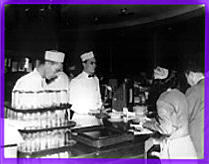
| A large staff of cooks and servicemen plus as many as 14 girl carhops prompted fast service and many repeat customers. |
 |
| Mels co-owner, Harold Dobbs was running for mayor of San Francisco at the time and some believe that the demonstrations were politically motivated because the protesters used the weekend before the mayoral election to demonstrate. In addition, the local newspapers noted that protestors chose to picket in front of Dobbs home but not the home of his co-owner, Mel Weiss. Organizers of the demonstration denied any political motivation. Dobbs did not win the election. However, a week later he signed an employment agreement with the Ad Hoc Committee to hire black people in up front positions. Some black carhops and bartenders were hired immediately. |
| WHERE ARE THE NEGRO WAITRESSES? |
| Photo Courtesy: San Francisco News-Call Bulletin newspaper photograph archive |
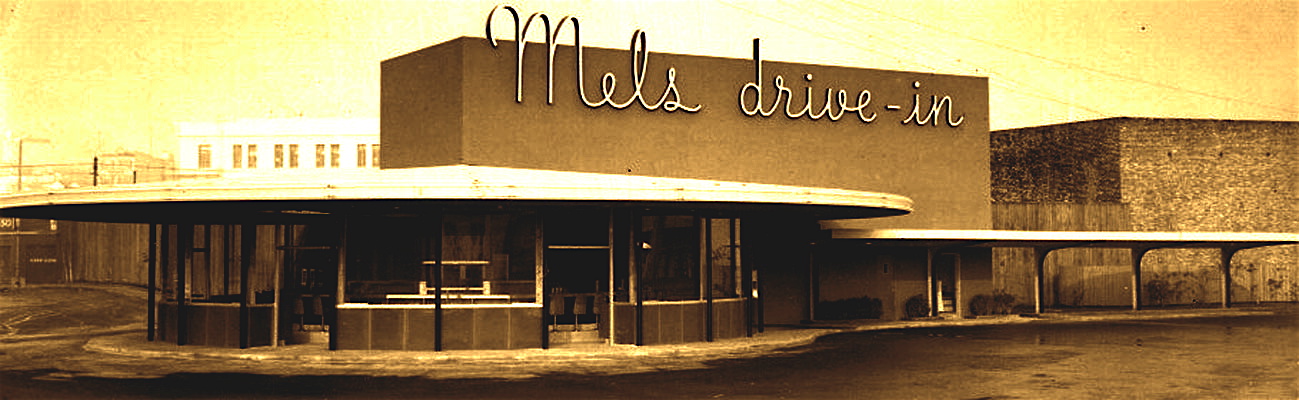
| The original location of Mels drive-in at 140 South Van Ness Avenue near Mission Street was the perfect location. It consisted of ample grounds, attractively landscaped with the capacity for 110 cars, and a two-story rectangular building. The distinctive Streamline Moderne structure had great expanses of glass that wrapped around the circular dining portion of the building and a foundation of orange tile. It's round shape suggested the mobility of a flying saucer ready to spin off into outer space. And, like the aerodynamic wing of a jet, a roofing canopy (with smooth edges and recessed lighting) stretched alongside the rectangular portion of the building to cover cars. During the later part of the 50s, the appearance of automobiles with flared, rocket-like tailfins were a perfect match for the building�s mobility imprinted design. |
|
 |
 |
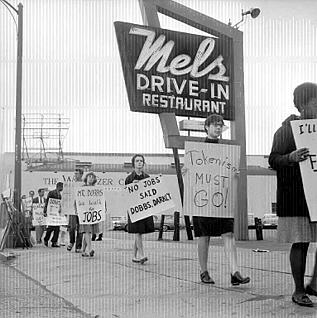 |
| Protesters picket the job discrimination at Mel's |
 |
| A Tribute to the Very First Mels Drive-in |
| Page 2 |
 |
| A few days before the grand-opening, Dec. 23, 1947 |
 |
|