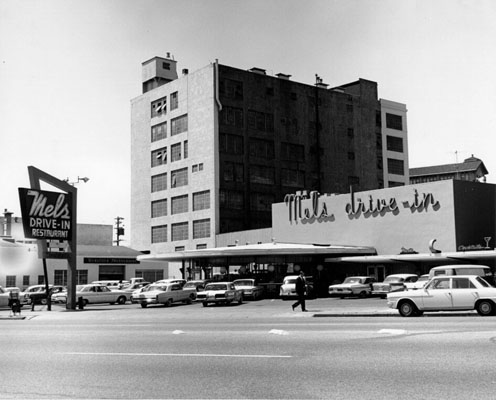
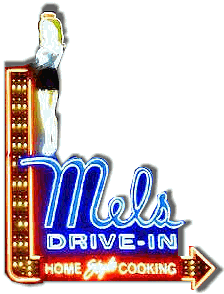
| After the civil rights protest in 1963, Mels carhop restaurants continued to reign for another 10 years before fast-food hamburger chains squeezed out their service. McDonalds was the biggest culprit. With it's limited menu and a self-service ordering system McDonalds had established itself as the undisputed leader of the fast food industry. By 1970 The McDonalds empire consisted of 1,500 franchised outlets and was quickly growing. By 1972 Weiss and Dobbs had sold the Mels franchise to the Foster's chain. It was during this year that the location manager for American Graffiti, Nancy Giebink was scounting a location for a building to represent Burger City in the film. The 140 S. Van Ness location came to her attention and arrangements were made through Dennis Kay, Director of Operations for Foster's West to lease the restaurant for the film. Graffiti Co-Producer, Gary Kurtz recalls the drive-in being rundown when they first leased it. "It was in terrible shape," he said. "We had to repair the neon in the signs and repair the light bulbs and paint it. When [cinematographer,] Haskell [Wexler,] saw it for the first time, he decided, since we were going to do so much shooting there, to replace the light bulbs with photofloods." In addition, the neon letters that spelled COCKTAILS on the street sign (under the arrow), were replaced with the words BURGER CITY to match the burger shack that was described in the script. Filming at Mels began on Monday July 10, 1972 and continued for the following two days. During the nights of filming, the restaurant was closed for business but reopended in the morning. The crew returned the following Monday on the 17th to film the interior scenes and exteriors such as Curt talking on the phone. Unfortunately, in the process Lucas' expensive Eclair camera fell off the tri-pod causing damage to the camera and some of the film. So, they had to return one more day, August 2nd to shoot some exterior shots. Foster's eventually filed for bankruptcy and the restaurant was sold once more. The drive-in eatery was open several more years before it met its demise and was torn down. However, Mels drive-in with it's dramatic structural form and dazzling neon was preserved on 35-mm, Techniscope film. And, the popularity of the film, has helped to establish Mels as icon of mid-century American popular culture. To find out about the modern day original Mels check out their website by using Kip Pullman's American Graffiti LINKS page. |
| Page 3 |
| Bayer, Patricia. Art Deco Architecture. London: Thomas and Hudson, Ltd., 1992. Burger Chain Delivers Mels on Wheels Cruising Modesto. The Modesto Bee. Oct. 5, 1991. California Living Magazine, November 20, 1983. Freeman, Jo. At Berkeley in the Sixties: Education of an Activist, 1961-1965. Indiana University Press Hurley, Andrew. Diners, Bowling Alleys and Trailer Parks. New York: Basic Books, 2001. Mels Drive-in Web Page. Retrieved Sept. 6, 2004. www.melsdrivein.com. Meiklejohn Civil liberties Institute Archives. Civil Liberties Docket Vol. IX, No. 3 April 1964. Retrieved June 21, 2005. <http://sunsite.berkely.edu/meiklejohn/meik-9_3-4.html> Online Archive of California; <http://ark.cdlib.org/ark:/13030/hb9w1009k9>. Specialty Real Estate Web Page. Retrieved Sept. 6, 2004. <www.specialtyrealestate.com/issues/nov98/aclassickeepsonrockin.html.> |
| Tribute to the very first Mels drive-in 140 S. Van Ness San Francisco |
 |
 |
 |
| Mels 140 S. Van Ness Ave. San Francisco c. 1964 |
| Photo: Alan J Canterbury |
 |
 |
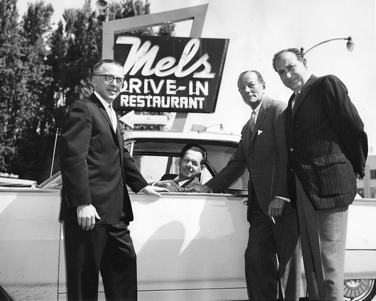 |
| FIREMAN WINS NEW '62 T-BIRD Al Williamson (seated) was the top prize winner in a promotion conducted by Mels Drive-In. Also pictured are Harold Dobbs, Al Schlesinger, and Mel Weiss (l-r) |