| When mixing the sound Murch had separate control of both the original show and the "worldized" version. By blending the recordings he was able to get the right amount of atmosphere for the right moment in the film. He could make transitions from a live very present sound to something that sounded like it was very distant and bouncing off many buildings. One of the more extreme examples of this in the film is the period when BARBARA ANNE by The Crests is playing on the radio and 'Curt' is kicked out of the car. Murch explains, "When your in the car, you're hearing the closed in, slightly muffled sound of car radio speakers of the time. Then when he gets kicked out |
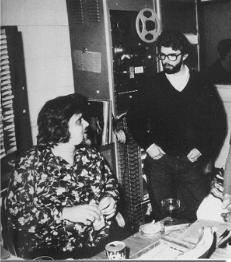
| One of the most striking aspects of Graffiti is the convincing sound of street-cruising ambience supplied by sound designer, Walter Murch. Murch, the the son of Abstract Expressionist painter Walter Murch, (1907-68), had first met Lucas when they were both film students at the University of Southern California (USC). Lucas wanted something special to be done with the music in the film and Mr. Murch was just the person to provide it. At the time, Murch felt the available effects machines that produced reverb and echo sounded much too artificial so he set out to create his own effects for the film. To make the music bounce around the environment Murch employed a process he termed, "worldizing." |
| MURCH the MIX MASTER of MUSICAL MONTAGE |
 |
| After filming, but before the mix, Murch and Lucas produced a radio show as if one had happened to tune in to radio station XERB in the late summer of 1962, complete with Wolfman's patter, commercials, songs, and people phoning in requests. They then took a tape of the radio show into various outdoor environments, and played it back and captured what they heard on a second tape recorder. |
| Those that have worked with Mr. Lucus believe Graffiti�s �docu-style� to be a direct reflection of his own personality. �George is more aloof, he�s more private and you can see that in his movies,� says Graffiti co-writer Willard Huyck. |
| Huyck further elaborates, "George started out as a documentary filmmaker with long lenses, and with long lenses you don�t have to get that close to the subject.� Certainly, Lucas felt more comfortable in the editing suite then on-location. �His style was to shoot a lot of footage and sit in the editing room and put it all together,� recalls Graffiti co-producer Gary Kurtz. For the reserved director, it was much easier to manipulate film rather than an entire cast and crew. Essentially, Lucas�s directing was done in the editing room. Although the feature took just four weeks to film, it took six months after filming was completed to edit the movie down to a manageable size. With the assistance of film editor Verna Fields and wife Marcia Lucas (also a professional film editor), Mr. Lucas managed to make the first cut of Graffiti an enormous three hours in length. Therefore, a lot of trimming was required to shorten the length and still really define and make the movie that Lucas wanted. |
| The camera was often placed at a distance in an attempt to interfere as little as possible with the subject being filmed. It is understandable how someone who is shy or lacks social skills would be attracted to this technique. |
 |
| Sound Designer, Walter Murch & George Lucas. ca. early '70s. |
| GRAFFITI Style |
|
 |
| and he's at those crossroads, kind of wondering what's gonna happen next, the music becomes probably the most ethereal that it ever is in the film." With the possible exception of Orson Welles' intended version of Touch of Evil (1958) sound had not been explored to such an extent in American cinema. Mr. Murch did an incredible job mixing the sound of those "oldie but moldy" tunes into the film. In fact it is not just the songs that sound great but the way in which their presented and mixed into the film that makes the music sound so good. Working his wonderful magic Murch created an aural delight that makes the film not only fun to watch but satisfying to listen to, as well. |
| SILENT GEORGE |
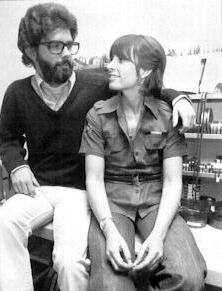 |
| Mr. & Mrs. Lucas |
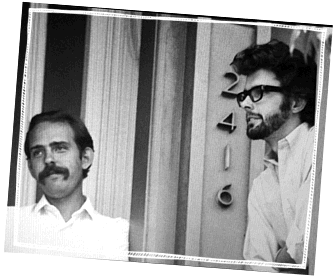
| Wolfman & Lucas |
| Page 4 |
|
|
 |
 |
 |