 |
 |
| Side 3 of 4 (Record 2) Continued |
| You're Sixteen-You're Beautiful (And You're Mine): Johnny Burnette (1:56) Johnny and his brother Dorsey were part of a mid-50s rockabilly act before moving to LA where they cowrote several songs for Ricky Nelson and others. Johnny went solo in 1958 and signed on with Liberty records. He changed his image by appearing clean cut and making his music a bit softer. He enjoyed teen idol status when "You�re Sixteen" became a hit in November 1961. The single sold millions and peaked at number eight, becoming the largest selling record of his career. Love Potion No. 9: The Clovers (1:53) Hailing from Washington D.C., the Clovers were one of the most successful rhythm and blues vocal groups of the 1950s. By combining blues and gospel they created blues with a beat. By mid-1957 the band had 19 hits and was hoping to put a record on the pop listings. They met that challenge in June 1956 when their song "Love, Love, Love" made it to number 30. Unfortunately, the significant appearance of "Love" in the pop charts marked the beginning of The Clover's commercial decline. Their hit record streak was in a slump in 1959 when Jerry Leiber and Mike Stoller, wrote a song for the group titled "Love Potion # 9." It was the groups� most successful single in the pop charts reaching number 23. Unfortunately, it was the last major hit for the band and marked the end of their commercial success. |
| Side 4 of 4 (Record 1) |
|
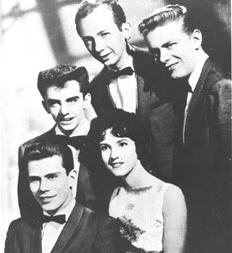
| Since I Don't Have You: The Skyliners (2:35) The Skyliners consisted of 5 white Pittsburgh teenagers with perfect voices. The lyrics to "Since I Don't Have You" were written by manager Joe Rock, (while sitting in his car between stoplights), while 17-yer-old lead singer, Jimmy Beaumont wrote the music the next evening. A rough a capella demo was recorded. After shopping the demo around and getting rejected by 13 established labels, the group contacted Calico Records who set up an audition. The group passed and "Since�" was recorded on December 3, 1958. A total of 18 musicians were used which was the first time a full orchestra was used with the group. The record was released the day after Christmas and shot up the charts to number one in Pittsburgh, which resulted in the group being invited to appear on Dick Clark's American Bandstand. Within three days of their performance on Bandstand, "Since" had charted on Billboards' Top 100 and had sold 100,000 records. |
| Chantilly Lace: The Big Bopper (2:21) The Big Bopper was a disc jockey at KTRM in Beaumont, Texas. Bopper (real name Jiles Perry Richardson) became a pop star when he recorded and released a single called, "The Purple People Eater Meets the Witch Doctor." The B-side was a rockabilly song he wrote called "Chantilly Lace" which became an international hit in 1958. He created a stage show based on his radio personality and was asked by his friend Buddy Holly to join a Midwestern tour in the winter of 1959. On February 3, 1959, between concert stops in Mason City, Iowa and Fargo, North Dakota the tour plane crashed killing everyone on board including Buddy Holly and Ritchie Valens and the "Big Bopper." Teen Angel: Mark Dinning (2:35) Born in Oklahoma, Mark Dinning came from a musical family. His 3 sisters were known as The Dinning Sister in the 1940s. Their biggest hit was "Buttons and Bows." Mark had a contract with MGM in 1957 but had a failed career as a country artist. His sister Jean and her husband gave him a song they wrote called, "Teen Angle." The lyrical content, somewhat dark, was about a girl who was killed by a train while retrieving her boyfriend's ring. In February 1960, it rose to the top of the US charts. One of the first examples of songs about death "Teen Angel" spawned dozens of similar morbid tunes. 8 |
| Crying in the Chapel: Sonny Till and the Orioles (3:04) Considered to be one of the founding fathers of rhythm and blues, The Orioles, with their smoothe delivery were also excellent at singing love ballads. The group's origins started in Baltimore in 1946 by singing on street corners which in turn landed them a opportunity to sing at the bar on one of the corners where they sang. Inside they met songwriter Deborah Chessler who became their manager. By 1948 the group had recorded and released a single written by Chessler, "Its Too Soon." Almost immediately the group's single shot up the pop charts to number 13. The group followed up their success with many more great records. The group made many appearances on TV shows and played for top dollar. The band suffered a setback in late 1950 when an auto accident killed guitarist Tommy Gaither and injured some of the others. In June 1953 the band went into the recording studio and recorded their next single, "Crying in the Chapel." It was one of the group's strongest efforts and by the end of summer 1953 the song reached number 11 on the pop charts and number 1 on the R&B charts |
| A Thousand Miles Away: The Heartbeats (2:25) One of the leading harmony groups, The Heartbeats, owe much to their fan club who helped popularize their biggest hit. After having only two releases, Heartbeats fan clubs started springing up all around the New York area. When their single "Oh Baby Don't" began to get airplay in the fall of 1956, fans would call up the radio stations and demand that the disc jockey turn the single over and play the B-side, "A Thousand Miles Away." Lead singer, James "Shep" Shepard wrote the song about his girlfriend who had moved to Texas. Shep's lilting lyrics and soaring voice helped make the song a classic. Shep would revisit the "Thousand Miles Away" story several times and his other group, Shep and the Limelites charted with a similar sounding song "Daddy's Home" in 1961. |
 |
| SOUNDTRACK Page 6 |
|