 |
 |
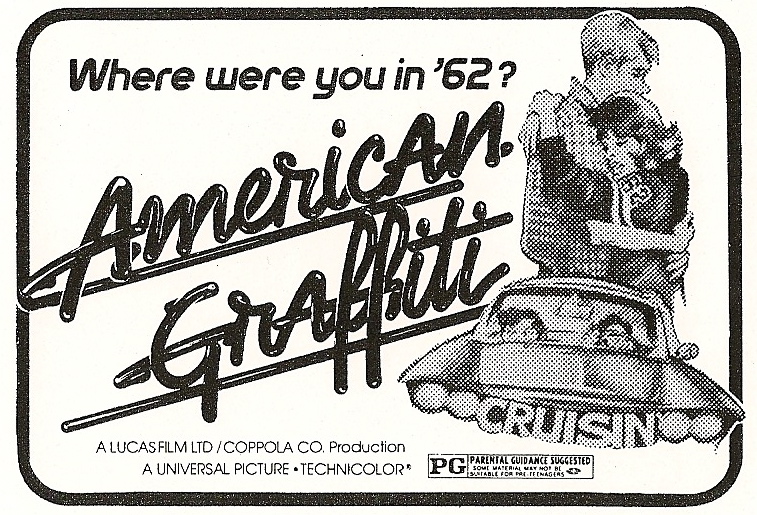
| "Where were you in '62?": American Graffiti, George Lucas and the Baby Boom Generation Pg. 3 |
| In the light of these budgetary restrictions, shooting the film had to be done on the cheap. Fortunately, Lucas could draw on his previous experiences as a documentary filmmaker. He used then largely unknown actors shot the film on location (rather than in an actual studio), and worked long hours and incredibly fast, sometimes using several cameras. One might say that instead of directing the actors, he tended to observe them, as a documentary filmmaker would do. Filming started on 26 June 1972 and took twenty eight days. After several months of post-production (which included editing and the careful matching of pop songs on the soundtrack to the action), the film was previewed on 28 January 1973 in San Francisco. While the test audience seemed to like the film, Universal executives did not. They demanded significant changes, but, with Coppola's help, Lucas managed to prevent what he considered to be a full-scale mutilation of his film. Still, he did cut four and a half minutes of footage, a scene with a used car salesman, an encounter with a former teacher at the school dance, and Harrison Ford singing "Some Enchanted Evening." Lucas was later able to restore these scenes. Nevertheless, it is important to note that he deeply resented Universal's intrusion. The edited version of American Graffiti finally was released on 1 August 1973. |
| 2 The Storylines of American Graffiti So what is the film like, and what is it about? For those of you who have never seen American Graffiti, or haven't seen it for a long time, I don't want to spoil your later viewing of the film by giving too much of the story away. But it's probably save to say that the film starts in the evening before the day that close friends Steve (played by Ron Howard) and Curt (Richard Dreyfuss) are scheduled to leave Modesto for college in the East. With "Rock Around the Clock" playing on the soundtrack, Steve, Curt, Laurie (who is Curt's sister and Steve's girlfriend, played by Cindy Williams) as well as their friends Terry (Charlie Martin Smith) and John (usually known as Milner, played by Paul Le Mat) arrive with their cars (and Terry on his Vespa) at Mel's Drive-In. They will soon depart for their separate, yet occasionally intersecting, adventures during the night, only to meet again the next morning (after time has indeed moved "around the clock") at the airport because one of them is leaving - but I'm not going to tell who leaves and who stays. We learn in the film's first scenes at the drive-in that each of the four male friends has issues to resolve. Most obviously, Curt has doubts about leaving home, while Steve sees it as an opportunity "to see other people", as he tells Laurie, who probably expected a proposal rather than this thoughtless declaration of male independence. Terry is not only a somewhat nerdy type, but also less well off than the others (indicated by his means of transportation); he thinks that he has to pretend to be someone other than who he actually his, and is delighted when Steve hands his flashy car over to him. Milner is older than the others; he left school years ago and now works as a car mechanic, but is still hanging around with high school kids, while also defending his reputation as the fastest drag racer in town. When the four friends go their separate ways that evening, they begin to address the issues they need to resolve, and they do so mainly through their encounters with the opposite sex. Milner is confronted with the fact that he is simply too old for his way of life. When he tries to chat up high school girls while cruising, he instead finds himself with a twelve year old girl in his car. Carol (played by Mackenzie Phillips) stays with him for much of the night, and the utter inappropriateness of the situation is played for laughs. Importantly, Milner reveals a perhaps otherwise hidden fear to Carol when he takes her to a car junkyard, and talks about drag racers who died in crashes. Still, in a moving scene between Milner and Terry towards the end of the film (after the climactic race between Milner and his latest challenger, played by Harrison Ford), we begin to understand why it is so important for Milner and for others like Terry that he carries on with his drag racing. |
 |