 |
 |
| "Where were you in '62?": American Graffiti, George Lucas and the Baby Boom Generation Pg. 4 |
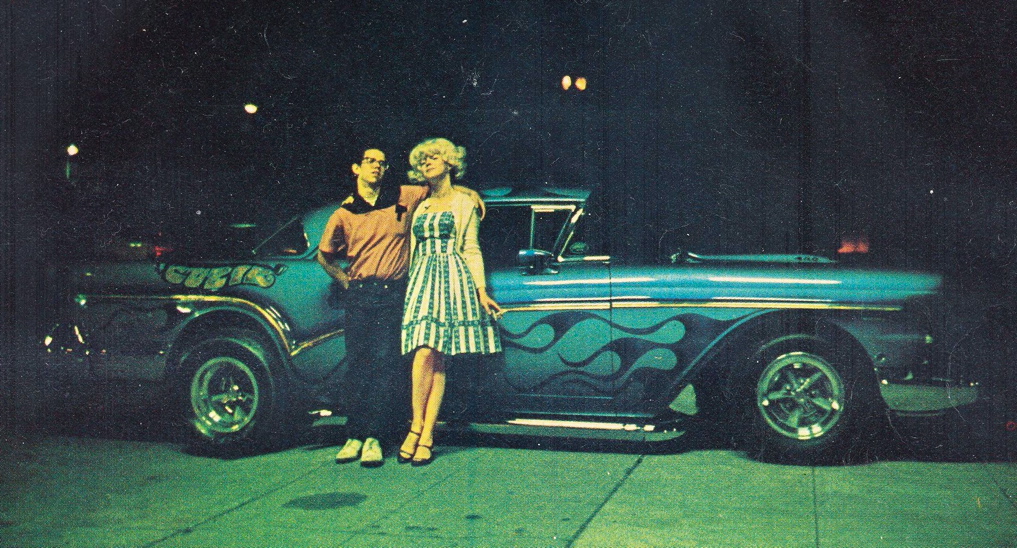
| Terry uses Steve's car very successfully to attract the attention of Debbie (Candy Clark), who he approaches in the street. Debbie is nothing like the prim and proper Laurie; she does not appear to have her own car, depends on treats from guys, and is out to have fun (rather than being overly concerned about protecting her reputation). While Debbie is quite happy simply to spend time with Terry, Terry feels he has to impress her by making ridiculous statements about his wealth and his possessions. Of course, all his plans go disastrously wrong, and he looses everything, including his dignity, but, to his surprise, not Debbie. It seems that she is willing to take him for what he is, which is a hopeful lesson for Terry to learn. Steve's great plan to keep Laurie back home while also seeing other girls at college is, it turns out, not very well thought out. At the school dance, we learn that Steve is not in fact very good with girls, Laurie had to make all the moves to get and keep their relationship going. And when the events of the night threaten him with losing Laurie altogether, he is confronted with the strength of his feelings for her, and he has to draw the consequences. In a somewhat indirect way, Laurie thus manages to teach him a lesson about his true emotions, and he does away with silly macho fantasies. Finally, Curt is revealed to be a dreamer. He gets it into his head that a chance encounter with a blonde woman driving around town is of the utmost importance, and tries everything to meet her again. She might be a rich man's wife or a prostitute or some kind of angel. Searching for her, Curt meets an ex-girlfriend, gets involved with a local gang, and goes to a secret radio station at the edge of town to leave a message for the legendary disc jockey Wolfman Jack (played by the man himself). I am not going to reveal to you whether he actually gets together with the mystery woman, but I can tell you that it certainly seems to be the case that his quest for her teaches him lesson about what he wants to do with his life. |
| 3 The Sixties and Nostalgic Longing in American Graffiti The film ends with the gathering of friends and family at the airport and the departure of one of the characters. Superimposed on the image, four short statements tell us about the future of the male characters. One will die in a car accident, another will settle down in Modesto, a third will go to Canada and a fourth will go missing in action in Vietnam. I think we can take the reference to Canada to mean that the character in question moves there to escape the draft. Thus, the life of two of the four friends is overshadowed by the Vietnam war. Are these the only references to key events associated with the 1960s? I think that it is no coincidence that the tagline "Where were you in '62?" is somewhat reminiscent of the familiar statement, often heard from baby boomers and their parents, that they remember exactly where they were when they heard that Kennedy had been shot. Indeed Kennedy is explicitly referenced in American Graffiti, when Curt's ex-girlfriend reveals that his great ambition is to work for, and shake hands with, the younthful president. Of course, this was not to be � because little more than a year after the night depicted in the film Kennedy was assassinated. Some critics have concluded from this that with American Graffiti Lucas was trying to recreate a more hopeful, harmonious and comfortable time which preceded the great and divisive upheavals of the sixties, best exemplified by Kennedy's death and America's increasing involvement in Vietnam. Indeed, critics have interpreted American Graffiti as the expression of a perhaps misguided nostalgic longing for the good old days before the 1960s. Yet, does this match what is actually going on in the film? It is worth pointing out that the film does portray social divisions between well-off people such as Curt, Steve and Laurie who have lots of options in life, and less well-off people such as Terry, Milner and Debbie, and indeed the local gang members, who do not appear to even dream of leaving their home town behind and going out into the world (unless it is to fight a war). One could go further and observe that with Debbie the film very positively portrays a harbinger of one of the key developments of the sixties,namely the sexual revolution. Contrary to the moral standards of the fifties and early sixties, Debbie appears to see sex primarily as a source of fun and pleasure, as do most of the male characters -, and the film does in no way condemn her for this. Instead one might say that American Graffiti accepts her modern attitude which undermines the age old double standard allowing men considerable sexual freedom but denying it to women. |
 |