 |
 |
| PETER KRAMER Lecture |
| Where were you in '62?: American Graffiti, George Lucas and the Baby Boom Generation |
| The following is a transcription of a presentation given by Peter Kramer at Modesto''s Celebration of the 35th Anniversary of George Lucas' American Graffiti, in Modesto, California, May 31, 2008. Mr. Kramer offers some brilliant insight and intelligent commentary on the film. He has written several books on cinema and is the Senior Lecturer in Film Studies, University of East Anglia, Norwich, England. |
|
| In 1973, the poster for George Lucas' second feature film American Graffiti asked: "Where were you in '62?" I presume that many of you would have answered: "I was here in Modesto." I, on the other hand, would have had to say that in 1962 I was a mere baby in a village in Germany. Yet, such has been the international impact of American Graffiti that today I can feel almost as strongly as you about the life of young people in early 60s Modesto, which the film so vividly and engagingly depicts. While American Graffiti was shot in the bay area, it is set here in Modesto, recapturing a crucial summer in George Lucas' life and an important moment in his home town�s history and also in American history more generally.
Throughout the 1950s and into the 1960s, Modesto's population was growing rapidly; between 1950 and 1960, it more than doubled from 17,400 to 36,600. Partly this was due to people moving to Modesto, but, to a greater extent, it was due to a phenomenon that swept all of the United States at that time: the baby boom. After the war, lots of people had lots of children, and they often had them at a fairly young age. The resulting, unprecedented high birth rate did not return to normal levels until the mid-1960s. The years of the baby boom (usually dated from 1946 to 1964) were characterized by enormous economic growth and widespread prosperity. For the first time in history, a large percentage of teenagers had a lot of money to spend on entertainment, food, drink and cars. As a consequence, youth culture became an important presence in public life - through radio stations playing rock and roll, diners frequented mostly by teenagers, and main streets populated in the evenings and at night by young people cruising around in their cars. This is the setting for American Graffiti's story about the last night of the summer holidays of 1962, and the - in some cases life-changing - experiences of a group of teenagers during that night. Like George Lucas in the summer of 1962, most of these teenagers are about seventeen, eighteen years old, and thinking about what to do with their lives now that their school days, and with them their childhoods, are finally over. |
| Lucas was born in Modesto on 14 May 1944, as the third child, and the only boy, in his family. Strictly speaking, he is not a baby boomer (since the beginning of the baby boom is usually said to be 1946), but his life experiences overlapped considerably with those of the older segment of the baby boom. He grew up with television, moved to the suburbs with his parents when he was fifteen, and became increasingly interested in cars, driving around in a souped-up Fiat.
Lucas was about to graduate from high school when in the afternoon of 12 June 1962 he had a near fatal car accident just outside town. He later said about the impact of this event: "The accident made me more aware of myself and my feelings. I began to trust my instincts. I had the feeling that I should go to college, and I did. I had the same feeling later that I should go into film school, even though everybody thought I was nuts". Thus, the accident became a turning point in his life, setting Lucas on a course which brought him to Modesto Junior College and the University of Southern California and from there to Hollywood. With American Graffiti, Lucas went back to this turning point. Instead of a straightforward autobiographical story, though, he told a tale of four friends, two of whom were at crossroads in their lives, having to decide whether to leave their home town or to stay, while a third had to confront the prospect of likely death associated with his car obsession. Importantly, in this film, Lucas also explored the crucial role played by four girls in the lives of these boys, in particular in the learning experiences they all undergo during this fateful night at the end of the summer. In this talk, I want to approach American Graffiti from a variety of perspectives. First, I will say a little bit more about how the film came about and how it fits into Lucas' career. Next, I'll examine the storylines of the film�s central male and female characters in more detail, before I then discuss the ways in which the film references key events and developments of the 1960s. I will also ask whether the film is nostalgic, and, if it is, what it is nostalgic for. Finally, I will outline the film's enormous success and lasting cultural impact. |
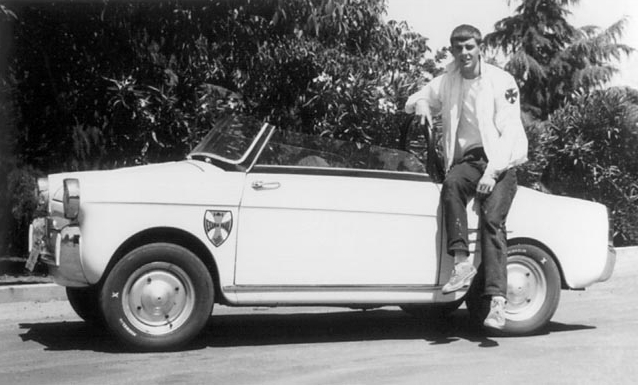 |
| Teenage Lucas and his famous Fiat |