In this page we will be looking at the following aspects of supervision:
1) Must and can interventions.
2) Identifying unhealthy processes in supervision.
3) Game Playing in supervision .
4) Mirroring, Parallel Process and Transference/Counter-Transference.
5) Strategies for dealing constructively with unhealthy processes
in supervision.
6) Principles that assist manage the Supervision/Therapy Dialectic.
Must and can interventions are notions derived from Proctor (1988).
These notions are to be used by supervisors when it becomes apparent
and necessary to encourage the supervisee to change their behaviour.
'
the supervisee (social worker) is doing something that concretely and
tangibly affects you, or it is part of your job to ensure the performance
of
certain tasks.'
Two examples of when a must intervention would be appropriate are:
1) when a social worker is the rostered duty social worker and
they are nowhere to be found without arranging for another social worker
to cover them, or
2) when reviewing a case it becomes apparent that children are
at risk of harm.
With a must intervention the supervisor must be satisfied with the action that is proposed.
The Guidelines for a must intervention are:
1) Signal you are concerned.
2) State your concern (Be explicit and explain why you
need to intervene).
3) Involve the supervisee (social worker) in finding a
solution.
4) If you perceive the supervisee (social worker) is resistant
or reluctant, use reflective
listening to explore the resistance
or reluctance.
5) Make sure you are comfortable with the solution (It
is important that you have
a set bottom line and that you make
this clear to the supervisee).
(Proctor,1988)
1) Ensure that you and the supervisee are in the right space
to permit challenge.
2) State your concern in general terms and seek permission
from the supervisee to
provide some information.
3) Wait for the supervisee’s permission before you proceed.
4) Provide your information (be specific).
5) If you perceive resistance or reluctance use reflective
listening.
6) Be brief and to the point. (Do not repeat yourself)
7) Let the supervisee decide how, if, or when s/he wishes
to act upon your intervention
(Do not follow up unless invited to by the
supervisee).
" I am relieved when s/he does not turn up for supervision and the session is postponed."
" I always come out of a session with him/her feeling like I am banging my head against a brick wall. "
I wonder how many of us can identify with the above statements? Each of them is an example of something beneath the surface colouring the interaction taking place. This something beneath the surface that colours the interaction is an unhealthy process.
According to Morrison (1993:91):
'All interactions have at least two components:
The Content : the surface action, the overt,
what is said or written down.
The Process : the depth action, the covert, the
unspoken, the hidden agenda based
on undeclared feelings and beliefs often operating at a preconscious level.'
Supervisors may be lured into unhealthy or hazardous processes from
different levels namely:
A reported example of the effect of unhealthy processes is
found in the following comments attributed to the General Manager of the
then Children and Young Persons Service who was reported by the Evening
Standard (24 November 1995) to have:
' ...described
morale as variable and said the service mirrored the dysfunctional
nature of its clients to an "alarming extent" .'
Some particular types of repetitive unhealthy processes are sometimes
called Games.
The consequences of Games are:
' a recurring set of transactions, often repetitious, superficially rational with a concealed motivation.'
Essentially there are three main elements involved in a Game :
1) A continuing sequence of mutual interchanges which appear reasonable
on the social stage.
2) There is a hidden agenda/motive beneath the interchange which
3) Contains a predictable payoff, which ends the game and provides
the purpose for the game.
According to Kadushin (1992), both supervisors and supervisees can play games (It is important to note here that he does not assert that all supervisors and supervisees play games). Kadushin (1992:280) argues that games are used in supervision as:
"Defensive adjustments
to the threats and anxieties that the supervisory situation
poses for them [ie. the initiator of the game]."
Manipulating demand levels
Games of this type include: "Seducing for subversion " (eg. Management
is treating you
terribly!"), "Two against the Service", (eg. We both know that the
service requirements
are ridiculous don't we?), "Be nice to me because I am nice to you"
(eg. I wish I knew as
much as you did.). These games are played to reduce the level of demand
the supervisor places on the supervisee
Redefining the relationship
Games of this type include: "Treat me don't beat me" (eg. My personal
life is a mess and I
am finding it hard to cope.). Here the supervisee would rather
expose themself than their
work. Another game is "Evaluation is not for friends". In this
game the relationship is
redefined as a social one.
Reducing the Power disparity
Games of this kind include: "If you knew the DSM IV TR like I
do..." Here the supervisee to
use knowledge that the supervisor does not have, to be-little and expose
the supervisor
and thereby place the supervisee in the expert position. Another
game is "So what do you
know about it?" This game is usually played by experienced and
senior practitioners who
will let you know that they have been in the service for 20 years and
this is the best way
do things etc...
Controlling the situation
Games of this kind include: "I have a little list". Here the supervisee
sets the agenda by
repeatedly putting questions to the supervisor for an answer, so that
they can avoid having
their work discussed. "Yes but", "I'm fragile", "I did as you
told me and it didn't work" and
"I'm confused" are also games which supervisees use to control the
situation.
" Supervisors play games for the same reasons that supervisees play. The games are methods of adjusting to stresses encountered in performing their role. Supervisors play games out of the felt threats to their position in the hierarchy, uncertainty about their authority, reluctance to use their authority, a desire to be liked, a need for the supervisees' approval- and out of some hostility to supervisees that are inevitable in such a complex, close relationship. "
Some of the classic supervisory games are:
" I wonder why you really said that" - In which honest disagreement
is turned into a resistance
to be explored and analysed.
" One good question deserves another" -Where questions asked by supervisees are met with another question in an attempt to avoid letting the supervisee know that you don't know the answer. Usually characterised by "What do you think?"
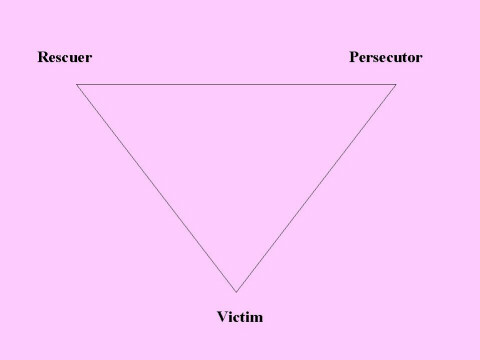
Behaves by - Taking control (eg, Tells
the client/Supervisee/social worker what to do).
Doing the thinking and problem solving.
Doing more than their share.
Believes that- The Victim (Client/Supervisee/social
worker) can not solve their problems and is
unable to help themself. They (Rescuer/social worker/Supervisor)
knows
what is best for the Victim.
Behaves by - Punishing the
Victim (Client/social worker) (eg. By telling them off - You should
have kept your appointment and it's not good enough !!!).Blaming the Victim
(Client/social worker) for their behaviour (eg. Because you're not
doing what
you're supposed to, you're forcing me to take action. Putting the Victim
(Client/social worker) down (eg, You're forever rescuing your clients.
When are you ever going to manage a case properly!!!)
Believes that - You mess with me you
pay! And "Its pay back time!!!"
Behaves by - Abdicating their
personal responsibility, control and power.
Complaining about their powerlessness and discomfort.
Blaming others for their powerlessness and hurt.
(eg. The demands from all these cases is making me work late all
the time
and it's stressing me out).
Believes that - Someone else must/should solve
my problems.
And that my problems are someone else's fault and responsibility.
They are unable to solve their problems.
It has been my experience that social workers that are involved in the Drama Triangle are usually in a state of Role Confusion, ie. their definition of the social worker role and its boundaries has become blurred. Often the social work role is finely balanced between helping/ care and statutory authority/ control. An over-emphasis on helping clients can leave a social worker in the Rescuer position. Likewise an over-emphasis of the social workers statutory authority can lead to the Persecutor position. In both cases the client is likely to be either wanting to be in the Victim position, or is already there.
It is worthwhile to point out that the positions in the Drama
Triangle are not fixed, and that a social worker can, in the process
of a case or a supervision session, move from Rescuer to
Persecutor
to Victim etc... Also, If you (as a supervisor) notice
that this process is occurring between the social worker you are supervising
and their client, YOU CAN BET THAT THE PROCESS IS BEING PARALLELED/MIRRORED
IN YOUR SUPERVISION SESSION. (eg. If the client is in the victim
position and the social worker in the Rescuer, it is likely that the social
worker is in the victim position and the supervisor is in the Rescuer
etc... ).
In dealing with a parallel process in supervision, it is important
for the Supervisor:
In terms of dealing with Transference and Counter-Transference, the key questions for both parties are:
Berne,E. (1964) Games People Play, Harmondsworth, Middlesex,
Penguin.
Gresham Supports Page's Comment. (24 November 1995). Manawatu Evening Standard, p.7.
Harris,T., and A. (1985) Staying OK, London, Arrow Books.
Itzhaky H, and T, (1996) The Therapy - Supervision Dialectic, Clinical Social Work Journal Vol 24, No 1, pp 77-89.
Kadushin, A. (1992) Supervision in Social Work 3rd Edition, New York, Columbia University Press.
Karpman, S. (1968) Fairy tales and script drama analysis. TAB, 7, 26, pp39-43.
Morrison, T, (1993) Staff Supervision in Social Care, An Action
Learning Approach,
Harlow, Longman.
Proctor, B., and Inskipp, F. (1988) Skills for Supervising and Being Supervised, St Leonards on Sea, Sussex, Alexia Publications.
Strean, H. (1996) Psychoanalytic Theory and Social Work Treatment. In
Turner, F. (ed) Social Work Treatment 4th Edition, New York, Free
Press.

Dated: 4 February 2001