|
|
              |
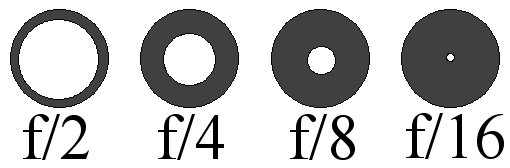
Glossary: This page outlines some of the terms used in this guide in greater detail. Aperture: The aperture of a camera determines two factors. Firstly, it determines the amount of light which enters the camera which determines exposure time. Secondly it determines the depth of focus. Aperture is measured as the fraction of light let into the camera. So an aperture of f/2 lets in two times as much light as a aperture of f/4. Some camera's have a set aperture, but on higher-ed cameras this can be set by the user. When the aperture is settable an opening in the camera (termed the iris) opens or closes to adjust the aperture.
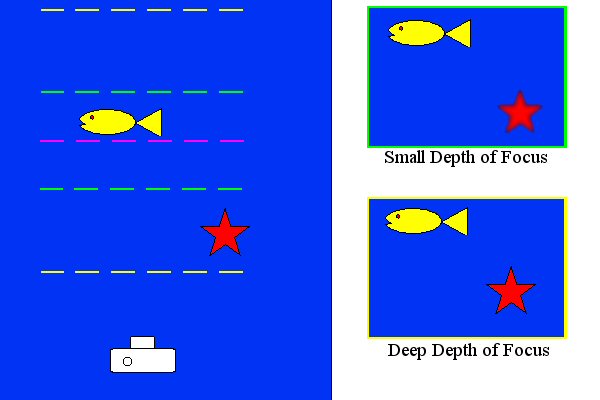
Aperture of a camera. Aperture is decreasing from f/2 (left) to f/16 (right). Backscatter: Backscatter is the most common difficulty you will run into during underwater photography. Backscatter occurs when light from your flash reflects off of microscopic particles in the water. This reflected light goes directly back towards the flash. If your flash is mounted on the camera (termed a strobe) this light is picked up by the lens, creating a "snowstorm" effect. This is why most photographers use an externally mounted flash - by placing the flash to the side it ensures that most of the backscatter will return to the flash, rather then going into the lens. Depth of Focus: The term depth of focus described the ability of a camera to focus on objects different distances away form the camera. A camera with a small depth of focus will only be able to focus on objects a similar distance away from the camera. A camera with a deep depth of focus will be able to take a picture with objects in focus which are a large distance apart. The depth of focus is determined by the aperture - the smaller the aperture the deeper the depth of focus. Of course, this increased depth of focus comes at the cost of needing a larger exposure time.
Depth of focus. The camera is focused at the pink line. A camera with a small depth of focus will take pictures in which only the fish in focus. With a deeper depth of focus both the fish and starfish are in focus. Exposure Time: Exposure time refers to the the amount of time a camera's shutter must be open to take a picture. This is usually just a tiny fraction of a second (1/60th of a second or less). Generally you want the shortest exposure time possible, as longer exposures tend to be blurry due to the movement of the camera and your subjects. The sole factor determining exposure time is the amount of light reaching the film, but many things factor into this. The size of the lens is one factor - the larger the lens the more light it can collect, and thus the shorter the exposure time required. As mentioned previously, aperture plays a major role. One of the biggest factors effecting exposure time is the ISO of the film. But be careful - most cameras can only use one or two different ISO films. Focal Length: The focal length of a camera is a measure of the distance at which a camera's focus is centered. In the depth of focus figure above the pink line represents the focal length of the camera. For macro cameras this distance tends to be very small - often as small as 10cm! For most cameras the focal length is around 1m (3'). Cheaper cameras (which have a set focus) are focused at "infinity". In simple terms this means that the camera is focused such that any object past a certain distance will be in focus. Framers: Framers are a special tools used by macro photographers to make sure their subjects are in focus. Basically, framers are nothing more then 'L' shaped rods extending from the front of the camera. These rods are placed such that they don't appear in the picture, but they are set such that they are at the focal length of the lens, and the vertical portion of the bars outline the area which will be imaged by the camera. This makes it very easy to get your subjects in focus and set up your composition - you simply put your subject between the framers and take the photo. Unfortunately, most animals do not like having things placed near them and will run away if you try to use a framer. ISO: ISO is the measure of the sensitivity of film. The higher the ISO the more sensitive the film, and thus the less light is needed to take a picture. Low ISO film (ISO50 or ISO100) tends to be to slow for underwater pictures, whereas mid-rage film (ISO200, ISO400, ISO800) tend to take good pictures. High ISO film (ISO1000 and faster) suffer from a lot of graininess, and should be avoided unless you are trying to capture images of extremely fast moving animals. O-Ring: O-rings are a special type of seal used for underwater equipment. The o-ring consists of a rubber rings placed inside of the area that needs to be sealed such that it rests on the joint between the two pieces which need to be sealed. Water pressure forces the o-ring into the gap between the pieces, thus preventing water form entering the camera. Proper care of your o-ring is central to maintaining your camera - It should be kept clean and lightly greased with silicone. Dry or cracked o-rings should be replaced immediately. Failure to take proper care of your camera's o-rings will result in leaks, and possible the loss of your camera! Strobe: The
technical term for a flash mounted outside of your camera.
Strobes are an important part of an underwater camera as they are often
more powerful then the on-camera flash, and thus do a better job of
illuminating the subject. More importantly, strobes can be
mounted to the side of a camera. This helps to reduce, or even
eliminate, backscatter.
|
This Page, and all other pages in the http://www.geocities.com/k_o_dionysus/ directory copyright (2004), Bryan Heit & the Knights of Dionysus