|











|

Black Jack
Strategy, plan, tactics, method, system, technique.
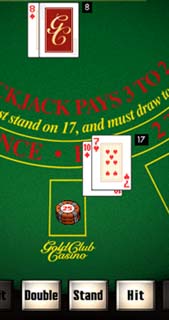 Unlike
most other casino games, blackjack is a game whose outcome is greatly
influenced by the player, right from the moment the player cuts the deck
of cards. The dealer is practically like a robot. He follows set rules
and makes no decisions of his own. Unlike
most other casino games, blackjack is a game whose outcome is greatly
influenced by the player, right from the moment the player cuts the deck
of cards. The dealer is practically like a robot. He follows set rules
and makes no decisions of his own.
There are three different approaches to the game a player can take using
three different strategies:
1. Play blackjack as a game of luck using money management only.
Determine when to call a card and when to stand irrespective of what
the dealer shows, apply a suitable money management system like the
Paroli system and set appropriate profit
and loss limits for when to quit.
2. Use basic strategy. Follow the game and take into account
the dealers card to determine whether to call a card or stand. Apply
a suitable money management system like the D'Alenbert
system and set appropriate profit and loss limits for when to quit.
3. Card counting. This is not easy to do and some casinos don't
like it. If you choose to play blackjack this way, it is best to learn
from the experts. There are several books on sale that should teach you
how to go about it.
A note on card counting
The principle behind card counting is that a deck of cards rich is tens
and Aces is favorable to the player, a deck rich in small cards is favorable
to the dealer. A deck rich in tens and Aces, is likely to bust the dealer
more often.
To gauge the richness of the deck in high cards or lack of them, the player
needs to keep track of the cards that are already played and assign a
point value to each card. The calculation is quite complex, but basically
the card counter will give a plus point each time the deck of cards becomes
more favorable and a minus point each time it becomes less favorable.
Basically, the high cards have a -1 point and the low cards a +1 point
and the in between 0 point.
The counter then counts by adding and subtracting points according to
the cards played and keeps a running total of the count called 'running
count'. Then he also needs to divide the running count by the proportion
of the size of the deck of cards left to get the 'true count'. Now he
knows the relative richness of high cards in the remaining deck.
A positive count is good and a high positive count is best and the card
counter will assess his hand, the dealer's up card, weigh up his options
and intensify his betting accordingly.
To be a successful card counter you need to have a powerful memory and
fast reaction while amassing information as you play. And for what? If
everything works out well, you will be looking at a slow and tedious 1%
average profit. If you wager large sums of money to make the 1% worthwhile,
you are likely to be noticed by the pit boss and prompt frequent shuffling
of the cards. Card counting is hard, not liked by the casinos and is not
as rewarding as it may seem.
The Paroli system:
This system is in a way the opposite of the Martingale system. You start
with one bet and you increase your bet when you win rather than when you
lose.
However, you will need to plan a betting procedure whereby you know how
far you will let the bet build before you take it down to the initial
starting bet and how much to raise after each win. This obviously depends
on the type of game played and the odds of the bet.
The advantage of this system is that you do not require a large bankroll.
It lets the profit run and cuts short the losses.
The D'Alenbert system:
This is a mixture of Martingale and Insurance systems. Bets are raised
one unit after each losing bet and lowered one unit after each winning
bet. The sequence and amount raised or lowered can be varied to suit particular
games and odds.
The 1-3-2-6 system:
The name of this system says it all. It is similar to the Paroli system.
It is based on the premise that you can win four times in a row.
Your initial bet is 1 unit, the second 3 units, the third
2 units and the fourth 6 units. Let's assume that each unit
is $10 and the odds are 1:1 - even money.
The first bet is $10. When winning, $10 is added to the $20 on
the table making the second bet $30. When winning again on the
second bet, there would be $60 on the table. Of this you take down $40
and the third bet is now $20. If the third bet wins, you will have
$40 on the table to which you add $20 making a total of $60 for
the fourth bet.
If the fourth bet wins, there would be a total of $120, of which $100
is net profit. Now all the bet with the profit is taken down and you start
the system all over again at $10.
If you lose the first bet, your loss is $10. The second level loss is
$20. At the third level, a loss will give you a net profit of $20. At
the fourth level, a loss leaves you breaking even. Each time you lose,
you start all over again at $10.
The attraction of this system is that you risk $20 at a chance of making
$100 net profit. This means you can lose five times, and with one win
get your money back.
The Labouchere system:
This system is also called the 'Cancellation' system. There are many variations.
In its simplest form, you write down a series or a set of numbers; say,
1 2 3 4 5 6. The series can be short or long and not necessarily sequential
such as 1 1 1 3 3 5 7. The choice of a particular series depends on the
type of game you want to apply it to and the odds of the bet.
Each number represents
the amount in units or chips to bet. You bet the first and last of these
numbers. In this example 1 and 6, which totals 7 units.
If you win, you cross out the two numbers and bet the next two 'ends'
(the outside numbers). In this instance 2 and 5. If you win again you
bet on the next two remaining numbers 3 and 4, and if you win that too,
you would have made a 'coup' or completed one game. Then you start all
over again.
If you lose, then you add that one number to the end of the series. Say
you lost your first bet of 7 units (1+ 6). Then you add number 7 to the
end of the series to look like this: 1 2 3 4 5 6 7 and your next bet would
be 8 units (1+ 7). If you won the first bet but lost the second 2 and
5, then the series of numbers would look like this: 2 3 4 5 7.
If you work it out, you will see that when the series is completed or
when you make a 'coup', there is always a profit. The negative side of
this system is that you could end up betting large sums of money even
if your initial bet is small.
The Martingale system:
The Martingale system is a very old and extremely simple system. It is
based on the probability of losing infinite times in a row and
is usually applied to 'even money' bets.
You start with one bet. If you win, you start again with one bet. If you
lose, you double your bet. Each time you lose, you double your last lost
bet. Eventually you are bound to win. When you win you would recover all
your lost bets plus one unit (or chip) profit against your initial wager.
Although infallible in theory, the Martingale system requires a large
bankroll, has a very low return and is a very risky one because of the
maximum bet limits imposed by the casinos. If you run out of money or
reach the house limit, you can lose a lot with no chance to recover your
losses.
The Parlay system:
This system is similar to the Paroli system and has the effect of 'pyramiding'
your profit. Pyramiding is a parlay wager whereby the original wager plus
its winnings are played on successive wagers.
It is commonly used in horse racing betting. Basically you make a bet
and if you win you re-invest the winnings on the next bet. You 'let it
ride'.
This method of play is by no means risk free, but it offers the least
amount of risk of all wagers since the player is only concerned with either
a win, place or show selection or a combination of the three.
It is one of the oldest methods of wagering and was originally derived
from the same premise that banking systems use to compound interest.
Interesting links
Blackjackcenter.com
A basic blackjack strategy - also has sections on card counting, cluster
counting and betting systems.
Blackjackinfo.com
|
|
|