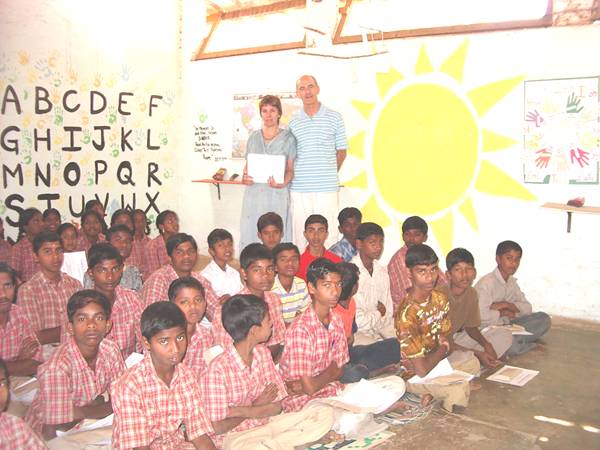
In good end-of-term fashion, we had an arts and crafts last day in each school and used glitter, glue, crayons, coloured paper and tissue paper to make shapes, posters, etc. We decorated the reading rooms with all the work and they looked very colourful. The children, both boys and girls, loved doing this as they don�t normally have an artistic outlet at age 14 � 16.
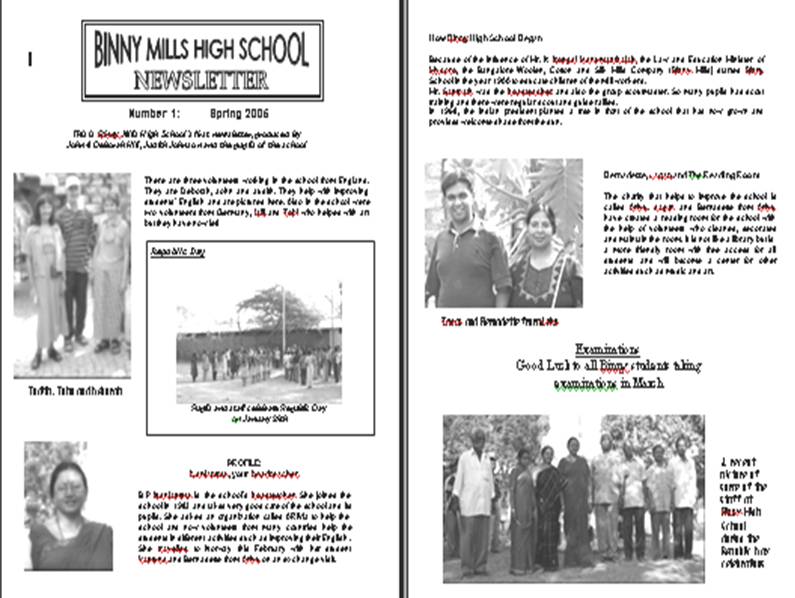
The newsletter (see below) we produced (sadly without any contributions from pupils who, whilst grasping the concept, didn�t have sufficient English to put articles together and the interpreter we booked was unable to come) was finished and presented.
We wrote up our lesson plans and a report for Peace Child / Arivu.
At Binny High School, we left the day before they began exams. For 8th and 9th standard, these were internal year-end exams. 75% attendance over the year is required to enter the exams and 35% marks needed to progress to the next year. Hence the wide range of ages in each class. The 10th standard have state exams.
The school held a Saraswathi Pooja, a study prayer day. Each classroom was turned into a temple decorated with tinsel and paper garlands. The desk became the shrine with pictures of the gods and oil lamps.
The head & other teachers and ourselves visited each class. A coconut was broken as an offering and a prayer said. Then gifts of sweets and bananas were given to us. All the children (and us) had tikka powder put on our foreheads (red dot) and fresh flowers for our hair (except John!). Afterwards, we and the teachers stood in a row and the children knelt on the floor, touched our feet and hands were placed on the children�s heads. This felt very uncomfortable for us. We felt, along with the pooja for success in exams, the children needed to work very hard.
Later we visited the home of one of the pupils in the slums. We walked from school across the dusty wasteland, over the railway line, through rubbish tips, piles of cow dung, swarms of flies (a desparate place) to Usha�s home. 5 of the family share share one room (like a small hallway), a bedroom with one large shelf and some rolled up mattresses as a bed, a few shelves, one cupboard and a kitchen with a 2 burner bottled gas cooker, plastic pots and stainless steel utensils. The water is stored in a large barrel and is collected from outside. Most parents of these children do not value education and therefore many of the children do not either. They are streetwise, however, and, if they get a job, earn about Rs2,000 per month (25 pounds). According to one of the teachers, they are satisfied if their basic needs of food and shelter are met.
We were then kindly taken out to lunch by the head, along with the staff to thank us for the work we had done. Our Arivu colleagues also invited us to lunch an a separate day and Deborah received a silver bangle as a memento.
It will be a real wrench for us to leave India and Bangalore particularly. The young people we have got to know have been so enthusiastic and loving. We wonder how their lives will turn out and what will become of them all. We have met wonderful people doing extraordinary things for others and have enjoyed unprecedented hospitality. We learnt a lot, achieved a lot and have risen to many challenges, which, of course, was the reason for coming here. We�ve enjoyed ourselves a great deal.