The Leaf Frogs
The Leaf Frogs are probably our favorite frog group; it is so hard to come up
with a favorite. We have kept and bred Red-Eyed Leaf Frogs (Agalychnis
callidryas) for about 5 years now and they still amaze us every time they start
to move around from their normal, bump on a leaf state. Few animals can
rival the collection of colours distributed throughout this beautiful
frog. Although all of the leaf frogs are nocturnal, which makes them
difficult to observe, they all have a character about them which makes them very
welcome additions to our group. We have many different leaf frogs and
their relatives, not all are pictured here yet, but most will be soon.
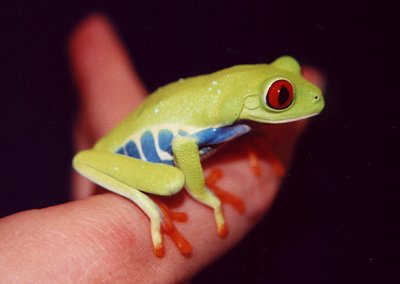 Red-Eyes
are wonderful frogs, they are vividly coloured (giving them an almost unreal
look) and fairly easy to keep if you
get healthy individuals. The biggest problem is that these frogs, like all
of the other leaf frogs, come in very weak and susceptible to almost anything
that they happened to pick up on their travels. They often come in with a very high parasite load. Often you will get what are called
"farmed frogs" this is NOT the same thing as captive bred. Farmed Red-Eyes are not much different than wild-caught, they have
been confined to an area in the jungle where they occur naturally and fenced
in. This effectively confines the progeny so that they can be easily caught.
We have found that these frogs arrive in worse condition than the true wild caught.
You can generally tell which you are getting by their size: if all of the
frogs are the same size, then they are probably farmed, if you can
positively make out males and females (the females are much larger than the
males) then likely they are wild caught. Until you get better at sexing
leaf frogs this can be hard to do, it can be difficult to separate out groups of
males from groups of juveniles. The ideal situation is to get captive bred individuals,
and these are becoming widely available in North America, but if you cannot, it is best to treat your frogs as soon as
you get them for the multitude of parasites and bacteria that they are probably
carrying around
with them. Contact a vet which is familiar with Herp. care.
Red-Eyes
are wonderful frogs, they are vividly coloured (giving them an almost unreal
look) and fairly easy to keep if you
get healthy individuals. The biggest problem is that these frogs, like all
of the other leaf frogs, come in very weak and susceptible to almost anything
that they happened to pick up on their travels. They often come in with a very high parasite load. Often you will get what are called
"farmed frogs" this is NOT the same thing as captive bred. Farmed Red-Eyes are not much different than wild-caught, they have
been confined to an area in the jungle where they occur naturally and fenced
in. This effectively confines the progeny so that they can be easily caught.
We have found that these frogs arrive in worse condition than the true wild caught.
You can generally tell which you are getting by their size: if all of the
frogs are the same size, then they are probably farmed, if you can
positively make out males and females (the females are much larger than the
males) then likely they are wild caught. Until you get better at sexing
leaf frogs this can be hard to do, it can be difficult to separate out groups of
males from groups of juveniles. The ideal situation is to get captive bred individuals,
and these are becoming widely available in North America, but if you cannot, it is best to treat your frogs as soon as
you get them for the multitude of parasites and bacteria that they are probably
carrying around
with them. Contact a vet which is familiar with Herp. care.
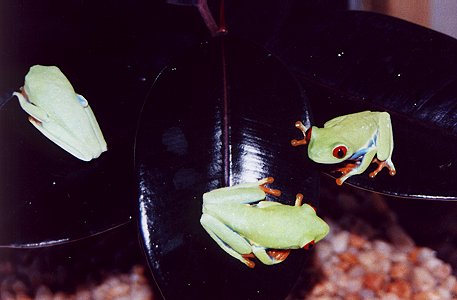 Once
acclimated, Red-Eyes look great in a well planted aquarium, their only drawback,
and this is true of all of the leaf frogs, is that they are fully nocturnal, which makes them very difficult to see.
During the day they look like green gobs of gum stuck to the plants and aquarium
walls.
Once
acclimated, Red-Eyes look great in a well planted aquarium, their only drawback,
and this is true of all of the leaf frogs, is that they are fully nocturnal, which makes them very difficult to see.
During the day they look like green gobs of gum stuck to the plants and aquarium
walls.
Observe the Leaf Frog Life Cycle
with pictures of our own Red Eyed Tree Frogs Breeding and close up pictures of
the development of the eggs and tadpoles.
In general, leaf frogs require a well planted aquarium with it's size in
height rather than length. The smaller frogs do not need all that much
space but we really believe that overcrowding causes stress levels to rise and
this can lead to the death of your animals. The starting size in our
opinion should be a 15-20 gal. aquarium for a max of about 6 frogs. These
frogs are delicate animals, they require clean water and careful attention
must be given to their temperature and humidity requirements. Red Eyes and
the Tiger Leg (Phyllomedusa tomopterna) require higher humidity than many
of the other common leaf frogs, the other Tiger Leg (Phyllomedusa
hypochondralis), can also be called Jaguar frogs, tend to come from
savanna-like areas, and thus require lower humidity and higher
temperatures. The true Monkey frogs, Phyllomedusa bicolor
and P. sauvagii require very high temperatures, which should range into
the high 80's low 90's in a basking area. Temperature is very
important for all reptiles and amphibians, these animals do not produce
their own heat the way we as mammals do, instead they rely on their
surroundings to provide the heat necessary for their bodies to work
properly. Failing to provide enough heat or providing too much heat means
that these animals cannot digest properly, their bodies don't function properly
and this all translates into stress. The monkey frogs also come from very
arid areas, and thus should not be excessively misted down, and their relative
humidity should be kept low.
Next to the Red Eyes, another really cute Leaf Frog is the Tiger Legged Leaf Frog, there are
actually two different species known commonly as Tiger Legs, they are Phyllomedusa
tomopterna and P. hypochondralis, we have both of them but I only
have a photograph up of one: P. tomopterna.
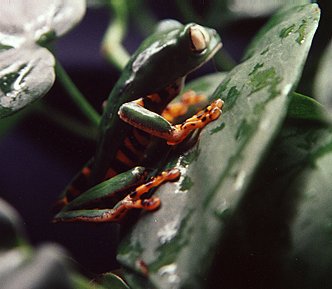 This is one of our little male P. tomopternas, these frogs are smaller than
the Red Eyes, and a lot thinner. P. hypochondralis are smaller
still hitting a max of about 5cm in length, whereas a large female P.
tomopterna will be around 7 cm. The two species are easy to tell
apart: the stripes on P. tomopterna are generally more distinct and
alternate down the sides and legs of the frog, for P. hypochondralis, the
stripes are distinct on the legs but tend to turn into a dust like pattern on
the sides of the frog. This distinction will be easier to see once I have
a picture of P. hypochondralis up. Another feature to look at in separating
the two is in the presence of a calcar on the heel of P. tomopterna.
A calcar is a flap of skin which extends out from the leg at the point of where
the heel would be.
This is one of our little male P. tomopternas, these frogs are smaller than
the Red Eyes, and a lot thinner. P. hypochondralis are smaller
still hitting a max of about 5cm in length, whereas a large female P.
tomopterna will be around 7 cm. The two species are easy to tell
apart: the stripes on P. tomopterna are generally more distinct and
alternate down the sides and legs of the frog, for P. hypochondralis, the
stripes are distinct on the legs but tend to turn into a dust like pattern on
the sides of the frog. This distinction will be easier to see once I have
a picture of P. hypochondralis up. Another feature to look at in separating
the two is in the presence of a calcar on the heel of P. tomopterna.
A calcar is a flap of skin which extends out from the leg at the point of where
the heel would be.
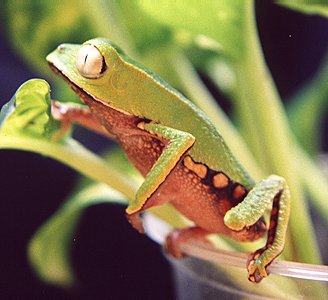 Phyllomedusa vaillanti is also a leaf frog, it is sometimes named the
Razor-Back Leaf Frog because of the fairly sharp lateral folds down each
side. Like most of the leaf frogs, it's sides are distinctly pattered,
only not with stripes; these guys have orange circles, surrounded by and
connected to each other by a beep burgundy background. They are quite cute
and are similar in size to the Red Eyes.
Phyllomedusa vaillanti is also a leaf frog, it is sometimes named the
Razor-Back Leaf Frog because of the fairly sharp lateral folds down each
side. Like most of the leaf frogs, it's sides are distinctly pattered,
only not with stripes; these guys have orange circles, surrounded by and
connected to each other by a beep burgundy background. They are quite cute
and are similar in size to the Red Eyes.
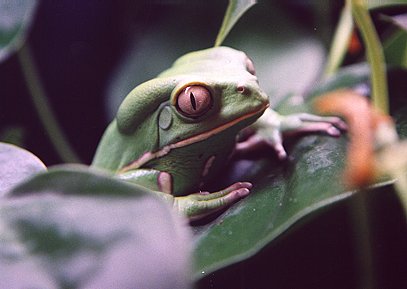
The Chacoan Waxy Monkey Frog, P. sauvagii is a beautiful frog, this species,
along with the Giant Monkey frog (P. bicolor), are the major members of the what
we call the Waxy Monkey Frogs. These frogs hop very little, they
dominantly walk through the forest in a hand over hand motion. They are
called monkey frogs because they have an opposable thumb which gives them the
ability to grasp things easily.
 These
frogs are native to very arid conditions, generally amphibians loose water
through their skin very quickly and would dehydrate and die under dry
conditions. But many frogs have developed ways of dealing with these
difficult conditions. The Waxy Monkey Frogs secrete a wax out through
their skin and then rub this over their bodies with their feet. This has
the effect of making the skin waterproof, by doing this they reduce the amount
of water that they loose to the atmosphere through their skin and are able to
maintain themselves under dry conditions.
These
frogs are native to very arid conditions, generally amphibians loose water
through their skin very quickly and would dehydrate and die under dry
conditions. But many frogs have developed ways of dealing with these
difficult conditions. The Waxy Monkey Frogs secrete a wax out through
their skin and then rub this over their bodies with their feet. This has
the effect of making the skin waterproof, by doing this they reduce the amount
of water that they loose to the atmosphere through their skin and are able to
maintain themselves under dry conditions.
Above is a picture of one of our female P. sauvagii's, we also have P.
bicolor's but I do not have a good picture of them yet. These two
species are really nice frogs to keep: they are very large, P. bicolor is one of
the largest tree frogs; because of their dry skin, the walls of the aquarium
stay quite clean for a long time which is rare with most tree-frogs; and they
feel very different, their dry waxy skin makes them feel like no other frog,
they don't feel slimy at all.
Back to Frog Page
Home