
Daylilies have come a long way since the early hybrids of Stout. No longer are we limited to the yellows, golds and oranges of yesterday's cultivars. Today's hybrids are in almost every colour except true Blue, and come in numerous petal forms including frilled, ruffled and pie crust. Colour combinations with eyed, haloed, watermarked, and edged petals makes the combinations of traits and colours infinite. It is for these reasons that the Daylily has become as popular as it is; coupled with the fact that except for true lilies, there is very little else which adds colour to the garden late in the summer the way Daylilies do.
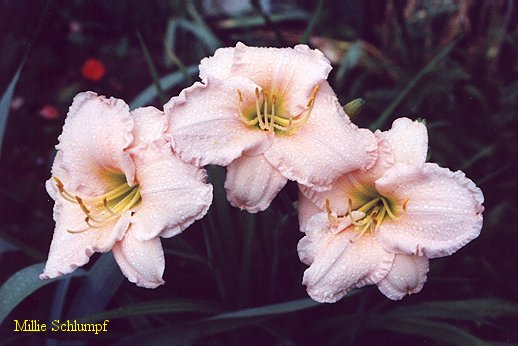
We have a small collection of Daylilies, last time I took a count we were at about 125 (125 is not as many as you would think it is).
 If you are new to Daylilies, it is best to purchase plants off of someone in
your area, these plants have become accustomed to the weather conditions
as well as the winters that your location experiences. The next best thing
is to purchase plants (cultivars) which you know are grown by people in your
area. We have purchased plants from Florida to Ontario (and many locations
in between), every purchased plant has survived, but there are some ways
to help them through their move. Most suppliers will ship plants in either
the late fall or early spring, if you are purchasing plants from the southern
States, it is best to get them shipped in the spring (Remember spring for us is
blooming season for them, well not quite but close). There are a few
reasons for a spring shipment; the main one is that most places fertilize their plants, and
since the growing season is not over in the south when we here in the north need
our plants, we get our new plants in active growth, which in itself is not too
bad, but because these plants have not experienced a hard winter, that existing
tissue is does not cope with the winter well. By purchasing plants in the
spring, the plants have a whole season to recover and put out new growth for the
upcoming winter. Dormant, semi-evergreen and evergreen, I do not think
that it matters, what makes or breaks a plant here in the North is how it
behaves in our winters and springs. In most cases I do not believe that it
is the winter that kills our plants, it is the spring. Early, full thaws
coupled with late hard freezes does a huge amount of damage to a plant, and a
plant which speeds into growth the first sign of spring, only sets itself
up for a nasty freeze. The easiest way to try to avoid this, is to
mulch.... a lot. At least 6 inches of mulch laid over the crown and
surrounding root area will go a long way to slow down that early spring growth,
once you are certain that the threat of a late freeze is gone you can push some
of the mulch away from the crown to help things warm up faster, but don't remove
it, once the plant is growing strong put it back around the roots, it will be
helpful in late summer when the rains have stopped and the moisture content of
the soil is low. Some people say that they don't want to fuss around
their plants like this, they don't have the time or motivation, what I and
others have found is that for many if not most cultivars, after you have done
this for a few years with newly acquired southern grown stock, it is no longer
necessary. The plants will adapt to the conditions in which they are
placed, so long as they survive the first few winters, this is the logic and benefit
behind
purchasing a specific cultivar from a locally grown plant as apposed to one from
a very different temperature zone.
If you are new to Daylilies, it is best to purchase plants off of someone in
your area, these plants have become accustomed to the weather conditions
as well as the winters that your location experiences. The next best thing
is to purchase plants (cultivars) which you know are grown by people in your
area. We have purchased plants from Florida to Ontario (and many locations
in between), every purchased plant has survived, but there are some ways
to help them through their move. Most suppliers will ship plants in either
the late fall or early spring, if you are purchasing plants from the southern
States, it is best to get them shipped in the spring (Remember spring for us is
blooming season for them, well not quite but close). There are a few
reasons for a spring shipment; the main one is that most places fertilize their plants, and
since the growing season is not over in the south when we here in the north need
our plants, we get our new plants in active growth, which in itself is not too
bad, but because these plants have not experienced a hard winter, that existing
tissue is does not cope with the winter well. By purchasing plants in the
spring, the plants have a whole season to recover and put out new growth for the
upcoming winter. Dormant, semi-evergreen and evergreen, I do not think
that it matters, what makes or breaks a plant here in the North is how it
behaves in our winters and springs. In most cases I do not believe that it
is the winter that kills our plants, it is the spring. Early, full thaws
coupled with late hard freezes does a huge amount of damage to a plant, and a
plant which speeds into growth the first sign of spring, only sets itself
up for a nasty freeze. The easiest way to try to avoid this, is to
mulch.... a lot. At least 6 inches of mulch laid over the crown and
surrounding root area will go a long way to slow down that early spring growth,
once you are certain that the threat of a late freeze is gone you can push some
of the mulch away from the crown to help things warm up faster, but don't remove
it, once the plant is growing strong put it back around the roots, it will be
helpful in late summer when the rains have stopped and the moisture content of
the soil is low. Some people say that they don't want to fuss around
their plants like this, they don't have the time or motivation, what I and
others have found is that for many if not most cultivars, after you have done
this for a few years with newly acquired southern grown stock, it is no longer
necessary. The plants will adapt to the conditions in which they are
placed, so long as they survive the first few winters, this is the logic and benefit
behind
purchasing a specific cultivar from a locally grown plant as apposed to one from
a very different temperature zone.