
Created : 27 april 2002
Last updated : 02 may 2002
Classification : General analysis
Copyright : Restricted freeware
Status : Being constructed
Comments : The info given here may be subject to change; to do : price info

Now the "How to make a gennaker setup" can be found on another page on this page as well as other pages about things like :"How to make a simple and cheap spi hound for your mast". So this leaves the weight issue and the cost of the more general parts. This page will give answers to any question that a sailor, looking to upgrade to a Formula 16 by adding a spi, may have.
The prices will be added later, but for now it should suffice that the setup given
costed 953 Euros ( 840 US$ / 1555 Aus$) and after 2 years of beating it up, it is still going strong
If indeed a question is not answered in this page about the weight and cost of a gennaker setup than you are sure to get one on our online forum.
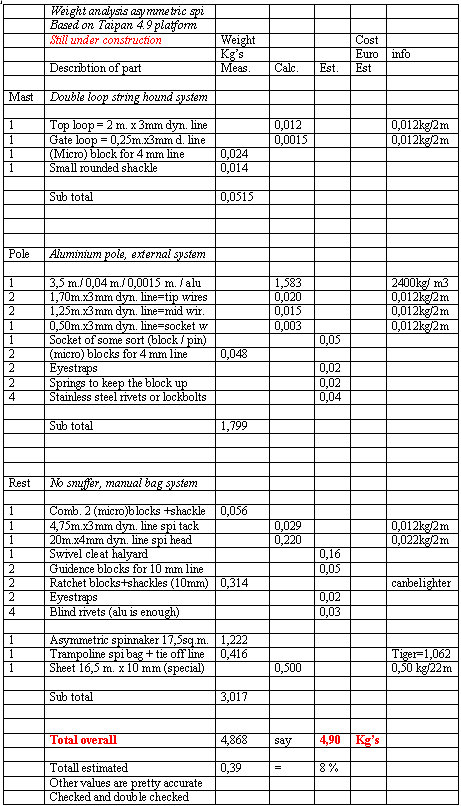
The listing given is compiled by grapping all the gear togther and walking over to the electronic scale in the local supermarket. There it is used to weight the vegetables and other goods. As it is commercially used, these scales are well calibrated and checked by the national authority. These electronic scales are accurate to the gram. More than accurate enough for weight a spi gear.
The setup that was weight was by no means a no expenses spared setup. At the time it was made, the main concerns were cost, durablilty and simplicity. Just a few examples :
-1- A normal (heavier) cloth was chosen reasons in order of consideration : durability and I didn't see the necessity to spend more on my first spinnaker.
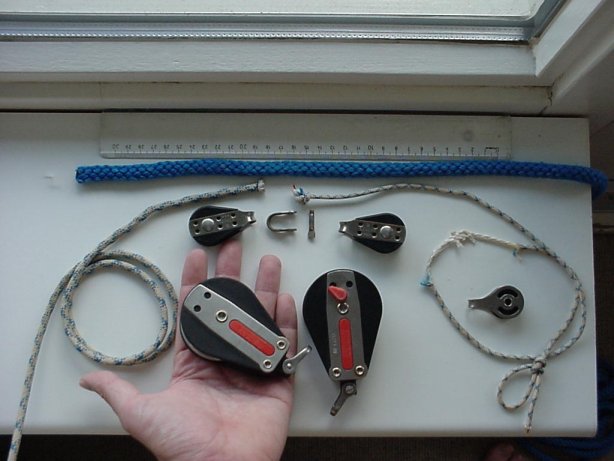
-2- The ratchet blocks (75 mm sheave diameter) are really a bit to big (and to heavy) than needed. I also use a 10 mm diameter line as a spi sheet. Several brands have now ratchets blocks that are considerable smaller that run up to 8 mm line. My 10 mm sheet line is however of a very special make and I haven't encountered any other line that is lighter per mtr. despite the fact that their were often of a smaller diameter.
-3- My halyard lines (both tack halyard and head halyard) are a little bit on the thick side to at 5 mm diameter. Dyneema line of 4 mm is more than enough and even 3 mm will function although than it is nice to wear sailing gloves to prevent painfull hands.I measured the 4 mm line I had and put that in the table instead of the 5 mm line that is actually used.
-4- The other blocks used are rather large too as they had to allow 5 mm diameter line running through them. Microblocks for 4 mm line would be perfect and probably just as expensive.
Things that are pretty on the max are :
-1- The aluminium pole is pretty much on the limit. It functions just fine but it needs to be supported in the middle. Without these supports the boom has a slight tendency to bend upward in force 5 and higher conditions. However, the two dyneema lines of 3 mm to the middle of the pole are enough stabilize the pole again. So 1,6 kg's for the aluminium spinnaker pole which two 0,0075 kilogram lines is what is reasonable without being fragile. Any bigger would only add weight. Boats that are alot bigger or have considerable longer poles might want to opt for the 2 mm thick tube of the same diameter.
-2- The 10 mm spinnaker sheet measured is pretty darn optimal. It feel unbelievably light for it's volume (10 mm diameter !!! ) and the best of it is that it doesn't absorp water. It is more plastic than dyneema but still doesn't burn the hands. When I find out what it trully is than I will tell you all immediately.
What can we make lighter (in order of effectiveness) :
-1- Carbon spi pole. The ratio of density of carbon/epoxy laminate to aluminium is roughly 60 %. So going carbon will win you 1,583 * 40 % = about 0,60 kg's. Could be a little expensive ; Aluminium pole typicially costs 16 Euros / 14,50 US$ / 26 Aus$
(setup becomes = 4,3 kg's)
-2- Smaller and lighter blocks. Opting for smaller and much nicer automatic ratchet blocks and smaller microblocks for 4 mm line; will win you an estimated 150 grams. Shouldn't cost alot more than the larger blocks.
(setup becomes = 4,15 kg's)
-3- Opting for the lighter spinnaker polyester. It also flies better than nylon in flat water, but also rips out over a meter when a normal nylon rips only 0,1 mtr. Will win you an estimated 200 grams. (will be double checked) Extra costs are pretty small, that is unless unless you keep ripping them up.
(setup becomes = 3,95 kg's)
-4- Remove the protective shielding of the halyards, This is seen on Intl. Tornado's and several skiff designs. The sailors just remove the tough outer shielding that encloses the fibres on the inside. On a F16 you can do that over about 8 mtr. and win about 80 grams.
(setup becomes = 3,87 kg's)
-5- Use a lightweigh cam cleat instead of the swivel cleat ,won't like that from a handling point of view. Anyways this will win you an estimated 50 grams.
(setup becomes = 3,82 kg's)
And that is about it. Opting for smaller lines or sheets is not really an option; you'll only be winning grams to the expense of your valuable hands. How much inconvience will you be willing to trade-off for say a 150 grams ?
-1- Sheet 8 mm dyneema line coz the store didn't have anything else cheaper => adding 0,150 kg's
-2- Halyards all 5 mm dyneema line, because that was available and cheap => adding 0,025 kg's
-3- You'll be flying an old 21 sq. mtr. spi for an adrenaline run fun now and than => add 0,245 kg's
-4- You think "pole is to weak for this spi and 6 bft. wind" ; wall thickness up to 2 mm => 0,500 kg's
-5- The parts in the other listing were already to big and chosen because they were cheap => 0 kg's
With this the heavy duty and cheap setup comes out at :
4,90 + 0,150 + 0,025 + 0,245 + 0,500 + 0,000 = 5,82 kg's = say just less than 6 kg's.
6,0 kg's for a heavy duty and cheap setup ; achieving this weight or less is not difficult.
5.7 kg's for a pole snuffer setup as measured by a F16 group member with such a system.
4,9 kg's for a bag on the trampoline setup with smart but robust components / aluminium pole
4,0 kg's (about ..) for carbon pole with a bag on the tramp system and other lightweight goodies.
Option 1 to 3 can easily be build at home by an amateur using only a drill, screwdriver and small pliers. All the components listed were readily bought in sailing stores and the local hardware store apart from the carbon pole.
The asymmetric spinnaker was ofcourse ordered from a sailmaker as was the spi bag. The building of the setup of 4.9 kg's took about 4 hours but that was more the result of figuring out how to do it at the same time.
Far more time will be invested in finding the optimal trim of the spi. So good luck with the new learning curve that you've just added to your boat next to 4.9 kg's !!!