
Created : 18 june 2001
Last updated : 6 december 2001
Classification : General analysis
Copyright : Restricted freeware
Status : Pictures added. Being updated continiously
Comments : Looking for more designs to grandfather in. If you know any please mail to [email protected]

The first four boats presented in this document are found to be able to comply to the rules without any, or only small, modifications. The others maybe be capable of becoming a F16HP too but they might need more extensive modifications or we're still investigating them. A few of these are also described in this document.
Catamarans that are / have been investigated : Stealth (EU), Bim F16 (EU), Taipan 4.9 (Aus), Spitfire (EU), Cirrus Energy (EU), Mystere F16 (EU), Isotope (US), Poison Oak (US), Hardcore 16 (US)

The Grandfather rule can be divided into three main categories :
-1- Existing designs which are grandfathered in as fully compliant with all F16HP rules and are called "foundation boats". No limitations with respect to racing will be put on these designs. Examples : Taipan 4.9, BIM F16 and Stealth. These boat form, together with true F16 HP's, like the Stealth F16, the F16 HP fleet.
-2- Existing designs which are only compliant with a subset of the whole F16 HP rule framework. However, these boats are equal in handicap number to F16 HP. Limitations with respect to racing these designs are that they can't be raced for a specific F16 HP class prize when they are not in full compliance mode without a (class wide) dispensation from the F16 HP authority. These boats form, together with the F16HP fleet from point -1-, the OPEN F16 HP fleet. Examples : the Swell Catamaran Spitfire.
-3- Equal performance class grandfathering. This encloses all designs that are modified to have the same handicap rating as the F16HP class (which is equal to the F18 rating). These boats were effectively already sailing one-design like with both the F16 HP and F18 classes in handicap races and are now able to enter OPEN F16HP races. These designs are however disallowed to compete for national and international titles, but that is logical. Example : modified Nacra 5.5 uni, modified Nacra 5,2

The Taipan 4.9 is the result of many years of experimenting with A-cats by its designers, Jim Boyer and Greg Goodall who also produce the very successful Auscat "A" class catamarans. It's design is already more than ten years old and it still is a very hard (16 foot) boat to beat. This is a good indication that the designers have been able to strike a near optimal balance within the limits of a 16 foot platform. It was this aspect and the fact that it is so comparable to the Bimare F16, that this design was used as a basis for the F16 HP framework. Later the Stealth was found to be in the same leaque and the begin of a true multimanufacturer Formula class was made.
The Taipan 4.9 can be bought in three continents (Australia, America, Europe) and is also available as a home buildable timber (tortured plywood) design.
For more information on this boat go to :
www.boyer-fibrecraft.com.au
www.taipan-sailing.de
www.taipanamerica.com
The specifications are (source www.boyer-fibrecraft.com; www.knwv.texelrating.nl) :
Platform
length : 4,95 m
width : 2,34 m
weight : 105 kg (2-up), 97 kg (1-up) ; class minimum : 102 kg (2-up), 97 kg (1-up)
mast height : 8,5 m
Sail areas
mainsail : 13,7 sq.mtr.
mast : 1,4 sq. mtr. ( Mast & mainsail Texel measurement : 14.58 sq. mtr.)
jib : 4,2 sq. mtr. ( Texel measurement : 4,08 sq .mtr.)
Luff Lengths
mainsail : 8,02 m (Texel measurement)
jib : 4,89 m (Texel measurement)
Texel Handicap (official F16HP system)
The following data was measured by Texel officials and is used in calculating the Texel handicap number:
length : 4,95 mtr.
weight : 105 kg
mast height : 8,5 m
mainsail/mast : 14,58 sq.mtr.
mainsail luff : 8,02 m
jib : 4,08 sq. mtr.
jib luff : 4,89 mtr.
crewweight : 150 kg
2-up TR (105 kg) = 105,82 = 106
2-up TR with genaker (105) = 102,82 = 103
1-up TR (97 kg) = 103,29 = 103
1-up TR genaker (97 kg) = 100,29 = 100
To compare F18 class = 102,62 = 103 (actual boats 103,01 to 103,27 = 103)
ISAF small cat
2-up ISAF (105 kg) = 1,0556 = 1,06
2-up TR with genaker (105) = 1,0211 = 1,02
1-up TR (97 kg) = 1,0474 = 1,05
1-up TR genaker (97 kg) = 0,9916 = 0,99
To compare F18 class = 1,0062 = 1,01
Needed modifications for F16 HP compliance-
1-up:
Adding a genaker setup to the standard Taipan 4,9 and leaving the jib off is enough.
2-up:
Adding a genaker setup to the standard Taipan 4.9
Conclusion : Pretty much ready off the shelf as a F16 HP boat in either configuration when a genaker setup is added. Timber homebuilt option should be just as competitive as the glass dealer version (regatta's in Australia have shown this to be true). Plans available from AHPC. This texel measured Taipan was not even at it maximum as it is allowed in the Taipan 4.9 class rules; the jib luff may be lengthend to max 5,1 mtr and we used 105 kg's instead of the class minimum weight of 102 kg's. The Taipan 4.9 is fast enough to beat the F18's and this is also indicated by wetted surface calculations.

The BIM F16 is currently available to sailors in two continents, the Americas and Europe. The BIM F16 can be purchased with Zuccoli sails, the brand that now dominates the Tornado class due to its high level of workmanship, and also with a carbon mast instead of an aluminium one.
For more information on this boat go to:
www.bimarecatamarani.com
www.sailfastusa.com/bimare
The specs are (source communique Bimare yard; www.bimarecatamarani.com ; www.knwv.texelrating.nl)
Platform
length : 4,96 m
width : 2,28 m
weight : 95 kg / 90 kg = alu / carbon mast (ISAF 103 kg, Texel 110 kg are of older boats)
mast height : 9,0 m
Sail areas
mainsail : 13,8 sq. mtr. EU configuration
mast : --- (already in mainsail)
jib : no jib.
genaker : 12 or 15,6 sq. mtr.
Luff Lengths
Mainsail : 8,60 m (Texel measurement)
Jib : no jib
Texel Handicap (official F16HP system)
The following data was measured by Texel officials and is used in calculating Texel handicap number:
length : 4,94 mtr. (= actual waterline length)
weight : 90 / 95 kg (=carbon mast / aluminium mast, add 7 kg's for genaker equipement)
mast height : 9 mtr.
mainsail/mast : 13,77 sq.mtr. (Texel measurement)
mainsail luff : 8,6 m
jib : ---
jib luff : ---
crewweight : 150 kg (75 kg when solo sailing)
1-up TR (carbon) = 102,57 = 103
1-up TR genaker (carbon) = 99,57 = 100
1-up TR (alu + genaker) = 100,57 = 100
2-up TR (carbon) = 115,86 = 116
2-up TR (carbon + genaker) = 112,86 = 113
2-up TR (carb./gen/ F16 jib) = 102,51 = 103
2-up TR (alu./gen/ F16 jib) = 106,22 = 103
To compare F18 class = 102,62 = 103 (actual boats 103,01 to 103,27 = 103)
ISAF small cat
Insufficient data of daggerboards to calculate ISAF handicap number. The 95 kg Bim 16 will be close to the Taipan 4.9 ISAF rating; the measurements are just to close to have any considerable rating difference.
Needed modifications for F16 HP compliance
1-up :
No modifications necessary when looking at the numbers, BIM 16 alu and Taipan 4.9 are 100,57-100,29 = 0,28 % = 9 seconds in one hour racing apart (Texel). Despite the others weight measured under Texel and ISAF the Bimare yard has assures us that these are old measurements andall 2001 and new Bim F16 are indeed 90 / 95 kg depending on the mast material. The genaker is justa bit smaller but again Bimare assured us that they can supply the genaker / mast to F16 HP specs on request. The BIM is therefor full compliant and up top speed in the 1-up configuration. In fact when a bigger genaker of F16 HP size is requested than this 16 footer is a pure Formula 16 HP design in 1-up mode.
2-up:
The Bimare has communicated to us that they believe that the jib would actually hurt the boats performance and therefor it is not fitted with one. However, both Texel and ISAF do rate it slower, as a 2-up, without it.
If you should choose to fit a jib to the BIM F16 anyway, than a bridle foil setup or Tornado sport like high bridle is advices to reduce stresses on the hulls. A full compliant jib of 3,5 sq. mtr. actual area will do the trick.
It's genaker, again, could be chosen out of the two standard options of 12 sq.mtr. and 15,6 sq. mtr. or a F16 HP size on on request. Bimare yard indicated that on request they can deliver the Bim F16 on F16 specs with a double trapeze supporting carbon mast with a higher genaker hound. For similar costs.
Conclusion : The conclusions are simple and straight forward, The 1-up Bim F16 is right up there with the others and right above minimum weight. The Bim F16 in 2-up mode is subject to which theory you support, nevertheless on request the carbon mast will be made to support the F16 HP genaker and two on the wire just like the other F16's of other builders. This will not affect costs in any considerable way. So in both modes it is full compliant and if I might add at a very attractive price.
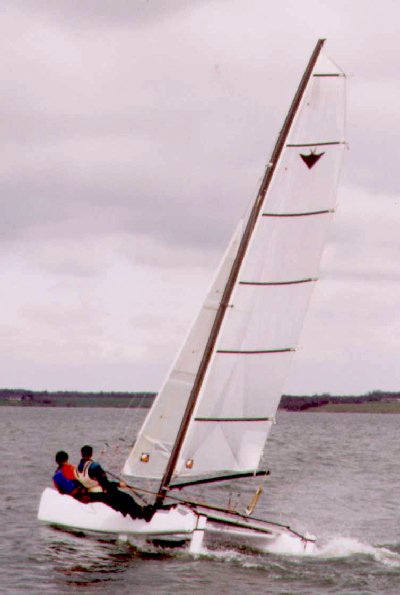
The Stealth is 5.03 meters long and is, therefore, in conflict with the F16 HP rules (it is 0,03 meters too long). But it has been decided to allow this as a grandfathered boat. Apart from this it is fully compliant and can also be sailed solo just like the Taipan 4.9 an Bim 16. This, and the fact that the designers are already getting it up to F18 speed, will make this boat a good (grandfathered) edition into the F16 HP class.
The boat has a carbon mast by Holland Composites and is built by Dave Ovington (who is a well known builder of Lasers, 49-ers, 29-ers and the Musto skiff). The Stealth is an English designed and built catamaran made by vacuum bagging fibre mats and epoxy resin. It's design is continiously being improved and the designers are fully involved in the setup of the F16HP. They have also indicated that they can get quite near to the F16HP minimum weight of 100 kg's with their Stealth design on a production basis.
Latest news : Stealth marine has just announced their new redesigned Stealth F16, it will be fully optimized under the F16 HP rules and will have a higher (8,5 mtr) tapered carbon mast and larger F16 HP sails. It's weight will be right at the F16 HP minimum of 100 kg's (2-up mode). This new Stealth F16 is therefor a pure F16 HP. This Stealth is fully compliant and doesn't have to be grandfathered in ofcourse.
For more information on this boat go to :
www.geocities.com/stealthmarine2002/ (page dedicated to new Stealth F16)
www.stealthmarine.co.uk
The specifications of the non-F16 HP stealth are ( source ; www.knwv.texelrating.nl) :
Platform
length : 5,03 mtr. (Texel measurement)
width : 2,29 mtr.
weight : 117 kg (Texel measurement, ISAF 109 kg's, designers : 100 kg's in reach)
mast height : 8,4 mtr.
Sail areas
mainsail : 14,19 sq.mtr (Texel measurement, includes mast)
mast : unknown . ( Combined Texel : 14.58 sq. mtr.)
jib : 3,38 sq. mtr. ( Texel measurement : or 4,9 sq. mtr. in the R version (webpage))
luff Lengths
mainsail : 7,72 mtr. (Texel measurement)
jib : 4,79 mtr. (Texel measurement)
Texel Handicap (official F16 HP system)
The following data was measured by Texel officials and is used in calculating Texel handicap number.
length : 5,03 mtr.
weight : 117 kg (109 kg's will also also be used in our calcs, ISAF weight measurement)
mainsail/mast : 14,19 sq.mtr.
Mainsail luff : 7,72 mtr.
Jib : 3,38,sq. mtr. (4,9 sq. mtr. in R version)
Jib luff : 4,79 mtr. (5.3 mtr. in the R version)
crewweight : 150 kg
1-up TR (112 kg) = 107,31 = 107
1-up TR genaker (112kg) = 104,31 = 104
1-up TR genaker (100 kg) = 102,02 = 102
2-up TR = 109,84 = 110
2-up TR with genaker = 106,84 = 107
2-up TR with genaker (109kg's) = 105,76 = 106
2-up TR with genaker (100kg's) = 104,52 = 105
To compare F18 ; = 102,62 = 103 (actual boats are 103,01 to 103,27 = 103)
ISAF small cat
2-up Stealth = 1,07
2-up Stealth R = 1,02
To compare ; F18 = 1,01
Needed modifications for F16 HP compliance
1-up
The Stealth at 112 kg's is not really up to speed as a single hander but when it gets near to the 100 kg weight is will be very close to the BIM 16 and Taipan 4.9 1-ups. A longer luff main on the same mast can make the 100 kg's Stealth equal to the other two. The mast at 8,4 mtr. is long enough to allow a longer luff main. An increased of the luff by 0,3 mtr. will bring the standard Stealth right at a rating of 100,00 and be faster than the Taipan 4.9 1-up. When the standard Stealth is 109 kg's than the same modification will put the Stealth just 1 % behind the BIM 16 1-up and 1,3% behind the Taipan 4.9 1-up. This is a mere 47 seconds in one hour of perfect racing. And that is quite small in 1-up genaker sailing; if not neglectable.
Ofcourse the new Stealth is fully optimized under F16 HP rules and needs no modifications.
2-up
The Texel measured standard Stealth is fast but not fast enough, but as the designers indicated there are some mods that will make it considerable faster. The R -version of the Stealth is almost there with a near perfect match at 102,67 when the boat weights the full 117 kg's. It must be stressed however that this is the result of the very large jib which loses effectiveness when flying a genaker. This jib will probably also violate the maximum size rule of the F16 HP framework. So lets look at the 109 kg's version as measured by ISAF. Now it has a rating of 102,96 when flying the F16HP maximum allowed grandfathered 4,25 sq.mtr. jib. This is just slower than the F18 class rating but faster than the Inter 18 and Hobie tiger. Very acceptable, no more mods needed.
Ofcourse the new Stealth is fully optimized under F16 HP rules and needs no modifications.
Conclusion : The Stealth as a whole comes quite close to a thoroughbred F16 HP, especially considering that it was designed with a genaker in mind. The designers's interest in making it as fast as the F18 class makes this boat a great candidate for the F16 HP class. However, its 1-up performance needs a boost and it needs to loose weight for that. It's 2-up R-version is up to speed but has a jib that is really too large for the F16 HP framework. Going lighter will correct this fully. A candidate for sure and maybe even the first true F16HP with its carbon mast and designed genaker. The new Stealth will be a pure F16 HP and that is all that needs to be said about this new Stealth.

For more information on this boat go to :
http://www.swell-catamarans.com/
The specs are (source http://www.swell-catamarans.com/ and ISAF measurement sheet) :
Platform
length : 4,98 mtr.
width : 2,50 mtr.
weight : 139 kg' s
mast height : 8,30 mtr. (Estimate based on luff length)
Sail areas
mainsail : 15,45 sq.mtr.
mast : ? sq. mtr. (Already in mainsail area)
jib : 4,45 sq. mtr.
Luff Lengths
mainsail : 7,90mtr. (estimate)
jib : 5,43 mtr. (estimate from Texel measurement of Prindle 16 - same mast height)
Texel Handicap system
The following data is taken from Texel measurement sheet and used in calculating Texel handicap number.
length : 4,96 mtr.
weight : 135 kg
mainsail/mast : 15,85 sq.mtr.
Mainsail luff : 7,9 mtr.
Jib : 4,64 sq. mtr.
Jib luff : 5,53 sq. mtr.
crewweight : 150 kg's / 75 kg's
Notice that these measurements are larger then supplied by the builder and as used in the ISAF system
1-up TR = 107,79 = 108
1-up TR genaker = 104,79 = 105
2-up TR = 106,40 = 106
2-up TR with genaker = 103,40 = 103
To compare F18 class = 102,62 (actual boats are 103,01 to 103,27 = 103)
ISAF small cat system
2-up genaker = 1,04
To compare F18 = 1,01
Needed modifications for F16 HP compliance
1-up :
The Spitfire is given four points less than the the fastest 1-up F16HP's when using the Texel handicap estimation. It will therefor be a little slow in the 1-up configuration but it is still close enough to be grandfathered in. Only way of making the 1-up Spitfire more equal to the other F16HP's is to make it lighter. The mainsail is in violation of the mainsail rule and therefor nothing can be done here.
2-up :
In the 2-up configuration the Spitfire comes at exactly the same handicap number as the F18 class and ofcourse the other F16HP's. However, It falls outside the F16HP framework on three accounts, mainsail area, jib area and genaker area (18 sq.mtr). The Spitfire will therefor not be a compliant boat, but because it is very comparable to the other boats the Spitfire has been voted in as a grandfathered boat; under the condition that the specs are not changed. The Spitfire can however always be raced in the Equal Performance Group with it's rating of 103. It will be part of the OPEN F16HP class.
Conclusion : The Spitfire by Yves Loday and Reg White is grandfathered into the F16HP. Owners are therefor allowed to participate in future open F16HP races with their Spitfires when it is at the specs given here. We are looking forward to welcoming them to the formula for the performance potential will keep sailors sailing the other brands sharp. It must be noted however that the specs differ from sourse to source, clarity must be attained before the sailors are given a start permit.

For more information on this boat go to :
http://www.mulder-catamarans.nl/mystere.html
The specs are (taken from source http://www.mulder-catamarans.nl/mystere.html ) :
Platform
length : 5,03 mtr.
width : 2,50 mtr. (or 3,0 mtr with wings making it effectively 2,75 mtr. wide.
weight : 155 kg's
mast height : 8,50 mtr. (Carbon mast)
Area's
mainsail : 16,0 sq.mtr.
mast : ? (assumed to be included in the mainsail area)
jib : 3,40 sq. mtr.
luff Lengths
Mainsail : 8,10 mtr. (estimate)
Jib : 5,00 mtr. (estimate)
The following data is estimated and is used in calculating Texel handicap number.
length : 5,00 mtr.
weight : 155 kg
mainsail/mast : 16,0 sq.mtr.
Mainsail luff : 8,10 mtr.
Jib : 3,40 sq. mtr.
Jib luff : 5,00 sq. mtr.
crewweight : 150 kg
1-up TR = 112,86 = 113
1-up TR genaker = 109,86 = 110
1-up TR sloop = 103,87 = 104
1-up sloop genaker = 100,98 = 101
2-up TR = 113,68 = 114
2-up TR with genaker = 110,68 = 111
To compare F18 = 103,01 to 103,27 = 103
Needed modifications for F16 HT complience
1-up :
The Texel handicap calculation predict a performance which is not comparable to the other grandfathered designs. Overall boatweight seems to be the culprit. On numbers we can't make the boat equal.
2-up
The Texel handicap calculation predict a performance which is not comparable to the other grandfathered designs. Overall boatweight seems to be the culprit. On numbers we can't make the boat equal.
Conclusion : The Texel rating mathematical model of performance shows that this boat will have a hard time beating the 110 boundery. Only sailing a fully sloop rigged Mystere KL F16 sailed solo wil put the performance in the same region as the other F16 HP grandfathered boats. This boat is not compliant with the F16HP rules and therefor not a real F16HP races, however it is possible that it is allowed to enter a F16HP race as a grandfathered design. This will be put to the vote.

For more information on this boat go to :
www.wildthing.nl
The specs are (taken from source www.wildthing.nl and Cirrus leaflet) :
Platform
length : 4,88 mtr.
width : 2,40 mtr.
weight : 145 kg's (excl. genaker; when incl. = 150 kg's)
mast height : 8,10 mtr.
Area's
mainsail : 12,0 sq.mtr.
mast : 1,10 (estimated by 0,15*(8,10-0,45)=1.1475)
jib : 3,45 sq. mtr.
luff Lengths
Mainsail : 7,65 mtr. (estimate)
Jib : 5,00 mtr. (estimate)
The following data is estimated and is used in calculating Texel handicap number.
length : 4,88 mtr.
weight : 150 kg
mast height : 8,10 mtr.
mainsail/mast : 13,1 sq.mtr.
Mainsail luff : 7,65 mtr.
Jib : 3,45 sq. mtr.
Jib luff : 5,00 sq. mtr.
crewweight : 150 kg
1-up TR = 118,00 = 118
1-up TR genaker = 115,00 = 115
1-up TR sloop = 106,76 = 107
1-up sloop genaker = 103,76 = 104
2-up TR = 117,23 = 117
2-up TR with genaker = 114,23 = 114
To compare F18 = 103,01 to 103,27 = 103
Needed modifications for F16 HT complience
1-up :
The Texel handicap calculation predict a performance which is not comparable to the other grandfathered designs. Overall boatweight seems to be the culprit. On numbers we can't make the boat equal.
2-up
The Texel handicap calculation predict a performance which is not comparable to the other grandfathered designs. Overall boatweight seems to be the culprit. On numbers we can't make the boat equal.
Conclusion : The Texel rating mathematical model of performance shows that this boat will have a hard time beating the 110 boundery. Only sailing a fully sloop rigged Cirrus Energy solo with genaker wil put the performance in the same region as the other F16 HP grandfathered boats. This boat is full compliant with the F16HP rules and therefor allowed to enter F16HP races, but ofcourse you want a shot at the first place. It has been reported by the builder that the Energy runs downwind with equal speed as his Cirrus F18 and this surprised himself too. Still the current setup seems to be a little lacking with respect to the other grandfathered F16HP's as well as the F18's. Making the Energy at F16HP minimum weight goes a very long way of correcting this. We would therefor very much like to see BCM design a lighter 16 footer which would give it just the extra upwind edge that is needed, because its F18 design is of an exceptional quality.

For more information on this boat go to :
www.intl-fibreglass.com/boatiso.html
The specs are (source www.intl-fibreglass.com/boatiso.html ) :
Platform
length : 4,88 mtr.
width : 2,24 mtr.
weight : 125 kg' s
mast height : 7,93 mtr.
Sail areas
Total must be 185 sq. ft. = 17,21 sq. mtr. (ratio between main and jib is left open) Builder states:
mainsail : 13,02 sq.mtr.
mast : 1,13 sq. mtr. (estimated by 0,15*(7,93-0,43)= 1,125)
jib : 4,19 sq. mtr.
Luff Lengths
mainsail : 7,5 mtr. (estimate)
jib : 4,70 mtr. (estimate from Texel measurement of Prindle 16 - same mast height)
The following data is estimated and is used in calculating Texel handicap number.
length : 4,80 mtr. (= actual waterline length)
weight : 125 kg
mast height : 7,93 mtr.
mainsail/mast : 14,15 sq.mtr.
Mainsail luff : 7,5 mtr.
Jib : 4,19 sq. mtr.
Jib luff : 4,70 sq. mtr.
crewweight : 150 kg's / 75 kg's
1-up TR = 109,55 = 110
1-up TR genaker = 106,55 = 107
1-up TR sloop = 98,66 = 99
2-up TR = 109,42 = 109
2-up TR with genaker = 106,42 = 106
To compare F18 class = 102,62 (actual boats are 103,01 to 103,27 = 103)
We also do need to add some modifications to this boat in order to get it up the F18 speed.
Needed modifications for F16 HT complience
1-up :
That could be a big problem for it's mast is to small to effectively add surface area. There is no jib to play with and the fact that the configuration with jib is different form the other cat-rigged F16HP 1-up designs will make the results of the Texel calculator less accurate. Making the catrigged Isotope 4 points faster is to much to do achieve within the self imposed limits of small modifications. The Isotope that is sailed 1-up as a sloop comes quite close to the intended rating of 100. From a grandfather standpoint it would therefor be better to substitute the genaker for a 3 sq. mtr. jib and allow the Isotope to be sailed sloop when 1-up as is arranged in the class rules. This is however an exception to the F16HP rule for 1-up sailing.
Option 1: allow 3 sq. mtr jib and disallow genaker. Sail 1-up sloop rigged TR = 101,07 =101
This will also keep the Isotope complient with its own class rules.
Option 2 : Use the Texel calculator to make the Isotope catrigged genaker equal to 100,25
The last can be done by sailing it with a lighter than 75 kg's skipper or to make the Isotope lighter. Putting a longer mast on it or a lighter one will help to move the skipper weight back to 75 kg's again. This approach will create a true equal Isotope F16HP but will require heavier modifications which will push the new Isotope out of its on own design class.
2-up :
Now by transfering 1,21 sq. mtr. from the jib to the mainsail (putting it in a square top) the total amount of sailarea will still be satifying the "max sailarea is 17,21 sq. mtr. "rule as is layed down in the Isotope class rules when a smaller jib (3 sq. mtr.) is fitted in Isotope races. An genaker will ofcourse be added. The F16HP adviced combined weight of craft and crew will be set at 250 kg's. Thus a 125 kg's Isotope will have a 125 kg's crew.
mainsail area / jib area/crew = 14,21 sq. mtr. / 4.19 sq. mtr/125 kg's => TR = 105,99 = 106
adding a genaker => TR = 102,99 = 103
This setup will result in :
When F16HT equal to 103 than the minimal cewweight when flying 3 sq. mtr. jib is 107 kg's
When F16HT equal to 103 than the maximal cewweight when flying 4,19 sq. mtr jib is 125 kg's
When F16HT most equal 103 rounded off than minimal cewweight with a 3 sq. mtr. jib is 104 kg's
When F16HT most equal 103 rounded off than maximal cewweight with a 4,08 sq. mtr jib is 129 kg's
In de last case the inequality with respect to F18 is just less of 0.5 % in the extremes, this resembles less than 18 seconds in one hour of racing.
Conclusion : The isotope 1-up sloop as regulated in its own class rules can sail with the other F16HP boats in the same fleet, having more or less the same performance. The handicap number of the F16HP catrigged and the Isotope 1-up sloop are equal so the two boats will sail One-design like in handicap races. When sailing 2-up, the Isotope is F16HP complient when it is sailed with a light crew, around 125 kg's. The weight range that can be equalled by resizing the jib is from 107 to 125 kg's. This boat will therefor prefer lighter crews than the Taipan 4.9, BIM 16 and Stealth but that was also to be expected considering it's lower mast. Main point here is that the Isotope can race as well in the F16HP class as it's own Isotope class with respect to 1-up and 2-up.