|
|
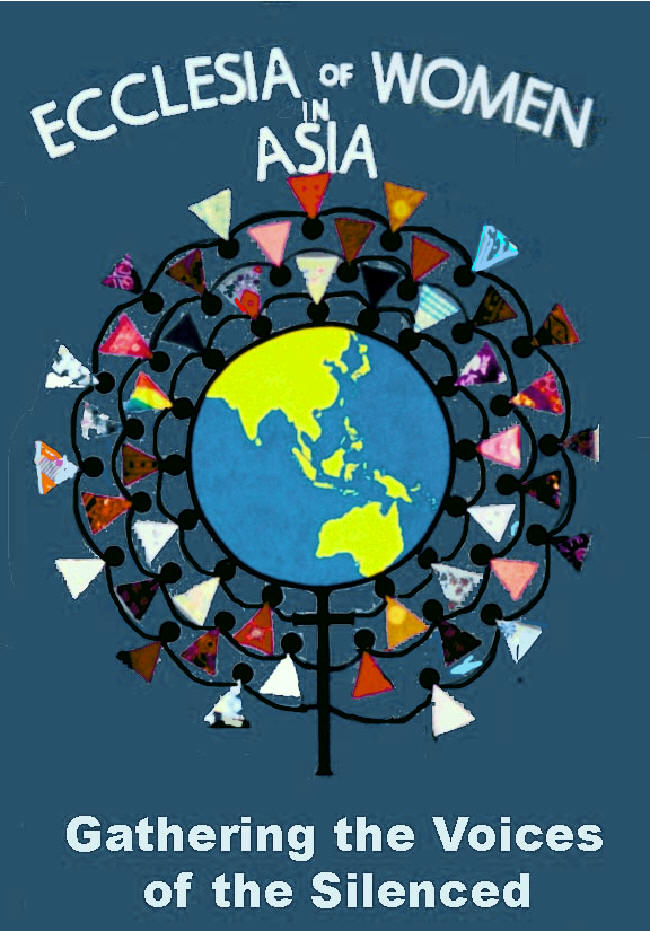
EWA 3, January 2007, Call for Papers “Gathering the Voices of the Silenced” Forum of Asian Catholic Women Theologians EWA II Conference Issue, January 2005 Update
CALL FOR PAPERS/PARTICIPANTS
Reimagining Women, Marriage and Family Life in Asia A 21st cen. Theological Challenge
Third biennial conference Ecclesia of Women in Asia
Venue: Colombo, Sri Lanka Date: January 21-24, 2007
THE ORGANIZING GROUP
Ecclesia of Women in Asia (EWA) is an association of Catholic women theologians in Asia. EWA’s mission is to encourage and assist women in Asia to engage in theologizing that: 1) is inculturated and contextualized in Asian realities; 2) built on the religious experience and praxis of the socially excluded; 3) promotes gender mutuality and the integrity of creation; 4) fosters dialogue with other disciplines and faiths.
This Call for Papers/Participants is extended to all Catholic women “doing theology” in Asia on the grassroot, pastoral and professional level.
THEME AND CONTEXT
In the past two decades, the processes of globalization, as well as, scientific and technological developments have had tremendous impact on women in Asian marriage and families.
· Within the current neo-liberal economic order, some Asian societies have progressed while many experienced further impoverishment. More Asian women now work outside the home both within the formal and informal economy. For women from the poorer sectors, however, seeking work outside the home is not so much a choice but the result of economic pressure to help assure the family survival.
· The increasing gap between societies/nations has resulted to massive internal and external migration in the economically underdeveloped sectors of Asia. Women migrate and leave their family to work in factories or do domestic labor/surrogate parenting in the cities/abroad, or are left behind as single/surrogate parents or as “motherless”/“fatherless”/“parentless” daughters.
· The greater mobility of peoples in general has also led to an increase in intercultural/interfaith marriages. Migrant families in diasporic communities have to deal with clashes between their traditional family practices (e.g. arranged marriages) and the values in the place of immigration which the 2nd generation immigrants have assimilated.
· Due to the shift from a feudal-agricultural to a free market economy, many Asian societies are getting “detraditionalized” as manifested in the breakdown of traditional support systems and care for the elderly and the disabled in the family. This has led to changes in roles of women and men vis-а-vis care of the elderly and the disabled.
· Revolutionary developments in information and entertainment technology are either enhancing communication and fostering family ties or serving as hindrance to family relations as well as posing new challenges to parenting.
· Cultural globalization processes are leading paradoxically to homogenization [read: Westernization and secularization] of cultures on the one hand, and heightened awareness of ethnic identities on the other. A reaction to this homogenizing trend [which some sectors link to the breakdown of “family values”], is the growth of religious and nationalist fundamentalist movements that stress the traditional roles of women within a patriarchal family.
· With more groups asserting their cultural identities and sovereignty, there has been a marked increase in ethnic armed conflicts after the end of the “cold war” resulting to the dislocation of thousands of families.
· Post-modern thinking fostered by a techno-culture, as well as, new liberation movements also provide an open space towards greater visibility of gay/lesbian/bisexual/transgendered relationships which are challenging traditional definitions of family.
· Advances in the field of reproductive technology have now afforded people more choices in the reproductive realm. In some Asian societies, we see the emergence of Double Income No Kids-DINK/Single Income No Kids-SINK families, as well as women choosing to delay marriage or reject marriage as a lifestyle.
· While the increasing affirmation of the equal dignity of women and men and parity in access to education and jobs in many Asian societies have challenged traditional gender roles, domestic violence in various forms and sexual discrimination still occur.
It is within this contemporary and revolutionizing context of Asia that we invite you to reflect and theologize on Women, Marriage and Family Life. In line with the vision of God’s reign, where women are valued as genuinely human subjects in a community of mutual relations, how can we “re-imagine” theologically marriage and family life in Asia in the 21st century?
POSSIBLE TOPICS
Below are just some of the broad questions related to the different fields of theology which you can explore for your papers. Contributors are asked to narrow down or focus on a very specific problematic which is of interest to them.
Moral Theology
1. How are the issues facing Asian families today (e.g. poverty, displacement in context of armed conflicts, “coming-out” of parent/child, new forms of families, etc.) challenging us to rethink/re-appropriate traditional moral principles/positions in social, sexual and reproductive ethics? For instance, how should our “theology of reproductive labor” regard surrogate parenting or employed mothering as well as the single lifestyle? Or how can the Covenant tradition (in the Scriptures and as understood in Asian contexts) shed light on commitments in general, and marriage in particular? Can there be a space in these understandings for “release from commitment?” 2 What are the strengths and weaknesses of the 2004 FABC document, “The Asian Family towards a Culture of Integral Life” in assessing and responding theologically and pastorally to the needs of Asian families today?
Systematic Theology
1. What new images of God/Christ can be drawn from life-enhancing Asian family-related metaphors/experiences? 2. Are there new possibilities of speaking of the Church as a family, in a non-patriarchal way? 3. What new model of Church can be inclusive of interfaith marriages? 4. Can mothering be considered a form of ministry?
Scriptures
What metaphors/passages in Scripture can be recontextualised towards reimagining Asian women in marriage and family life in the 21st century?
Sacraments
1. How should we deal with the question of the sacramentality of interfaith marriages/same-sex unions? 2. What new gender-sensitive life-cycle ceremonies can enhance family life? What new rituals do we need to bless covenants as well as help those healing from tragic situations as divorce and abortion?
Spirituality
1. What forms of spirituality of single/married women are emerging in today’s context (e.g. context of migration or long periods of separation from husband/family, or in interfaith/intercultural families)? 2. In what sense can we conceive of marriage/mothering/singleness as a vocation? While there are vocation/discernment programs for priesthood and religious life, what new programs are needed to promote discernment on married life?
Missiology/History
What can a postcolonial study of missionary/historical archives show about family practices of indigenous groups? Which of these traditional family practices and values promote mutuality and can be appropriated in today’s context?
Pastoral Theology
1. How do Basic Ecclesial/Human Communities respond to current issues/concerns of Asian families and to what extent are they gender-sensitive? 2. What have been the impact of activities of transparochial groups or movements like Couples for Christ, Pro-life and Opus Dei on the family and women in particular? 3. What new forms of Family Ministry (ministry for or by families), that address the effects of patriarchy are emerging/are needed in Asia?
While the theme of EWA’s 3rd biennial conference seems to be focusing on the life experiences of single/married women, we hope even Asian women in religious life can resonate with it as they have been and still are part of a family as grandmothers, daughters, granddaughters, or they continue to be in-touch with these issues in their pastoral work and social service.
IDENTIFICATION OF PAPER PRESENTERS/PARTICIPANTS
Because of EWA’s emphasis on promoting theological research, a fundamental criterion for participation in this conference is the ability and willingness to write and present an original, never before published, and creative theological paper. The deadline for the submission of an abstract of about 300 words is March 15, 2006.
A screening committee then conducts a blind-review of the abstracts to identify those who could be Paper-Presenters, taking into account the following criteria: relevance to the theme, consideration of the Asian contextual perspective, originality of insight, methodology and organization of the planned paper, as well as, representation by country. In terms of methodology, dialogue with feminist theories/other disciplines and faiths is encouraged.
By April 15 or earlier, those who submitted abstracts will be informed if they have been accepted as Paper-Presenter at the conference. All Paper-Presenters are then expected to submit their finished paper (max. of 3,500 words) by October 1. From the full papers, two papers will be chosen for plenary presentation while the rest will be presented in smaller interest groups. They will be informed by October 15.
Non-Asian and Non-Paper presenting Participants
An open invitation is also extended to leading women theologians from other continents who might be interested and willing to come and share their experiences with us. Such guests would limited to at most 10% of the total number of participants and they will not be asked to present a Paper. Intending non-Asian participants are invited to complete the “RSVP, ” minus the abstract submission. Likewise, any others who would like to attend as Non-Paper-Presenting participants), are also invited to submit the “RSVP.” The extent to which we will be able to accommodate Non-Paper-Presenters is subject to space and funding limitations. They (including those who submitted an abstract but not identified as Paper-Presenter) would be notified no later than July 15.
Process of the Conference
The papers will be circulated to all participants, for reading before they arrive for the conference. The conference will consist of plenary and small group sessions and it is hoped there will also be an invited guest speaker. The small group sessions will be a time for peer-review of the papers.
The conference will provide opportunities for expanding our awareness of issues from other Asian countries, input, discussion, prayer and networking. To stimulate interfaith exchange, a few women from other churches and religions will also be invited. The book containing some papers from EWA II will be launched at this conference. Time will be set aside as well for EWA business/organizational matters.
Funding
While we are trying to raise funds to subsidize the plane fare (excluding taxes) of participants especially from poorer countries and dioceses, we have no guarantees about the outcome of this. Therefore, we ask that each intending participant seek funds from their institution (university, seminary, pastoral centre, diocesan office, parish movement, religious congregation, etc.) for their travel expense to and from Sri Lanka. If intending participants can shoulder their own travel expense, it will be more possible for us to support those with greater difficulties. EWA will raise funds to take care of the conference fee of all participants (board and lodging and other local expenses), which will come to about US$150 per person. But we will welcome any contribution, however small, from those who can afford it.
RSVP
Those who are interested in participating in the proposed conference, either as Paper-Presenters or as Non-Paper-Presenting participant, please write in as soon as possible with or without the abstract, preferably by February but no later than 15th of March, 2006.
1. Name 2. Mailing address 3. Tel., Fax 4. Email (essential, since future communication will be via email) 5. Age group: select from (20-39), (40-59) or (60 above) 6. Indicate if you are a lay woman, or to which religious congregation you belong. 7. Profession, occupation, etc. 8. Church organizations, NGO activities, etc. 9. Academic qualification, complete list of publications, etc. 10. A few lines on the context in which you “theologise”. 11. How much can you shoulder for your travel to and from Sri Lanka? (This is absolutely essential so we can know our budget limits.)
Future Correspondence
It would be preferable that correspondence be done via email. Do not even bother to send the hard-copy once an email is sent. If you absolutely do not have access to email, then use the fax.
EWA Coordinating Team
Sharon A Bong, (Malaysia) Agnes M Brazal (Philippines) Andrea Lizares Si (Philippines) Evelyn Monteiro (India) Julia Ong (Singapore) Virginia Saldanha (India) Theresa Tsou (Taiwan)
To allow for centralized coordination, please send all responses to: Andrea Lizares Si (Philippines) Email: [email protected]
|