|
Links to Other Pages:
|
EWA 2004 ECCLESIA of WOMEN in ASIA Website of Asian Catholic Women Theologians, Jan., 2005 Update
Proceedings of the 2nd Conference (15-19 November, 2004, Yogyakarta, Indonesia)
Body and Sexuality: Theological-Pastoral Perspectives of Asian Women based on conference documentation and the articles submitted by Astrid Lobo Gajiwala and Virginia Saldanha
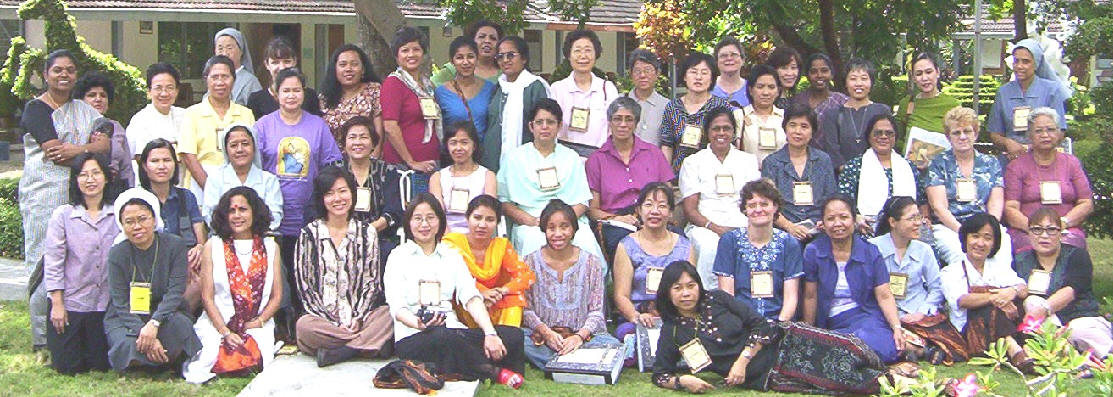
EWA 2. Two years later, the 2nd EWA Conference brought together at the St. Charles Borromeo Sisters' Syantikara House in Yogyakarta, forty-eight women to discuss "Body and Sexuality: Theological Pastoral Perspectives of Women in Asia." The women – religious, single, and married, professors and students of theology, pastoral workers, grassroots workers, ecumenical partners, feminists -- came from Australia, Bangladesh, China, India, Indonesia, Japan, Malaysia, Mongolia, Myanmar, Pakistan, Philippines, Singapore, Sri-lanka, Taiwan, Thailand and Vietnam. Guest participants from the United States, Germany, and Latvia also attended.
Opening Statement In her opening statement, Dr. Agnes Brazal, EWA Coordinator and Professor of Theology at the Maryhill School of Theology, Philippines, invited the participants to explore how body and sexuality have been experienced and constructed in the Asian context, keeping in mind that these constructions were linked with power dynamics that support particular groups". It was the responsibility of EWA, she said, to recover women's stories of the body as a medium of action in the world, and use these stories to reweave the strands of faith handed down to the community. She also expressed the hope that the deliberations of EWA II would find a place in the reflections and pastoral programmes of the Asian bishops who chose to focus on "The Asian Family: Toward a Culture of Life" at the 8th Plenary Assembly of the Federation of Asian Bishops' Conference held earlier this year. Observing that many Asian theologians have "skirted the issue," she described the conference as a "free space" and a "laboratory of ideas" on a topic in which women's voices have long been muted. (Full Text of the Opening Address)
Reactions to the Theme: On the first day of the conference, the participants, the majority of whom were attending EWA for the first time, were asked to share what they found exciting, enlightening, liberating, or puzzling about the theme. Single women in their 20s and 30s said they were uncomfortable when speaking about their body and sexuality. Women over 40 did not have the same difficulty and said the topic was relevant to women's concerns, especially in relation to violence, HIV/AIDS and the family. One said, "My body consciousness exploded when I read the title of the conference and began to think about it." Many participants saw the challenge of mainstreaming a theology of sexuality as one of the tasks for EWA. "We need to put women's sexuality on the agenda and see it as celebration of women's bodies, not just in terms of violence against women." Most were eager to bring the body and sexuality out from under the covers using new interpretations and life-affirming attitudes. Nuns particularly welcomed the opportunity to reclaim their bodies from the asexual spaces assigned to them.
“Body, Self, and Sexual Identity: Reflections on the Current Evidence,”
Dr. Christine Gudorf, award winning author of Body, Sex and Pleasure: Reconstructing Christian Sexual Ethics, and Professor of Religious Studies at Florida International University, U.S.A presented her paper on body, self, and sexual identity. Gudorf drew attention to the dangers of Christianity's negative approach to the human body. "If I am to live in constant suspicion of my body, careful to rein in its every appetite and deaden my ears to its voice, then I will not take seriously the demands that other bodies make on me," she warned. She named this body-denying attitude as one of the roots of the current crisis in the Church around clerical pedophilia, as well as of the silence of the pulpit about violence against women. Going beyond this crippling history, Dr. Christine dwelt at length on postmodernity's insistence that the body is inscribed, in an attempt to make the participants self conscious of how their selves were constructed, and so enable a rebuilding. Is the body the self? Does it have rights? Does the self have complete control of the body, or can the body be transcended in some situations? Can moral rules be based on sexual aspects that are not intrinsic to self-identity? These were some of the compelling questions she chose to answer in a stimulating presentation that drew from science, psychology, culture and the simple experience of being human. (Link to a summary of Dr. Christine Gudorf's paper)
Revisioning Eros for Asian Feminist Theologizing, Some Pointers From Tantric Philosophy”
Dr. Pushpa Joseph, teaching and post-doctoral Fellow in Christian Studies at the University of Chennai, India, linked the creative powers of Eros with the divine energy of Sakti in Tantric philosophy. She proposed a Sakti Theology with its rousing of all the energies one can discover in one's body, emotions and mind, as an alternative to the excessive intellectualism of patriarchal theologies. Based on an egalitarian foundation that recognises both intense connectedness and distinct identity, this Sakti theology advocates 'power with' as opposed to patriarchal 'power over' relationships. The use of Tantric Philosophy to understand and theologize on our sexuality from an Asian feminist perspective brought up many interesting insights, and questions. Among these questions are: “How do we understand human sexuality from the perspectives and traditions of the different dominant religions?” Do we start with Asian anthropologies? Since culture and tradition vary in different parts of Asia, how much do these shape the concept of persons in the different countries? These questions brought into sharper focus the need for deconstruction-reconstruction. We would need to look into cultural and religious stereotypes and scripts that prevent the emergence of Asian women’s perspectives, especially in the context of our Asian reality where Asian traditions celebrate women, yet there is so much violence done to them. Women need to grapple with a lot of questions with regard to their identity.(Link to a summary of Dr. Pushpa Joseph's Paper)
Conference Papers, Authors, and Schedule of Paper Presentations: 16 papers were presented in workshop groups during the first two days. After 20 minute presentations by the authors, members of groups had 45 minutes to discuss the papers. The papers covered a wide range of topics. Hindu Goddesses shared space with a God who can wear high heels. The Buddhist mandala and Lotus flower formed points of reference side by side with the Kama Sutra. The lesbian body with its dialectical tension between sex and gender was used to critique Pope John Paul II’s Letter to Women. Explorations of the Universe as the Body and Womb of God complimented discoveries of an ecological self that is embodied, sacred and relational. The broken bodies and spilt blood of women's Eucharistic lives were used to expose the scandal of a discriminatory communion ritual that prevents those who faithfully set the table from setting the agenda, and to call the Church to justice and healing in the scandal of clergy sexual misconduct. The experience of grassroots women formed an integral part of the discourse. These theologically trained women brought to the fore the disembodiment experienced by migrant domestic workers in Hong Kong and the oppression of women in Myanmar and Pakistan. They also gave centre stage to ageing women, suggesting a spirituality of imperfection that empowers elderly women to embrace new visions of themselves. Two studies allowed Scripture to creatively interact with the faith community. One focused on the metaphorical "woman," the marriage imagery of Ezekiel 16, and how readers in Singapore identified with the characters depending on gender, and the other used the sexuality of Jesus as a counterpoint to explore how small Christian communities in the Philippines experience their sexuality. Scriptural exegesis also looked at the body ethics of Paul in 1 Corinthians, and the body as a language of resistance as expressed in the silent testimony of the women in John 19:25. (Link to page 1 of the Abstracts/ Summaries of Conference Papers) November 16, afternoon session: Goup 1. a. Em-body-ing Theology: Theological Reflections on the Experience of Filpino Domestic Workers in Hongkong by Gemma Cruz Tulud, Philippines; b. Body and Sexuality in Pakistan, Theological-Pastoral Perspective by Zakia Tariq, Pakistan Group 2. a. Reflections on the Spirituality of Ageing Korean Women: The Empowerment of the Sacred in Their Body-image and Inner Life, by Han Soon Hee, Korea b. Queer Revisions of Christianity, by Sharon Bong, Malaysia Group 3. a. The Role of Myanmar Women in Society and in Religion Sr. Ann Shwe, Myanmar b. Ecological Approach towards Re-defying Sexuality of Women in the Context of Building Bridges East and West. Dzintra Ilisko, Latvia November 17, morning session: Group 1. a. The Gender Identity of the Reader of Ezekiel Chapter 16 Does Matter, Julia Ong, Singapore; b. Pauline Body in Corinthians, A Metaphor of Whole Human Being and of Christian Community, Nozomi Miura, Japan. Group 2. a. Can God Wear High Heels? A Conversation Towards a Better Understanding of God’s Nature, Marylou Menezes, India/USA. b. The Universe as Body or Womb of God: Theologizing on Difference and Interdependence, Jeane Peracullo, Philippines Group 3. a. India the Land of the Karmasutra: Erotic Love and Christian Sexuality – Pastoral Concerns, , Valerie D’Souza, India; b. Bodily Representations of Hindu Goddesses, a Feminist Perspective, A. Metti, India. November 17, afternoon session. Group 1. a. The Body, a Testimony to Discipleship (John 19:25-27), Cecilia Claparols, Philippines b. The Passion of the Womb, Women Re-living the Eucharist, Astrid Lobo-Gajiwala, India. Group 2 a. Facing the Reality of Clergy Sexual Misconduct in the Church, A Step Toward Justice and Healing, Nila Bermisa, Philippines b. The Antiquenas: Sexual Leaders, Silvina Tejares, Philippines.
Two workshops based on interest groups were made. The first was a division based on civil status – married, single, or religious. The singles' group admitted they were tongue-tied on the topic of "body and sexuality." Nevertheless, they brought up a nagging concern -- the pressure from family and society to get married. Issues that came up in the married group ranged from close friendship with men and adultery to men's sexuality. The nuns' group discussed sexual abuse of Religious women in the Church among other topics. (Photo left is of the married women's group) The second division into interest groups was done as an exercise in doing theology. Participants were asked to discuss and formulate pastoral responses to the following topics/issues suggested by the participants themselves: a. An Integrated Spirituality of Women Rooted in their Bodies and Linked to All Life; b. Politics of Clothes and Exploring Touch; c. Reconstruction of the Terms -- Body, Sex, Gender Orientation, Marriage, Family, Intimacy and Commitment; d. Theology of Hunger -- a Post-modern Perspective; e. Body -- A Hermeneutical Tool for Re-reading the Bible; e. Women's Bodies as Sites of Divine Dynamic Embodied Wisdom/Energies. All groups shared that formulating pastoral responses was challenging. A Philippine nun said, "Talking about our body parts is not easy for women or men." She attributed this to Christians having been socialized into a morality that regards genitals and reproductive body parts as sinful. A woman's body has been looked upon as a source of temptation and sin, she pointed out. Responses/Input from Protestant Theologians
Like most women's meetings, the process was as important as the content. The Liturgies evoked images of the Mother God sculpting woman's body, of woman's blood flowing from the womb into life, of woman's connection across time and space. Not to be forgotten was an evening for women from the different countries to share the wealth of their talents and cultures. Hierarchies were consciously avoided through circles of communication and a methodology that was respectful and creative, with scope for owning the process. And through the packed schedule were hints of women's connectedness – a phone call from a concerned 92-year-old mother, collective shopping for loved ones, an excursion to the famous Borobudur Buddhist Temple (Photo left was taken during the cultural night).
In an androcentric, patriarchal Church with restricted non-threatening spaces, continuing this dialogue will not be easy. But as Dr. Chris Burke, facilitator of EWA II astutely pointed out, "Women have a long history of strategizing. They have learnt that if you go by a curved route people don’t see you coming." A strategy the women may need to keep in mind after EWA II. Link to Notes for Nov. 16, 2004 (Based on notes by Marini de Livera) Link to Notes for Nov. 17, 2004 (Based on notes by Virginia Saldanha) Link to Notes for Nov. 18, 2004 (based on notes by Gemma Cruz)
Day 4 Photos of Borobudur and other pictures
Comments on EWA and the 2nd Conference
The conference served as a multicultural exchange of experience; an eye-opener to the strengths of women in Asia, a sharing of experience, knowledge and culture; an opportunity for the voices of women in Asia to be heard. One said it challenged and affirmed theological processes that she is engaged in in her home country. For many, it was exciting to be able to share with like-minded persons on a topic that is hardly ever discussed openly. Participants expressed that the EWA Network is valuable because the exchange of experiences, insights, and resources helps us to know what other Asians are thinking/doing. The network can help us evolve our own perspectives/processes in the living out of our faith and ministry. The exchange of ideas updates and challenges our perspectives and gives us support and empowerment in our struggles as women theologians or women doing theology. Indeed, EWA can contribute to the growth of Asian women theologies and the formation processes of Catholic Asian women. For the Church of Asia, it is hoped that EWA will help the Church of Asian women to find its voice. EWA looks forward to a Church that is truly a discipleship of equals, where women will not only have found their voice but will have their voices heard and be sharing power in the Church. Some participants expressed that as a group we need courage and discernment to go forward despite or against present Church structures. EWA represents hope for the Church as an agent of global peace and transformation into a more compassionate Church. It can also help bring about recognition of the richness of Catholic Asian spirituality. Among the things that participants said they would do to contribute to the EWA forum were: a. writing papers, doing research, publishing; b. holding echo sessions of EWA; c. sharing experience and concerns with women in religious congregation and community, spreading information; d. contributing to the website; e. contacting more theologically trained women to become members of EWA; f. networking with other women who could contribute; g. participation in future conferences.
Sources: This report was put together using material from conference documents and from the articles written about the conference by Virginia Saldanha and Astrid Lobo Gajiwala.
|




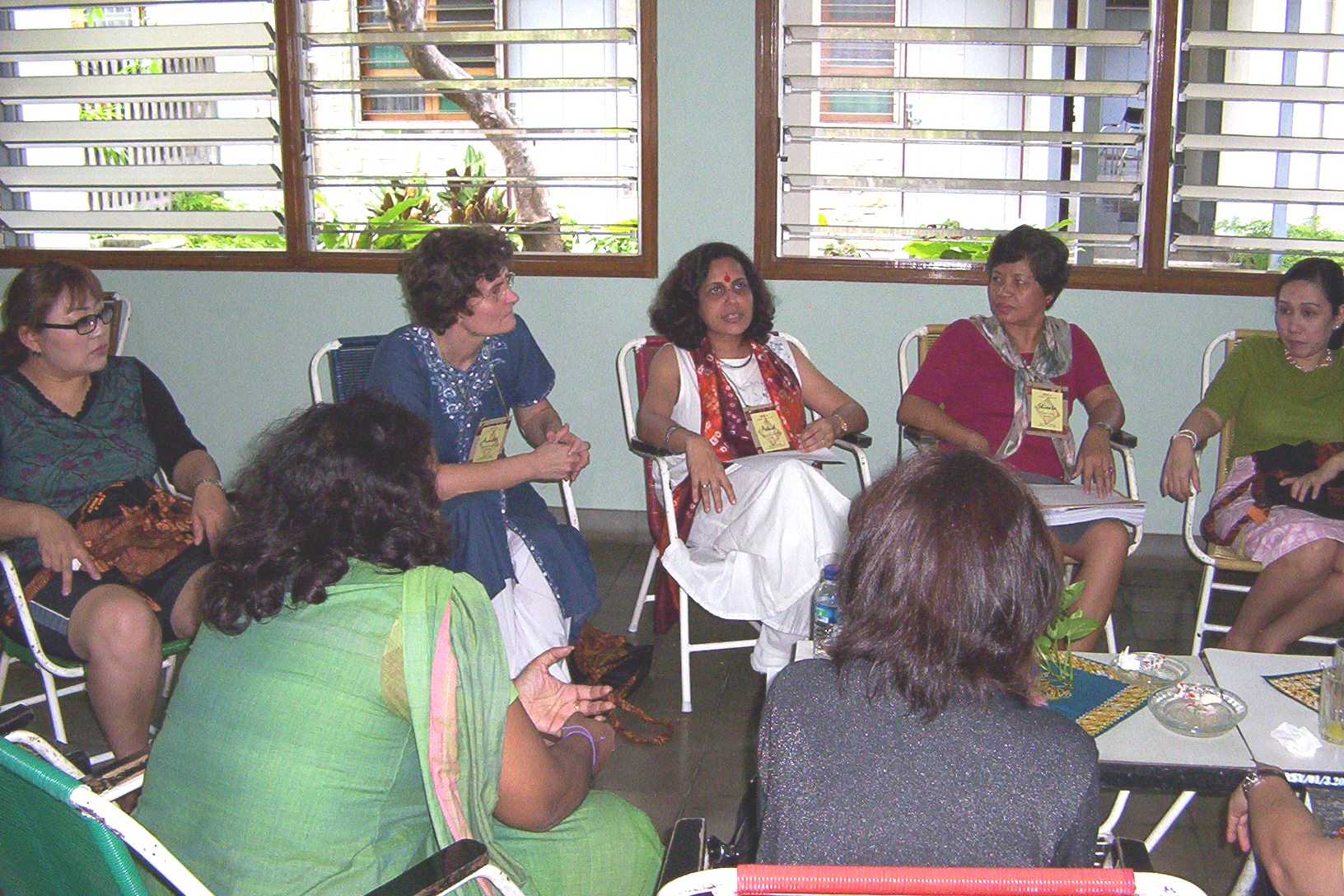
 T he inclusion of Protestant theologians and pastors
added a most enriching dimension to the discussions. Indrianne Bone, a Methodist
Pastor and Co-ordinator of PERIWATI, an association of theologically trained
women in Indonesia, bemoaned the dry, "sense"-less spirituality of her church,
symbolised in the "body-less" cross, and shared about the continuing
discrimination against women pastors. Many empathized with her sharing that for
Protestant pastors in Indonesia, speaking about body parts is also very
difficult as these have been linked to sin.
T he inclusion of Protestant theologians and pastors
added a most enriching dimension to the discussions. Indrianne Bone, a Methodist
Pastor and Co-ordinator of PERIWATI, an association of theologically trained
women in Indonesia, bemoaned the dry, "sense"-less spirituality of her church,
symbolised in the "body-less" cross, and shared about the continuing
discrimination against women pastors. Many empathized with her sharing that for
Protestant pastors in Indonesia, speaking about body parts is also very
difficult as these have been linked to sin. 

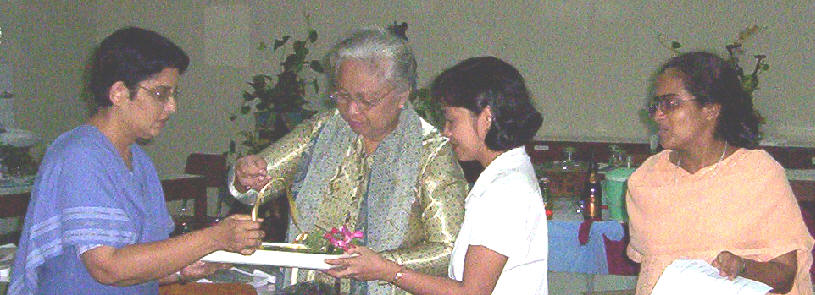 The
meeting also provided an occasion for the birthing of EWA's first baby. Guided
into this world by midwives Dr. Evelyn Monteiro and Dr. Antoinette Gutzler, this
collection of 28 essays from 13 different Asian countries is rich in style and
content, and provides a window into what happens when women in the Church gather
to break their silence and follow the questions wherever they may go.. (Photo
right is of the book launching)
The
meeting also provided an occasion for the birthing of EWA's first baby. Guided
into this world by midwives Dr. Evelyn Monteiro and Dr. Antoinette Gutzler, this
collection of 28 essays from 13 different Asian countries is rich in style and
content, and provides a window into what happens when women in the Church gather
to break their silence and follow the questions wherever they may go.. (Photo
right is of the book launching)