HOME These pages contain archive material for North Wales Rugby. Any contributions are welcomed. NORTH WALES v MONMOUTHSHIRE 1967 AND 2007 CLICK HERE LONDON WELSH v GOGLEDD CYMRU 1965 CLICK HERE
NORTH WALES v Carmarthenshire 1979 The late Ray Gravel was in the team. CLICK HERE
MONMOUTHSHIRE
v NORTH WALES 1982 CLICK HERE MORE FACTS AND LIST OF INTERNATIONALS FROM NORTH WALES CLICK HERE WRU RECOGNISES CONTRIBUTION OF NORTH WALES (wru article) CLICK HERE THE CLUBS OF NORTH WALESA brief history of rugby in North Wales
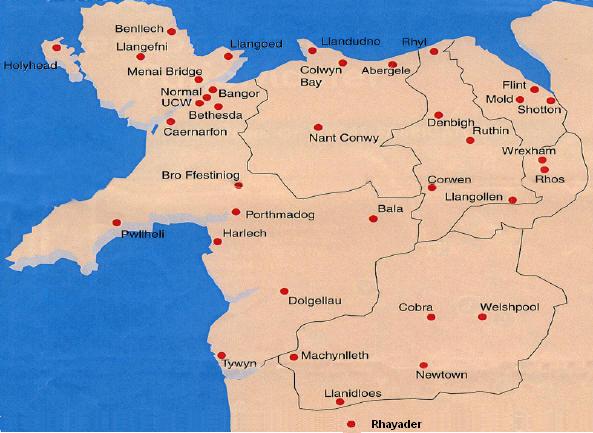
The history of rugby union football in the north and of mid Wales is rich with heritage. Records show that rugby was played in schools in Beaumaris, Ruthin and Ruabon from as early as the 1870s. The first game of rugby played under the laws of the WRU (or the Welsh Rugby Football Union as it then was) was between Bangor University and the Normal College in November 1887. Indeed Bangor RFC was one of the 11 founder members of the WRU in March 1881.
During 1881 a member of the club, Godfrey Darbyshire played for Wales in the first international against England at Blackheath. In 1882 two more local players H Vincent (Bangor) and CP Allen (then at Oxford University) were capped in 1882 and 1884 respectively, Charles Allen was the first Welsh player to score a try against England on the 5th January 1884.
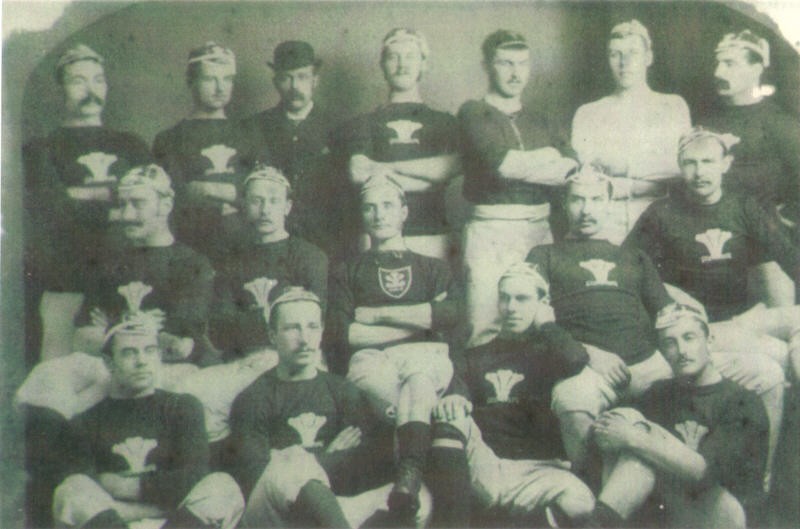
FIRST WELSH TEAM – WALES v ENGLAND 1881
Back Row
W. D. Phillips (Cardiff); G. F. Harding (Newport); R. Mullock, Hon. Sec. (Newport);F. S. Purdon (Newport); G. Darbishire (Bangor); E. Treharne (Pontypridd); R. G. D. Williams (Abercamlais).
Centre Row
T. A. Rees (Llandovery); E. Peak (Chepstow); A. J. Bevan (Capt.) (Grosmont); B. E. Girling (Cardiff); B. B. Mann (Cardiff).
Front Row
L. Watkins (Llandaff); C. H. Newman (Newport); E. J. Lewis (Llandovery); R. H.B. Summers (Havorforwest).
Following the First World War interest in rugby increased hence more clubs were formed in Rhyl, Colwyn Bay, Holyhead, Wrexham and Ruthin. These were soon followed by Machynlleth, Newtown, Mold and Dolgellau Old Grammarians. The North Wales Rugby Union was formed in January 1931. In 1936 Llanidloes and Builth Wells were admitted as members of this integrating body.
Currently there are 34 clubs with 19 who are full members of the Welsh Rugby Union.
Others who have won caps for Wales with distinction include Wilf Wooller, Dewi Bebb, Tony Gray, Arthur Emyr, Mike Roberts, Bill Morris, Ian Buckett, Stuart Roy, Andy Moore, Steve Moore and Robin McBryde. There have also been numerous players who have been capped at A, schools and youth levels. Tony Gray for example proceeded to become the national coach, the last coach to succeed at Twickenham.
Over the years North Wales has competed in the Welsh Counties Championship and have won the tournament on numerous occasions. During the 1970s North Wales played host to touring teams from Japan, Samoa, Fiji and a New Zealand U21 side.
Due to the construction work to develop the Millennium Stadium a full international match was played for the first time in Wrexham against Romania whilst in the same period welcoming a Rugby World Cup match between Japan and Samoa in addition to several A Internationals.
The huge local interest and enthusiasm for rugby was amply demonstrated in these well attended matches and helped enormously in raising the game’s profile in what is historically a football-orientated region. Despite the closeness of several of England’s major Premiership clubs, the interest in rugby football is immensely strong and is increasing.
It is more than ever important to tap into this enthusiasm and harness it to the benefit of the national game. Participation is high particularly at junior level. The Unitary Authorities are immensely supportive.
There was a small fact-finding committee set up in the 1950s, headed by Rowe Harding, the vice President in 1953, to assess the condition of rugby in north and mid Wales. It reported favourably on the hard work done to overcome the distances between clubs and the rooted popularity of soccer.
If there were dedicated men who nurtured the game in the schools and the locality in general, development was restricted by the lack of finances. Due to the post war difficulties the Unions itself was strapped for cash and only a small grant was made available.
Once more a working party has been set up to survey the rugby scene in the region. This is timely.
Rugby Union football North Wales and Montgomeryshire has reached another stage in its development. This is recognised in the Strategic Plan. The time has arrived to consider a pathway for the successful future of the game in the region.
There is a long-standing and honourable past which must continue to form the foundation for a future of pride and of distinction. This moment of reflection and the results of these deliberations must not be lost. Rugby throughout Wales will be the inheritors.