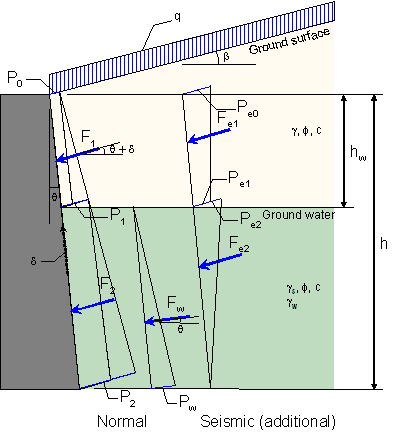
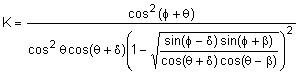
Pressures on an inclined surface of wall with a sloping ground surface, a surcharge, ground
water and seismic are explained as follows.
Soil parameters
1. Wet density (g) -
The wet density of soil above ground water table.
2. Saturated density (gs) - The saturated density of soil below ground water table.
3. Internal friction angle (f)
- The internal friction angle of all soil.
4. Cohesion (c) - The cohesion of all soil.
5. Soil slope (b) -
The slope angle of ground surface.
6. Depth of soil (h) - The depth of soil giving the pressure to the wall measured from the
ground surface adjacent to the wall.
7. Surcharge load (q) - The distributed surcharge on the ground surface.
Water parameters
1. Density (gw) - The density of water.
2. Depth of water table (hw)
- The depth of water table measured from the ground surface
adjacent to the wall.
Wall parameters
1. Wall inclination (q)
- The inclination angle of wall surface from vertical.
2. Wall friction angle (d)
- The friction angle of wall and soil.
Seismic parameter
1. Horizontal seismic coefficient (kh) - The horizontal seismic coefficient relative to gravity
acceleration (g).
Earth and water pressures
Earth and water pressures for cohesionless soil are calculated based on Coulomb's theory, as
follows.
1. Normal condition
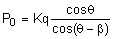
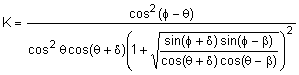
Soil pressures:
Water pressure:
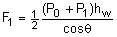
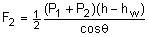
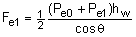
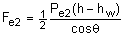
Soil forces:
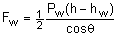
Water force:
2. Seismic condition
Soil pressures and forces for seismic condition are pressures and forces for normal
condition plus the following pressures and forces.
Soil pressures:
Soil forces:
3. Soil pressure inclination from horizontal = f + d
Horizontal components = Inclined pressures x cos (f + d)
Vertical components = Inclined pressures x sin (f + d)
Where:
1. Active pressure
2. Passive pressure
3. At rest pressure