 A Simplistic View of Total Quality Management
What is Total?
Everyone in the organization is responsible for quality.
What is Quality?
W. Edwards Deming defines quality as: "Pride in Workmanship"
Dr. J. Juran defines quality as: "those product features which meet the needs of customers and thereby provide product satisfaction." or "freedom from deficiencies."
Kaoru Ishikawa defines quality as: "total quality control, Japanese style, is a thought revolution in management."
Gary Griffith, in his book "The Quality Technician's Handbook," defines quality as: "the totality of features and characteristics of a product or service that bear on its ability to satisfy given needs."
For more on this question, click here..."What is the Definition of Quality?"
What is Management?
Management is a cycle of planning, doing, studying, and acting. All processes undergo the same cycle of management.
These processes may be any of the following: molding of a plastic part, recording of accounting information In a ledger, development of an engineering system for a company, etc.
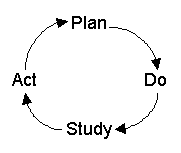
The PDSA cycle can be used in any type of management...be it quality, manufacturing, marketing, engineering...etc. Many people will recognize the PDSA cycle as a general management tool. It was originally developed by Walter Shewhart (yes, the guy that developed the original control charts for SPC) as the PDCA (Plan-Do-Check-Act) cycle. Dr. W. Edwards Deming popularized this approach to management. He changed from the PDCA to the PDSA just prior to his death.
Management is often the key to TQM. Most everyone (thus, Total) wants to do a good job (thus, Quality or Customer Service), but, often management gets in the way of a person doing a good job. This interference happens in many different ways...from being an offensive bully to simply not paying enough attention to someone. But, however a manager does it, managers prevent people from taking pride in what they do.
What are the components of Total Quality Management?
Total Quality Management is made up of three components. These components must work in harmony for the precept of TQM to work.
The first component is very simple:
All involved with a product, company, system, etc. must inherently trust everyone else to do their job, without concern that the company will fail.
An example of inherent trust occurs on a baseball team. When an opponent hits the ball, the defending team's players never question whether their teammates will do their best to cause the opponent to be "out." The same is true at work, everyone in an organization must believe that the rest of the organization is doing their best for their business
For more on the concept of "Trust in TQM" check out the following website: Frans J.C. Martins' Total Quality Management Page. This is an excellent page on TQM in general and, specifically on Trust in TQM.
The second component is equally simple:
The customer is not always going to be right. At times, the customer will come to a supplier and request something that is not possible. It is at those times that the supplier must, gently, teach the customer about why they cannot have what they want.
The customer may not be right, but the customer must be treated with respect. Thus, for TQM to work, you must focus
on the customer. That customer must always feel that they are the most important thing in the world to your company.
The final component is not as simple, but is very basic:
Process Management is where the "Rubber Meets the Road." Processes must be controlled at all times and they must be managed for improvements. The PDSA cycle will allow you to control, manage and improve your processes.
But, for the PDSA cycle to work, the Will to Improve must be instilled in everyone in the organization. Developing the will to improve is one of TQM's largest hurdles. It is often the point that TQM programs fall apart due to a lack of commitment to improvement or an inability to change. Improving demands change, so people must be receptive to both.
After developing the will to improve, we must establish a system for improvements. The system should be a coherent, focussed set of principles and tools for growth and improvement. Such a system is found in the Toyota Production System (or JIT Manufacturing). Too often, in TQM, we emphasize just the improvement of quality. This narrows the focus tremendously, you should expand the focus�work on anything and everything that can be improved. The strength of the Toyota Production System (TPS) lies in its integrated improvement of all company functions.
Elements of the TPS include:
Finally, we must give the teams and personnel a methodology to follow for improvement. A good way of doing this is to form Kaizen Teams. Kaizen means continuous improvement in Japanese, but it is more than just continuous improvement. Typical US applications of Kaizen involve big, splashy "events" that last for a short period of time. These events look good, but they do not adequately get at the improvements that are necessary.
For more on the Toyota Production System, please go to the following web page:
The Toyota Production System
A better way of doing this is to form Kaizen Teams (KaiT, pronounced like kite). A KaiT will form during the archetypal American Kaizen event. The KaiT, however, will stay together for a long period of time. The purpose of the extended period of time is slow, gradual "baby-step" improvements. These improvements become ingrained in the culture of the company and thus will be long lasting improvements.
For more on my concept of Kaizen Teams, please go to the following web page: Kaizen Teams
So, bottom line, what is Total Quality Management?
Total quality management is a systematic method, using Trust, a Customer Focus, and Process Management, that allows all employees of an organization to develop themselves, improve the company and take pride in workmanship.
By allowing all employees to take pride in the work they do, they will fulfill a company's obligation of exceeding customers expectations and needs.
These are but a few of the improvements possible with the TPS.
A Final Note on the Tools of TQM
The first two components of TQM are on the soft side of quality (i.e. the human side), while the third component is on the quality technology side. Many tools and techniques are available in quality technology. In this simplistic view of TQM, I have not described these techniques. There are many books written on quality tools and techniques. To aid in digging the tools out of books, I have provided a list of quality technology and tools books.
I originally put this page on my website as a suggested book list for people taking the CQE exam. But, it works equally well for someone that is looking for help with a thorny statistical issue!

| Return to Sending Page |
|
| Duane A. Floyd's QA Lab |
| Quick Links To | Duane's Major Pages | ||
 |
|
 |
 |
| Home | Professional | Humanities | Books |
Page is � 1999 by Duane A. Floyd