
Will the process generate an acceptable part? That is the most important question in all of quality (whether it be quality control or quality assurance). How do we predict that a product will be acceptable? A technique called process capability is what we need.
A process capability analysis is made of four things: the actual process, performance information, action on the process,
and action on the output. Using this information, it is possible to determine the proportion of output that will be acceptable. To conduct a process capability study, the following six steps are needed:
There are several process capability indices that are commonly used. The most popular is the CpK index. But, along with this goes the Cp, Cr, and CpM indices. The calculations for each of these indices are shown below:
Cp = (USL - LSL) / 6 * s
Cr = 6 * s / (USL - LSL), this is generally stated as a percentage, thus multiply by 100
CpK = Lesser of the following two equations: (USL - mean) / 3 * s or (mean - LSL) / 3 * s
CpM = (USL - LSL) / (6 * sq rt [ (s2 +( mu - T)2 ])
where,
USL = Upper Specification Limit
LSL = Lower Specification Limit
mean = mean of the process measurement (x bar)
s = standard deviation of the process measurement
T = target value
Of all the process capability indices, as stated above, CpK is probably the most used of the indices. The two indices Cp and Cr only relate the variation of the process to the specification limits, while CpK and CpM relate the to the centering also. That is the reason that CpK is popular. The CpM index is gaining popularity in that it relates variation of the process, the mean of the process, the spec limits, and the target value of the spec range. It is a relatively new index.
For further study, the concentration will be on the CpK index. The general concepts apply to all of the
indices.
To interpret the CpK index, we need pictures. Each of the pictures shown below represent a potential condition of a process. The process is represented by the ship and the specifications are shown by the box. To understand these pictures,
you must understand that a process capability analysis using one of these indices is a snapshot of your process.
Due to my ineptitude with computer graphics, I must explain my pictures. The vertical lines represent the specification limits for the process. The extra "little" lines do not represent anything, they are only there to help me get the entire picture onto the screen! The small vertical line at the top represents the target of the specifications.
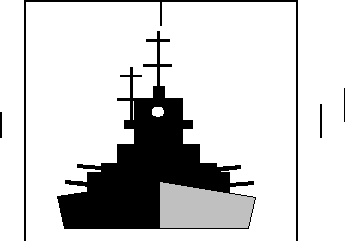
This process has a CpK value that is greater than 1.0. Since the CpK index > 1, then the Cp index must also be > 1. The process is centered on the target and the variation is within both specifications. This is the desired picture of your process.
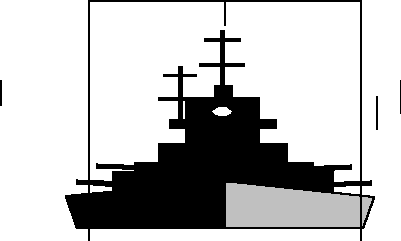
This process has a CpK index of < 1.0 and a Cp of < 1.0. Both are less than 1 due to the excessive variation in the process. Both sides of the process extend outside the specification limits. However, the process is still centered on target, but both indices show a non-capable process.
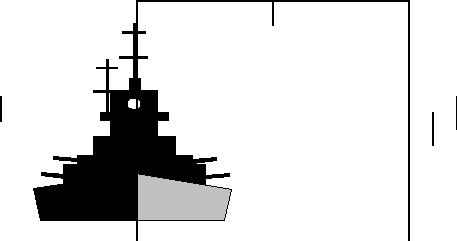
This process has a CpK < 1.0, while the Cp index > 1.0. The CpK index relates the target, while the Cp only uses the amount of variation in its calculation. It is feasible to have a Cp value of 3.0 (a truly good, low variation process) that has a -3.0 value for the CpK (the mean is outside of the specification limits).

| Return to Sending Page |
|
| Duane A. Floyd's QA Lab |
| Quick Links To | Duane's Major Pages | ||
 |
|
 |
 |
| Home | Professional | Humanities | Books |
Page is � 1999 by Duane A. Floyd