
This paper was presented at the 1999 Quality Management Conference in Charlotte, North Carolina on January 22, 1999. It is reprinted here with the caveat that I acknowledge this presentation. Many good questions were asked and, hopefully, answered. I appreciate anyone that reads this and all of the people that were at the presentation that day!
Also, if you have read my paper on Setup Time Reduction, you will see some similarities...also some of this information is contained in my other KITE Team page...so, no you are not seeing double...this is the full paper though.
Abstract
Continuous improvement comes in all forms. In Technimark's Packaging Products Division, we have developed the concept of a Kontinuous Improvement Through Evolution (KITE) Team. KITE teams start life together in a multi-day event, as happens in many companies. But, our teams do not complete all of their work within the span of this multi-day "Kaizen-type" event. They are charged with the responsibility of continuous improvement in their original area of responsibility. For example, one team developed the mechanism for improving our Statistical Process Control system and another tackled Changeover Time and reduced it dramatically.
These teams stay together for a minimum of one year and a maximum of one year. They are then responsible for choosing and training their replacements. Finally, they vote on one member of their team to become a member of the new team. This technique provides both new ideas and continuity from team to team.
Success was immediate and tremendous. The first team, Changeover Time, reduced changeovers by greater than 75% within the first six months. Problems arose, dramatic personnel type problems, and the team took responsibility for correcting them. Not only did they reduce Changeover Time, but they also revamped the entire system.
1.0 Introduction
Continuous improvement is a cornerstone of Total Quality Management. In the United States, this typically means a big, "splashy" program that usually shows negligible results. American factories constantly try revolutionary tactics to improve. A good example of this is Reengineering. Reengineering can be an effective tool, but it should not be
applied to all situations, another common practice (i.e. take a tool and apply it in every situation).
The Japanese, on the other hand, use Kaizen. Kaizen, in simple terms, means improvement. Nothing more, nothing less. Reality makes kaizen more difficult to understand. A typical American organization interprets Kaizen as a big "splashy" event. The event lasts three to five days and attempts to make radical improvements. To truly
improve in a Kaizen fashion, an organization makes small, incremental, almost unnoticeable changes.
The small changes allow an organization to develop Kaizen as a way of life. Big events cause turmoil in an organization by introducing large changes. Kaizen introduces small changes that do not disrupt the flow of an organization. People accept these small changes as necessary improvements and, thus, they do not resist the change. Slow, incremental Kaizen increases the probability of an organization evolving into a world class entity.
The KITE Team concept was developed to allow the evolutionary changes necessary to develop world class status. Kaizen events were tried, but resistance was substantial to this revolutionary type concept.
2.0 Revolution versus Evolution
2.1 Revolution
Revolution is defined as "a sudden, radical, or complete change" by The Merriam-Webster Collegiate Dictionary, Tenth Edition. When an organizational change occurs via revolution, it is impermanent Revolutionary changes are often catastrophic. Examples of catastrophic effects of revolution can be found in many companies.
One example that I am familiar with occurred at one of my client businesses. The company manufactures parts that are extremely aesthetically oriented. The former quality manager of that company was anti-inspection. He felt that inspection was antithetical to producing quality products. So, he convinced the senior management of the company to completely exorcise this demon and replace it with control charts. Introducing control charts would not have been a bad strategy, if properly instated. However, this quality manager was so violently opposed to inspection that he insisted in revolutionary implementation. Upon installation, the quality manager immediately eliminated all aspects of the former inspection system. Within a few weeks, on of their major clients returned 10 shipments of product for various aesthetic reasons. The client threatened to stop all orders…a catastrophe if ever I saw one.
2.2 Evolution
KITE teams utilize evolution in their changes. The Merriam-Webster Collegiate Dictionary, Tenth Edition defines evolution, as "a process of continuous change from a lower, simpler, or worse to a higher, more complex, or
better state." This characterizes a KITE team well. KITE teams embrace a process/system/product and slowly refine its quality
utilizing a Kaizen philosophy and Toyota Production System tools. Evolutionary change allows an organization to properly digest
the changes that are occurring. By moving slowly and surely, the quality manager in the example above would have avoided unnecessary problems for his company.
3.0 Evolution of KITE Teams
In most companies, continuous improvement itself is an evolutionary process. Some CEOs dictate that 'we will implement continuous improvement.' Middle management, the true leaders of continuous improvement, often subtly rebels against a CEO declaration. A successful execution takes time, sometimes years. In the development of KITE Teams, we started and stopped continuous improvement at least three times. Each time we utilized a different approach to implementation.
The last time we started, we decided to use the concept of Kaizen Events. These events started life as an edict from one of our customers, with three of our managers (myself included) opposing them. However, our
CEO insisted that we try to execute the system. Thus, we tried.
The first Kaizen Event in my division attacked our warehouse material handling system.
In organizing the event, several people were selected to work on the team: the materials manager, two warehousemen, two operators
and one "clueless" person (a person that has no understanding of "the way we have always did it") and a facilitator. Immediately prior to forming the team, goals were set and training was developed. This team has yet to fulfill its goals (over one year later)!
The team was asked to take corrective action as to what went wrong. Their root cause determinations were:
The team then asked the management team of the division to devise the corrective actions necessary for these root causes. The corrective actions appeared to be painfully simple…give the team more time and make it responsible for the system. But, these corrective actions dissatisfied the management team, the corrective actions were too simple. So after many hours of discussions with everyone involved, from the Kaizen Event team to the people that actually owned the system, the management team determined that the changes from the Kaizen Event were too radical (i.e. revolutionary) for a timely attainment of the goals. This fit with the four root causes that the team had suggested. Thus, the basic reasoning for KITE Teams developed directly out of this corrective action.
With this team as a consultant, the management team set out to develop a system that would address the concerns, while still pushing for continuous improvement. The first step in developing our KITE Teams involved coaching everyone in the organization. Every single person needed to understand that they were responsible for continuous improvement every day. Given the aptitude of the personnel of the division, this actually proved to be a simple task. The Kaizen Event team was transformed into a team that assisted with this implementation. Since the members of the team covered all areas of the division, it was easy for them to coach everyone. This step proved to be the critical step, and we did not even realize that when we were working it.
4.0 Development of a KITE Team
After this intensive grounding of the personnel, the first KITE Team was formed. The team starts by performing some passive tasks. Passive tasks are those tasks that do not directly improve the system. For example, the administrative tasks of the team, such as paperwork, are passive tasks.
The first passive task for a KITE team is configuring itself. A team leader will be chosen
who then chooses up to 7 other team members. These team members must come from all areas of the company with at least one "clueless" person. Most teams hold their "clueless" in high regard. Clueless is the person that asks one simple question, "Why?"
After forming the team, the task of learning about the existing process begins. For example, a team could be developed to create and refine a Kanban materials management system. Unfortunately, many people do not even know what Kanban means; they must master the intricacies of a Kanban system. Obviously, this passive task constitutes one of the many keys necessary for the success of the team.
The final, preliminary passive task is to allow the team to set its own goals. This appeared to be incompatible with good team theory. Common experience says that the goals should be set for the team so that they concur with corporate goals. However, we found a common ground in allowing the team to participate in the goal setting, along with the management team. Participation allows the team members to "buy in" to the goals. This approach also allows a natural interaction to develop between the management team (which must support the KITE Team) and the KITE Team. The timing of this last preliminary passive task is critical. It is crucial that this task occur after the learning task, as the members of the team must understand
what is being asked of them.
These three preliminary passive tasks constitute the Kaizen Event. The Event lasts for a minimum of three days, with a maximum of five days.
After these three preliminary passive tasks, the team is ready to move toward active tasks. Active tasks are those that lead to improvements in the system. For example, creating a standard place for all changeover tooling to reside is a direct, active task that directly improves the system.
The first active task of a KITE Team is to complete one small improvement within a one-month time frame. Not a spectacular change to the system, just one very simple betterment of it. Something that most people would not
be able to say is an improvement. For example, a Setup Time Reduction Team decides to develop a priority board for changeovers. This, in and of itself, is not a major change. But, it lays the groundwork for bigger changes later. This small, active task allows the
team to have a success to celebrate.
After the first active task, the KITE Team is almost prepared for the major tasks ahead. However, one more passive task is necessary. The Team prepares a plan of action, with a schedule, detailing the system changes. Generally, the Team takes about one month to develop this plan. Although not an active task by the definition of KITE Teams, this month of planning is crucial and very intense. The Teams usually take pride in their action plan.
After development of the action plan, the team executes the plan. The execution must take no longer than twelve months. After a period of twelve months, the existing KITE Team dissolves. It may be replaced with another team, should the system merit more work or the system may be judged to be adequate at that point. Should it be necessary to continue improving the system, the final, passive task of the Team is to select and train the new Team. An important rule for multi-year
KITE Teams: during the selection of the new Team, one member of the old Team must volunteer to participate on the new Team. This
allows continuity between Teams and, also, a sense of the history of the system.
5.0 Ground Rules for KITE Teams
6.0 A Prototype KITE Team
The first KITE Team focused on Changeover Time Reduction (CTR), an integral part of the Toyota Production System. The management team believed that CTR would be a relatively easy system to work. The KITE Team was launched on October 20, 1997 with a big, splashy Kaizen Event. The first celebration occurred on behalf of the formation of our first KITE Team (celebrations are extremely important).
The Team consisted of the continuous improvement manager as the facilitator, manufacturing manager as Team Leader, setup technician, HR manager as the "clueless" and three machine operators. The Divisional Director chose the members of this first Team (with input from the original Warehouse Kaizen Team), as the people within the organization were unsure of the program.
The Team began work on developing its goals. The first action of the team was to collect data on the existing changeovers. They determined that four types of changeovers occurred: (1) material changes, (2) mold changes, (3) robot changes and (4) assembly table changes. They documented the average time for each of these changeovers. 50% reduction of all changeover times became their goal.
The following list is the action plan that they developed.
Observations (O) and Recommendations (R)
Material Changes (applies to all types of changes except Robot)
O - Team leaders had to search in the warehouse for new material
R - Create specific staging area for new materials & locate prior to change (complete)
O - During changes Team leaders had to drain a full hopper
R - Communicate better to night shifts to "pull" wands & let material run
down (complete)
O - Often one person had to do the material changes
R - Require that at least 2 people do a material change (complete)
O - The material change was in the way of moving the automation table in or out
R - Drain hoppers and clean loaders while the machine is running (complete)
O - It took over an hour to drain and clean a large hopper
R - Replace large hopper with "one shot" mini hoppers (capital money of $400,000 approved to complete this project in 1998, benefits more than just quick change)
Mold Changes
O - The mold change was waiting on forklift from material change
R - Purchase a motorized pallet jack for team leaders (ordered)
O - Mold hanger had to search for special knockouts
R - Purchased 10 bins to stay with molds holding knockouts, switches, etc. (complete)
O - Mold hanger had to stand under the mold to remove / replace water pipes which had to be done to each mold, each time it was moved
R - Use shorter pipes (1" long) and put short legs on mold (2") (KITE came back later and suggested using a piece of 4" X 4" lumber to avert putting legs on molds, complete)
O - There was no mold spray on the setup cart
R - Developed a check list (in appendix B) for tools required prior to change (complete)
O - Wasted time blowing out water lines while mold was still in press
R - Purchased a vacuum to suck out the water once mold was in tool shop (complete)
O - Used a tape measure to square the mold
R - Purchased a magnetic level to square the mold quicker (complete)
O - Mold hanger had to shift eye bolts from old mold to the new mold
R - Purchased additional eyebolts for staging molds (complete)
O - New molds had to be retrieved from the green rack while machines were down
R - Stage new molds at the machine prior to shut down (complete)
Robot Changes
O - Brought out the wrong robot heads first and had to search for correct ones
R - Stage all accessory equipment prior to starting the change (complete)
O - People to work on robot not present at start of changeover
R - Implement checklist of people required to start changeover (complete)
O - Took 25 - 30 minutes to set positions on old robots
R - Replace old robots with Sepros (pending)
Assembly Table Changes
O - Had to borrow casters from table in the warehouse
R - Purchased new casters (complete)
O - Changed out conveyors then had to adjust
R - Standardize the type and size of conveyors (in process, complete by Jan. 1, 1999)
O - New table had a valve that was sticking and needed to be replaced
R - Save extra bases and covers then cycle table the day before changeover (complete)
O - Often new table is missing parts when installed
R - Enforce rule that tables do not get stripped while in storage (complete, ongoing)
O - Machines stopped at 6:45, changeover scheduled at 7:00
R - Better communication (PIT team concept) (complete)
O - New table and conveyors were brought from the shop with machines down
R - Stage table, conveyors and all equipment at the machines being changed (complete)
O - Assembly tables had to be jacked up to be set on casters
R - Mount casters and jacks to tables (complete)
O - It took a "technical" person to hook up air and electrical on table
R - Standardize plugs (air manifolds) so anyone can hook up (complete)
Over the course of six to eight months, each of these recommendations were implemented. The Team also added new recommendations as it went forward and worked with the system. The results are shown in Figure One. Numerically, as of August 1998, the CTR KITE Team had reduced the average changeover time by 75.3%.
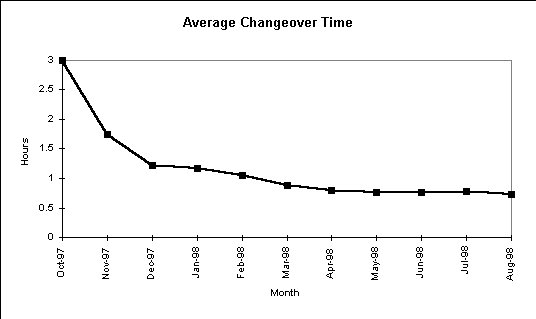
Obviously, the Team met its goals. But, additional unexpected improvements in the Division occurred due to this Team (and others). This great KITE Team provided a credo for all future KITE Teams in the form of 5 keys to success.
7.0 KITE Teams Keys to Success
(1) Leadership is necessary because without it this program has very little chance of success. We ask (and know) that the management team will support this effort through helping to implement and enforce the mostly procedural changes outlined above.
(2) Communication of the proposed changes is going to be very important because EVERYONE in Plant 4 will be affected. We feel that the Pit Crew Meetings are very important because it got everyone involved in the change on the "same sheet of music." Plant meetings are important, again because everyone is involved, the front office (how changes are reported) to the team members (doing color changes) and everyone in the middle.
(3) Accurate Documentation is required because without an accurate yardstick how do we measure progress? The team's suggestion is that we use 3 check off sheets: (1) Tools - all tools required on the change over cart prior to starting, (2) Equipment - verifying that all equipment is staged and has been inspected & (3) Personnel - the change over should not start before certain people are here and ready. Our suggestion is that these sheets be compiled by the Pit Crew Chief, reviewed by the Plant Manager then kept by the Business Unit Manager. Once the changeover is complete, the Pit Crew Chief will fill out the Production Log to assure proper reporting.
(4) Individual Involvement, everyone who works in Plant 4 is a part of the changeover "system." It is crucial for them to understand and be invested or the system will not be a success.
(5) Follow-up will be done in 30 days by the team. The focus of this initial follow-up will be to check on implementation. Additional follow-ups will occur once per month with results being the focus. We anticipate that there will be a substantial downward trend in the time it takes Plant 4 to do changes.
Although the specifics included relate directly to CTR, the five keys apply to all KITE Teams.
8.0 Conclusion
KITE Teams have proven to be an effective method of continuous improvement. They allow our company to gradually "change from a lower, simpler, or worse to a higher, more complex, or better state" (Merriam-Webster Collegiate Dictionary, Tenth Edition). Three additional Teams work within our organization currently. All of them have shown
positive success rates.
KITE Teams foster a deeper understanding of continuous improvement. These Teams force people to realize that everyone in the organization must work together to improve. By improving, we not only make the company more profitable, but we also enhance all of our lives while working. The managers, engineers and operators in our division now work together on improving every day. The entire group embraces opportunities to serve on KITE Teams (every single person in the Division volunteered to serve on any Team). But, they also realize that they can improve the company without serving on a Team, they only have to improve.
Imai, M. [1986], Kaizen: The Key to Japan's Competitive Success. McGraw-Hill, New York.
Imai, M. [1997], Gemba Kaizen: A Commonsense, Low-Cost Approach to Management. McGraw-Hill,New York.
Schonberger, R.J. [1996], World Class Manufacturing: The Next Decade. The Free Press, New York.
Womack, J.P. and D. T. Jones. [1996], Lean Thinking: Banish Waste and Create Wealth in Your Corporation. Simon and Schuster, New York.
[1993], The Merriam-Webster Collegiate Dictionary, Tenth Edition. Merriam-Webster, Incorporated, Springfield, Mass.

| Return to Sending Page |
|
| Duane A. Floyd's QA Lab |
| Quick Links To | Duane's Major Pages | ||
 |
|
 |
 |
| Home | Professional | Humanities | Books |
Page is � 1999 by Duane A. Floyd