Ysbyty |
 |
| Location Map |
Working Holiday Details
Ysbyty |
|
| Location Map |
Date: 5th - 7th March 2004 |
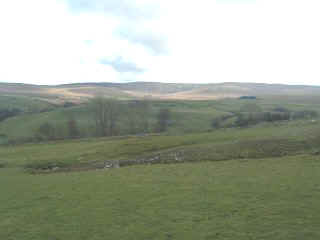
| Location: Ysbyty, North Wales |
| Basecamp: Hendre Isaf - Betws y Coed. |
| The volunteers present: | National Trust | |
Margaret Rachel Sandra Stephanie |
Clive (Leader) Andrew Andy David David David Tim Tony |
Andrew (Warden) Andy Assistant Warden |
This was my first Working Holiday where there was a specific skill being taught, rather than completing a weekend project. The purpose of this weekend was to introduce beginners to the art of Dry Stone Walling.
| Tasks undertaken. | |
| This weekend was primarily to introduce the group to the
art of Dry Stone Walling.
However in order to make the exercise realistic the training was undertaken on a stretch of wall that had fallen into disrepair and the weekend task was to restore this wall back to it's original state. The wall was on one of the tenant farms on the Ysbyty estate. |
 |
 |
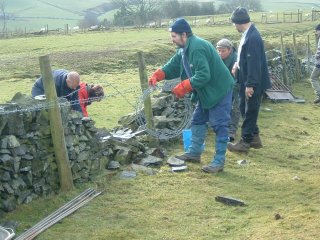
After removing the barbed wire fence that had covered the
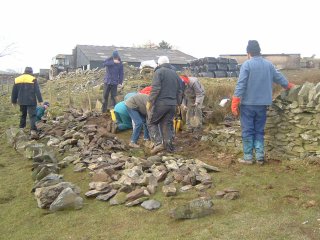
gap in the fallen wall, the first task was to lift out all of the stone
from the wall and lay it out in size order on either side of the wall.
The coping stones from the top of the wall were laid out in a single line on one side of the wall. |
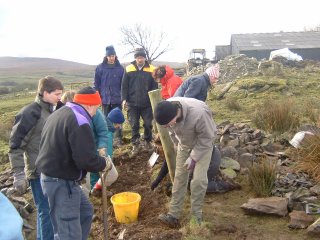
| When all of the stones had been removed a foundation
trench was dug out to give a secure base for the wall to stand on.
At the same time any loose stones on either side of the remaining wall were removed so that the replaced wall could blend securely into the existing wall. |
 |
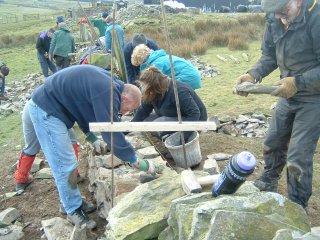 |
Large stones, known as footings are laid into the
foundation trench, ensuring that the top of each stone was horizontal.
Once these stones were in place steel rods were placed at either end. Wooden clamps were attached to the rods which were positioned so that string lines could be used from the rods in order to get the correct "batter" (angle/shape) of the wall. |
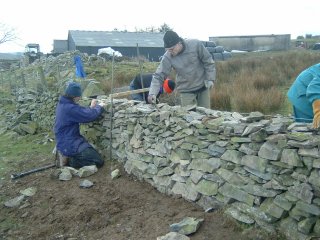
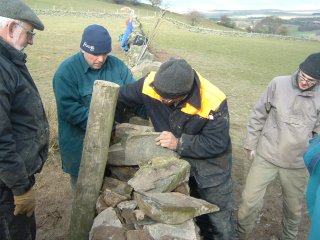
| The stones were then rebuilt back into the wall, starting
with the largest stones first.
A team worked on each side of the wall, ensuring the stones were secure and horizontal. Longer stones known as "throughs" were placed across the width of the wall to give added stability. Any gaps in the middle of the wall were filled with small stones known as "hearting". |
 |
 |
When the wall reached the correct level the coping stones
were replaced.
These larger stones gave the wall greater stability by holding together the two sides of the wall. Also the shape and height of the coping stones deters livestock from trying to climb over the wall. |
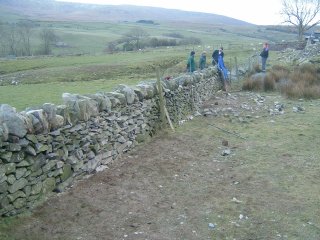
| After tidying up any remaining stones the only task then
was to stand back and admire the work the group had done!
Dry Stone Walls have been recorded as standing for over 100 years and we hope that ours will stand the test of time and last well into the future. |
 |
See some more pictures of the volunteer group.
The work of the weekend was very satisfying. We were all new to dry stone walling and the instruction and guidance from the staff was excellent.
It was pleasing that the training was undertaken on a wall that is to remain in place as at the end of the weekend as well as feeling that we had learnt a new skill there was also the satisfaction of repairing a wall on a working farm.