Lamprologus
Ocellatus "Gold"
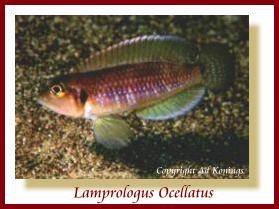
Thank you Cichlid Press
and
Ad Konings for allowing me to use your pictures.
I received this little guys via "The Cichlid
Exchange" (see link on link page) on
08/20/99. I had these guys in a community tank with some Julie's
and Compressiceps also some Brevis and Caudopunctatus and they did ok but
I moved them into a 20 long for breeding.
Tank size: 20 gallon long
Tank Temp: 78 to 82
Tank pH: 8.0
Fish size when adults - 2" (5 cm)
Breeding Information:
The male goes to the female's shell and once she is in
the shell he lays over the entrance. He lowers his tail into
the shell every once in a while and if the female tries to get out he pushes
her back in. ( I think we call that date rape) I watched this pair
for over an hour and the male is very aggressive towards everyone in the
tank that dares to come near. It is easy to tell when a female has
spawned. First her belly will be much smaller, second, she will lay
over the entrance to her shell and rarely leave it. Every 2 minutes
to 5 minutes the female will go into her shell to air ate her eggs.
I have been very successful in moving a female and her shell (once she
has spawned) into another tank. I do this to save the fry and its
less stress on the female. Once the fry have hatched it will be a
couple of days before they will venture out of the shell. It seems
once they leave the shell they rarely go back into it. Instead the
hang around under or around the shell with the female protecting them.
This is one of the few fish I have had that will attack your hand when
you put it in the tank when she has fry. The males seem to have little
or nothing to do with the raising of the fry. I have 3 females that
have spawned, females #1 & #2 have nothing to do with the male after
spawning, in fact they run him off. Female #3 lets the male stay
with her to help her protect her territory and fry. I do have 2 other
males but they are smaller and the big male keeps them in line. The
males fins are darker then that of the females and that is really the only
difference I can see.
Update:
I know longer have these great little shell dwellers
as I lost them all do to a heater malfunction.
Return to: