Lake Kyoga
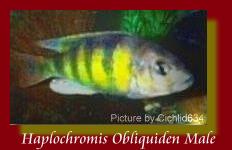
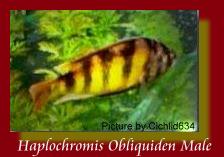
Haplochromis
Obliquiden "Redtail"
for a better picture of this fish click >>HERE<<
(NOTE: I sold these fish on 11/07/99)
This is another Haplochromis that is very bright and a great community
fish. I have had these fish in with Lake Malawi and Lake Tanganyika
fish. Currently I have 6 Females and 2 Males one male is in another tank.
If you do keep this fish or any other Haplochromis, do not put them in
the same tank. Haplochromis will crossbreed and males will fight
each other. Like many Cichlids it's hard to say when or if we will
be able to get more from the lakes, so for this reason, please if you breed,
make sure you do not allow cross breeding. It is NOT for breeders
to change the make up of these fish it up to breeders to maintain the natural
look.
Adult size: Male 5" or 12.5 cm & Female 3.5" or 8 cm
Breeding Information:
This is a mouth brooding Cichlid and it like most Cichlids loves to have
lots of rocks and hiding places. This fish is easy to breed and will breed
in a community tank. They are mouth brooders and the females like
to hide when brooding so the male will leave them alone. The average
spawn is about 20 to 22 fry. Younger and smaller females will have
smaller batches. I kept the temp at 78 to 82 degrees and my pH at
8.0. This seems to work great with this Cichlid. The males
(see picture above) gets a wonderful yellow background with the black strips.
The females stay a dull gray color with the black stripes but does tend
to get darker when ready to breed or is brooding. The Male can and
does get rather aggressive towards the females when he wants to breed so
for this reason it's a good idea to keep at least 3 females with the male.
Where is Lake Kyoga?
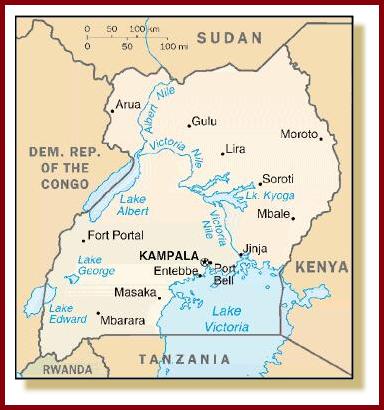
About Lake Kyoga:
Uganda, republic, 91,133 sq. mi (236,036 sq. km), E central Africa, bordered
by Tanzania and Rwanda (S), Zaïre (W), Sudan (N), and Kenya (E). KAMPALA
is the capital. Uganda lies astride the equator. Most of the country is
a fertile plateau, in the center of which is Lake Kyoga. Around the perimeter
are the lakes Albert, Edward, and Victoria;
Return to: