Altolamprologus
Compressiceps Redfin / Tanzania
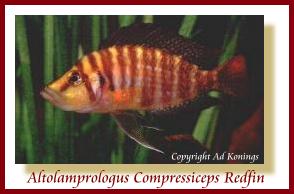
Thank you Cichlid Press and
Ad Konings for allowing me to use your pictures.
The Altolamprologus species both Calvus and Compressiceps are interesting
fish both in looks and in behavior. These fish have been my downfall
as I have always had a tough time keeping them alive. They do not
like the tank messed with so if you have or are getting some keep this
in mind. I have had these fish in a separate tank and talk about
boring they did nothing they need other fish (not to aggressive) to keep
them going.. This fish, like the Calvus is a fry eater so be careful
where you put him. Don't be fooled by his looks this little guy is
tough and does not back down. My understanding about the difference between
the Calvus and Compressiceps (because to me they look the same) is the
number of scales on the fish. If this is wrong please let me know
and I will change it. I ordered these fish online from Armkee's
(see
links page).
Tank size: 20 gallon long
Tank Temp: 78 to 82
Tank pH: 8.0
Fish size when adults - Male 6" (15 cm) & Females 4.5" (11 cm)
I have 3 of these fish
Breeding Information:
Substrate spawners. Female will select a spawning site, usually a
small cave or recess in a rock too small for the male to enter.
As the female lays her eggs, the male will lie over the opening of the
spawning site and release his sperm to fertilize the eggs. The perimeter
of the spawning site is vigorously defended by the male, while the female
remains with the eggs until they become free swimming. At this time
the juveniles should be fed live baby brine shrimp. Spawns may number
up to 300 eggs.
I have never spawned these fish, this is information that I have
gotten from several places. On January 21, 2000 Of the 3 of these
fish I have a pair has formed. I watch as the male and female where
at the opening of a shell and the male had his fins fully extended.
He was also making short bursts in front of the female trying to impress
her. I have watched this same behavior in other species and it was
always a prelude to spawning. I have my fingers crossed as I have
never had much luck keep altolamprologus alive much less spawn them.
It is very hard to tell the males from the females but there are two ways
to do it. The male is larger than the female and the Dorsal is also
higher. The second way is called Venting, see the link below for
information on that. Sadly I lost my female and I set up a show tank
at a local store and the male went to that tank.
Return to: