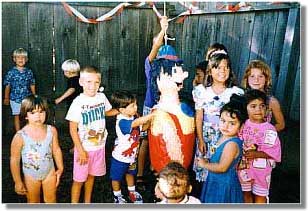
The Pinata
For generations, "the pinatas"
has been a part of Latin American festivities. But its origin dates back
many centuries before the arrival of Spanish explorers on Mexican soil.
Mexican Indians fashioned
"the Pinata" from a fragile earthen jar made especially to hold simple
toys and favors. They were gaily decorated, some to look like the gods
they worshipped, others to symbolize events.
The Pinatas soon gained
favor with early Spanish explorers, and they began sending Pinatas to their
motherlands of Spain and Portugal. The Pinata was on its way to becoming
an international sign of the fiesta. Today, the children of Mexico follow
the tradition started by their ancestors, joined by millions more around
the world.
Playing the Pinata
Game
The children form a circle around
a Pinata, which is hung from the ceiling, one of their number stands in
the center with his eyes blindfolded. He is given a stick and permitted
three tries at breaking the Pinata.
The other children, meanwhile,
sing and dance around in a circle. If the first child doesn't succeed in
breaking the Pinata, another child tries. When the Pinata is broken, causing
a shower of gifts to pour down on the floor, the entire party makes a wild
scramble to obtain shares of the treasure.
Students of
St. Paul's School, Barcelona, Spain
Teacher: Patricia Spiller
<[email protected]>
|