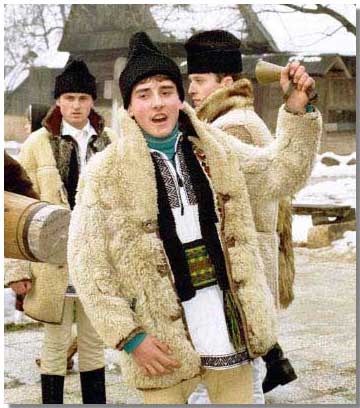
Children Winter
Customs in Romania
By Raluca Antonache
<[email protected]>
Al. I. Cuza National College
At the winter festivals, an
abundance of customs accompanied by music are displayed. These customs,
as varied as they are interesting, appear to have been inherited in the
main from the ancestors of the Romanian people.
It is well known that the
peoples of antiquity living in the regions of Romania celebrated the winter
solstice, "the birthday of the invincible Sun", with songs and dances,
with greetings, presents and wishes of prosperity. Later on, the feasts
of the Christian Christmas were established at this very period of the
year. The struggle of the clergy, to abolish the pagan customs and to replace
them by new ones, corresponding to the canons of the Church has been particularly
strenuous and to a great extent doomed to failure. "The unlawful" and "diabolical
songs", as the Lutheran pastor Andreas Mathesius of Cerghiul Mic, near
Blaj, called the Romanian carols more than three centuries ago, have proved
stronger. The church has succeeded in smuggling in and adopting a series
of songs (Cantece de Stea- Star-songs) and sundry "Vershuri" (occasional
songs with religious texts) as well as the nativity play (The Magi, The
Herods, or the Bethlehem) but it has not been able at all to suppress the
pre-Christian pagan customs.
These customs begin on Christmas
Eve or the day before, and last till Epiphany. The most important of them
is that known by the name of "colindat" (carolling). By these customs,
groups of "colindatori" -carollers- go from house to house and sing at
the windows or in the houses, according to a variable ceremonial, ancient
songs of greeting, called "colinde" (carols). These carols are song by
boys, youth girls, adults or mixed groups, according to the region of the
country.
The texts of these carols
may be either profane or religious in content. The profane ones tell about
the contest between the hors and the hawk, about the incredibly large dowry
required of the marriageable maiden, a dowry to which the wooers renounce
on seeing, the beauty of the girl and being convinced of her industry;
about the nine sons of the hunter turned into deer etc. The "religious"
carols contain popular legends of God end they are of ten imbued with pagan
elements. God and the Saints are personified: God as an old shepherd with
a white beard, playing the flute as he watches a flock of sheep; Got and
St. Peter dressed as beggars are driven out of the house of the rich, and
the apocryphal content of the latter has determined the churchmen to try
to remove them.
The Star-songs, whose poetical
contents is inspired by the Scriptures, were created to that end. Poor
in artistic images, they differ from the genuine folk creations both in
language and style. Their melodies and rhythms draw them nearer to the
pious Christmas hymns of the West. Here and there, as in the western part
of Oltenia for instance, the texts of the Star- songs appear to have borrowed
ancient carol melodies. Persistently diffused by the Church and old time
schools, the star-songs have achieved a certain popularity. They are, as
a rule, sung by children carrying a paper star painted and sometimes illuminated
from within. In Transilvania these songs also given the name of "colinde"
and are sung together with the authentic folk "colinde". This blending
of creations pertaining to two different cultures have much contributed
to the false conception which certain people still have of the "colinde",
considering them as a whole to be religious, mystical, etc.
The aim of the carols is
to greet and to praise in an allegoric way those to whom they are sung.
Hence their specialisation, here and there, into carols for a young man,
for a young girl, for a newlywed couple, for a shepherd, for a hunter,
for a fisherman, etc.
Reaming the village from
house to house, the carollers of Dobica, Hunedoara, part of Romania, play
on flute and drum the "Song of the drum". On this melody is superimposed
a carol for a young man, which the carollers sing as they march.
The "Dube" (drums) also
accompany certain carols from the village of Almas, Saliste. The poem tells
gracefully of a young shepherdess who wanted to pluck a flower in bud.
The flower advises her to wait till it blossomed, to adorn herself with
it and to dance the "hora" with it: as its petals will be scattered
and tossed about by the winds so will her beloved be tossed about by his
thoughts of her.
The luck –visit of the plough,
“plugusor” (little plough) is a very ancient fertility rite performed in
Wallachia and Moldavia on New Year’s Eve and New Year’s Day. A long recitation
in verse representing allegorically the whole work of the field, from the
ploughing to the kneading and baking of rolls of pure cornflower is intoned
against a background of sounds produced by the bellowing of a friction
drum called bull ("buhai"). Also it is added sometimes the melody of flute
or other musical instruments:
Our plough works
wonders
It has four or five coulters
Sharpened, tempered
Sharp and cutting,
Never sleeping
And where it passes it leaves
A soft and fertile furrow;
And where it furrows!
The field laughs and blooms!…
Among the masked dances
performed during the winter feast, the most remarkable is “Capra” (Goat),
emblem of fecundity. This custom, whose magical significance has become
lost during the course of time, consists of the dance of a masked man generally
representing a goat or a stag. The muzzle of the mask is made of two pieces
of wood covered with hare-skin.
Many of the midwinter musical
customs nowadays find excellent means of diffusion through the activities
of organized artistic groups, whether amateur or professional. |