Authentic Japanese
Ceremonies for Children in Japan
Chifuyu Omma from Japan
Hina-Matsuri is held on March
3rd. The parents celebrate their daughters' growth and good health on this
day. They not only celebrate, but also decorate the Hina-dolls on seven
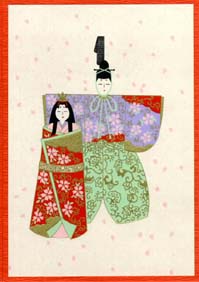
tiers of shelves which represent dolls of prince and princes, their 3 female
servants, 5 music players, 2 ministers and 3 guards working in the palace.
They have a good time drinking white rice wine, sugar rice crackers, Gomoku-sushi
(mixed sushi rice), and clear clam soup.
Children's day is May 5th
which is a national holiday. It used to be a boy's day originally, thus
the family who has boys decorate the warrior doll, helmet, sword, and bows
with arrows. These are showing parents' expectation for their son to become
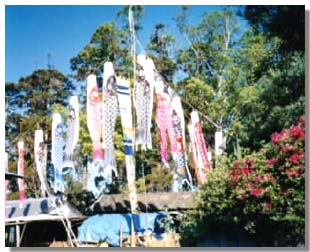
brave and have good luck in the future. They also put carp-shaped flags
on the high pole. Family celebrate with rice cakes with red bean sweets
inside and wrapped by Kashiwa leaves, and steamed sticky rice wrapped in
bamboo leaves.
Shichi-go-san Festival is
held on November 15th. Girls at 7 years, boys at 5 years and girls at 3
years are blessed at the shrine. On this day, children put on their formal
wear, like traditional kimono. They show appreciation for good growth and
wishes for better growth for future. The children have a candy bag which
contains 3 long stick candies called Chitose-ame in their hand, and to
have a good memory of their record of growth pictures are taken and put
in a photo album.
Cherry Blossom Season
Chifuyu Omma from Japan
In Japan, there are four seasons
in a year, so we can see many kinds of flowers each season. The best one
among them would be the seson of cherry blossoms. At the beginning of April,
cherry blossoms are in full bloom. At this time, the weather reporters
inform us of a cherry blossom front which comes up from the south to the
north and tells us when would be the best time for seeing cherry blossoms.
Then we go not only to appreciate the cherry trees, but also to make a
big picnic party under the cherry trees. It is called "O-hanami" in Japanese.
It is also an especially wonderful sight to see cherry blossoms at night.
Taking a Fresh Look
at How to Celebrate a Festival
Yukiko Hattori from Japan
Yesterday's paper had a short
article about the Coming-of-Age ceremony in a large city in Japan. According
to the article, the mayor of the city formally apologized to an enraged
professor who delivered a speech at the ceremony that was all but ignored
by 20-year-olds in the city.
The officials prepared 7,000
seats in a gymnasium where the ceremony was held for the 17,000 twenty-year-olds
residing in the city. But most of the seats were empty during the speech.
And many of the 20-year-olds who did show up ignored the professor and
spoke among themselves or talked on their mobile phones. Some even made
a ruckus outside the gymnasium.
One 20-year-old who attended
the ceremony said youngsters came to the ceremony not to listen to speeches
but to see their classmates. The mayor criticized the young generation
at a news conference on Tuesday, saying such behavior "is symbolic of the
postwar era which failed to nurture healthy character and social intelligence."
Personally I feel people
should not generalize the whole generation or the whole era when he criticizes
something. But it is also true generation gap is getting bigger and bigger
regarding the ceremony of Coming-of-Age Day. So far this ceremony has been
held with citizens' tax money. Many older generation understand this festival
as an entrance ceremony of adults' world which requires maturity including
responsibility, patience, and cooperativeness. Older people tend to be
"educational" to younger ones, while younger people tend to feel they finally
obtain a right to behave freely because they are now adults. Though, ironically,
young people have to ask their parents to buy them new clothes for the
ceremony. (A kimono costs from half million to one million yen.)
It is about time to change
the way we celebrate this festival, I think. The idea of blessing new 20-year-olds
is not so bad. But there seems to be some other ways to celebrate more
properly. The present way seems to me a little superficial and materialistic.
It can provide solutionless arguments between different generations, instead
of friendships and respects. Instead of eternally complaining about the
young's behaviors at the ceremonies, people should consider how they can
make their ceremonies worthier, I feel.
|