New Year's Customs
Worldwide
Celebrating the New Year
in Korea
IckChan Lee from
Korea
Like many other Asian countries,
Korea has two different New Year's days according to solar and lunar calendars.
The more widely preferred one is the lunar New Year's day, so called So-nal.
Sol-nal is a day for the whole family's reunion for refreshing everyone's
common life newly at the very beginning of a year. It has many special
meanings and events.
On New Year's Eve On Sol-nal's
Eve, people prepare special sieves made with straw (Bok-jori) and hang
them outdoors to prevent their family from evil and all the bad luck. Often,
kids are trying to keep awake all that night because they believe that
if they slept, their eyebrows will turn white.
Clothes
On the morning of Sol-nal,
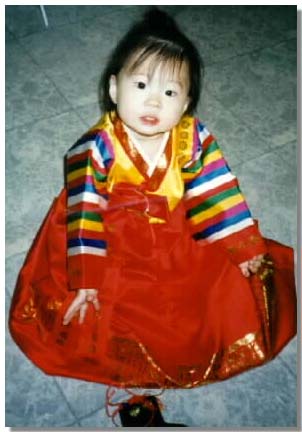
everyone dresses in specially prepared, traditional clothes (usually new
and fresh). Generally, it is decorated with five colors, and they call
it Sol-bim.
Food (meal ceremony)
Early in the morning, every
family gathers at their eldest male member's home to perform Cha-rye, which
is ancestral memorial rites with Ttok-kuk, which is a bowl of sliced thinly
white rice cake soup boiled in a thick beef broth with bright garnishes
topping and green onion. Ttok-kuk has the meaning of adding age, so people
believe if they have a bowl of it, they get a year older. Therefore, Koreans
traditionally count their ages one more, not after their birthdays but
after Sol-nal.
Jol (bowing)
After the big, very special
breakfast, the younger people bow to the elder, wishing their healthy and
long life, good luck, and prosperity in that whole year. This bowing is
called Se-bae or Jol. To perform Jol, man brings his hands together in
front of his eyes and sits on his knees touching the floor, and then bow
his head on his hands touched on the floor. For woman, it is much harder
so she needs assistants' help because she has to sit with her hands brought
together keeping in front of her eyes, but without touching her knees on
the floor, but sit down with her hip to the floor. Often, kids prepare
small beautifully decorated purse, called Bok-ju-mo-ny, and keep the money,
which the elders give them after the bow.
Entertainment
After the long bowing-time,
every young member goes outside to play kite flying, top spinning (for
boys) and Korean seesawing (for girls). Inside home, people play Yut-no-ri,
a stick game playing with four wooden sticks and checkers. They eat, talk,
and play all day long and enjoy their large family reunion from great grandfather
to great granddaughter.
|