 |
 |
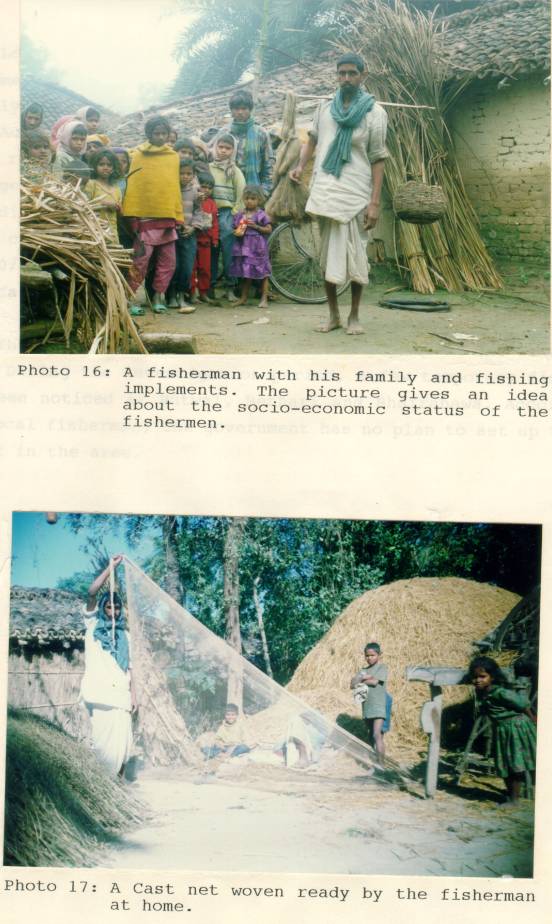
| 10. SOCIO-ECONOMIC STATUS OF FISHERMEN OF TINAU RIVER A set of questionnaire was developed and administered to local inhabitants of villages located near Tinau river such as Damkada, Charchare, Dovan, Butwal and Bethari to know the socio-economic status of local fishermen. The information obtained were analysed critically and the conclusions were made which are described below: Although survey revealed that about 12, 240 families are engaged in aquaculture activities and about 36, 7000 people have been estimated to be actively involved in fishery profession in Nepal (Pradhan and Pantha, 1995), an extensive study on the actual number of fishermen and their socio-economic conditions are needed to evaluate the actual production from capture fishery. Fishermen of Tinau River are locally known as �Majhi� and �Mallah� who generally inhabit the places near the bank of the river which includes Majhi, Tharus, Magars, Danuwars, Darahis, and Dhimals etc. In the Terai region they live by making separate territory due to social barrier, feeling for them as a lower caste. But such conditions are rarely found among the fishermen of Hilly region near Tinau river where Magars are mostly involved in fishing activities. Fishermen are always dominated by the people of higher caste and they get a lot of social harassment from the other communities. About eighty three percent of the total fishermen of Tinau River are totally illiterate, ten percent have an education up to fifth standard and seven percent with an education up to eight grades are found among surveyed fishermen. They are very much interested to give education to their children, among which fifty three percent are sending their children to school, seventeen percent send only sons, neglecting their daughters towards education and thirty percent are unable to send their children for study. They are not aware of the facilities of free education in the government schools. About forty percent of the fishermen know about the family planning idea but only few (about 20 %) of them have taken benefit from it and the rest think that there is no need of family planning system because children are the bless of God for them. Majority of the fishermen are having the family of 6 to 11 members. Though their main job is fish catching, they depend for their livelihood not on the fish catch, but they also have some their own land [average 8 kattha (0.26 ha) per family] which they cultivate to grow agricultural products. Only 27 percent of fishermen earn their livelihood by fishery profession and no one of the family members are engaged in other job, neither in the government sector nor in the private sector. Others (73 % fishermen) told that many of their household problems were fulfilled by fishing. Fishing activities continue throughout the year except the monsoon during which they are engaged in the work of agriculture. About fifty seven percent of the fishermen are living in small huts made up of bamboo (Dandrocalmus strictus) and Khar (Imperata cylindrica) and the bamboo wall is lapped with alluvial soil, seventeen percent have their houses made up of brick wall and have roofs of tiles (Photo 16) and about 26 percent have their houses made with stone walls and have roofs of Khar and Zinc plates (Karkatpata). Nearly eighty six percent males and fourteen percent females are engaged in fishing, but during off seasons male work as labour also. The females are engaged in their household affairs such as cooking, preparing bamboo basket implements, cleaning the house, collection of fire-wood, making dung-cake etc. Local fishermen themselves make different types of fishing implements especially during leisure periods with the help of locally available plant fibres (bamboo) and nylon strings (Photo 17). According to the local fishermen, the best fishing season in Tinau River is from March to July for fishing good-sized fishes. In average a fisherman can collect fishes weighing � to 2 kg per day according to the fishing season. They sell about 90 percent of the total catch composition of fishes at local markets at the rate of Rs. 60/- to 120/- per kg depending upon the species of fishes. The rest catch will be consumed by the family. The condition of fish market is very poor in the Tinau river area. During the investigation period, a few temporary fish shops had been noticed at Butwal, Bethari, and Bhairahawa. According to the local fishermen, the government has no plan to set up the fish market in the area. |
 |
| Home | Family | Curriculum | Thesis TU | Thesis NLH | Publications | Term Papers | Recent Paper | Proposal | Nepali Poems |
 |
| You are here: Home>>>MSc Thesis TU>>>Socio-economic status................ |