 |
 |
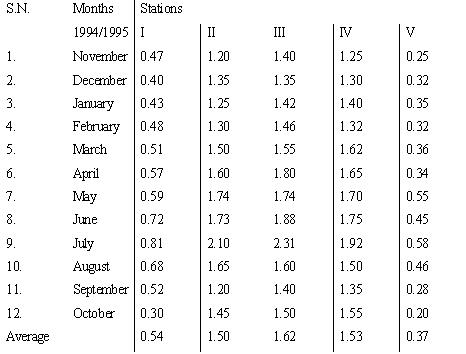
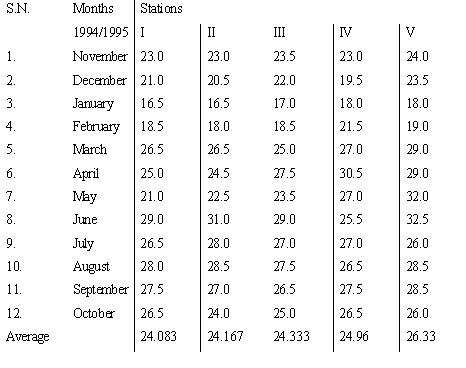
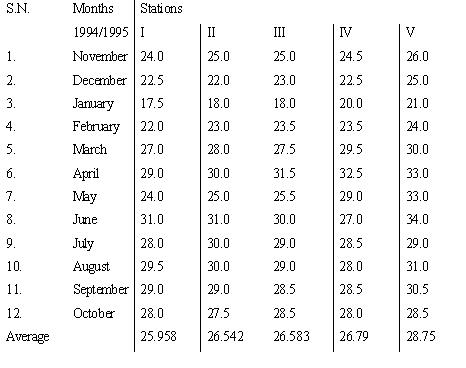
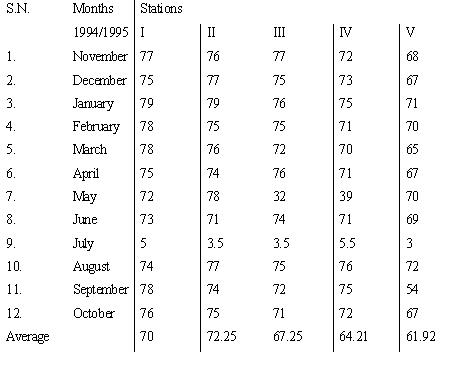
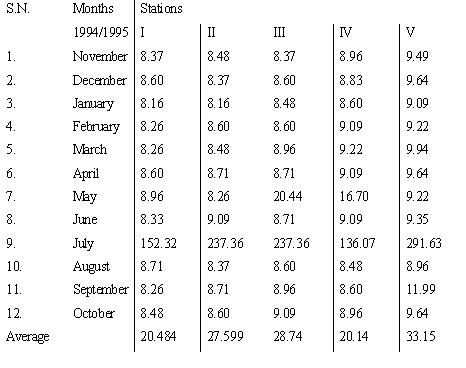
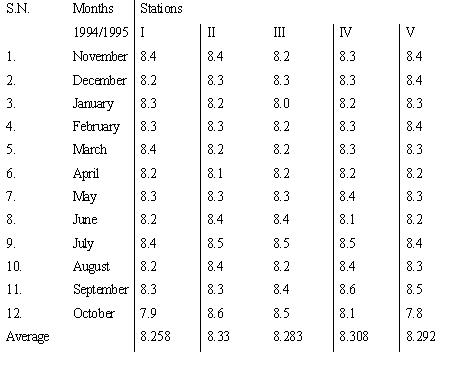
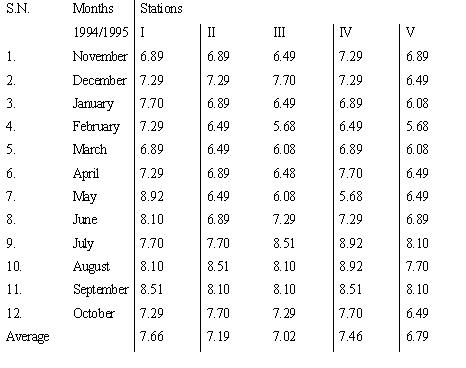
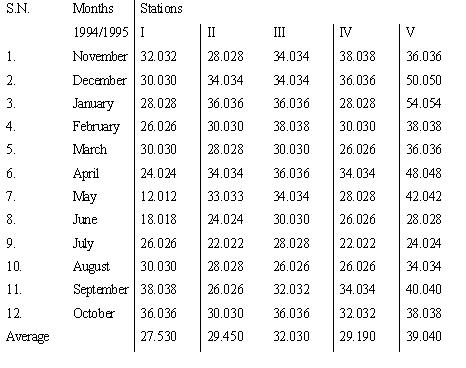
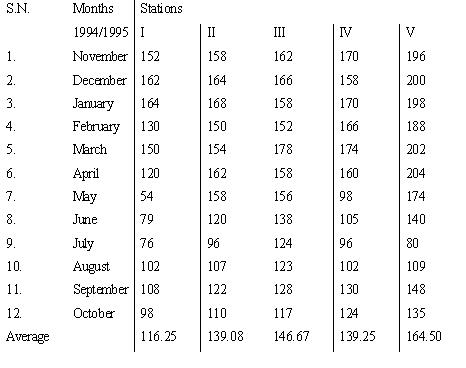
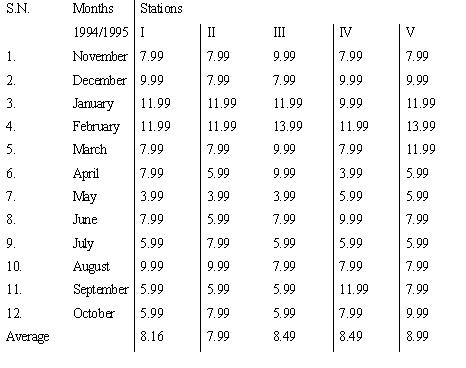
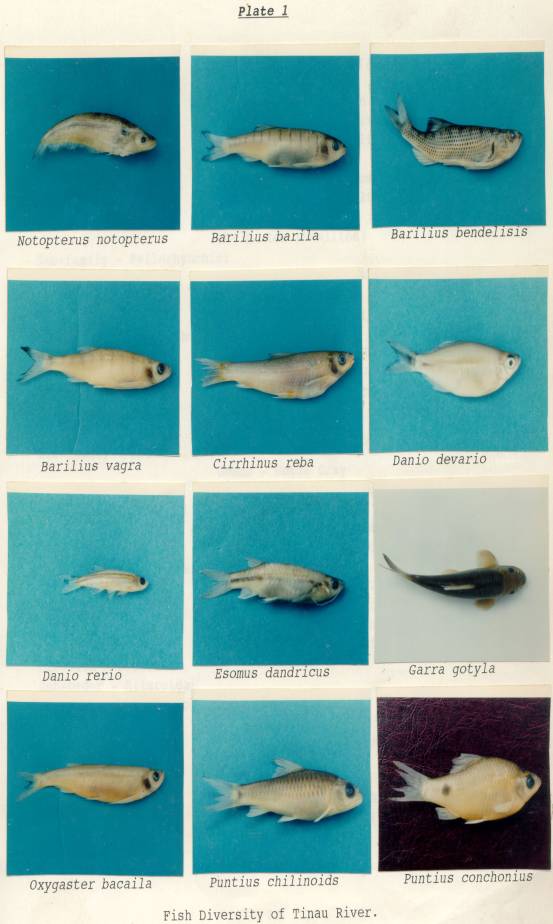
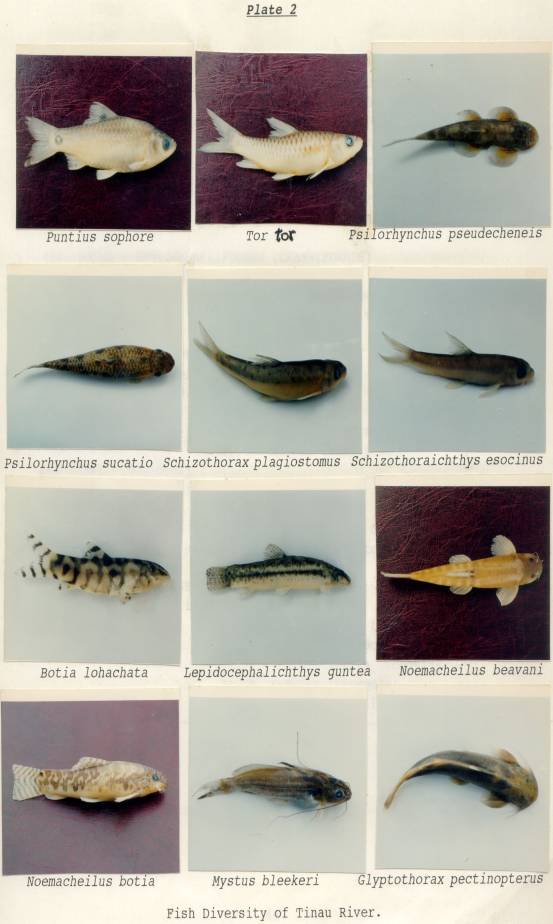
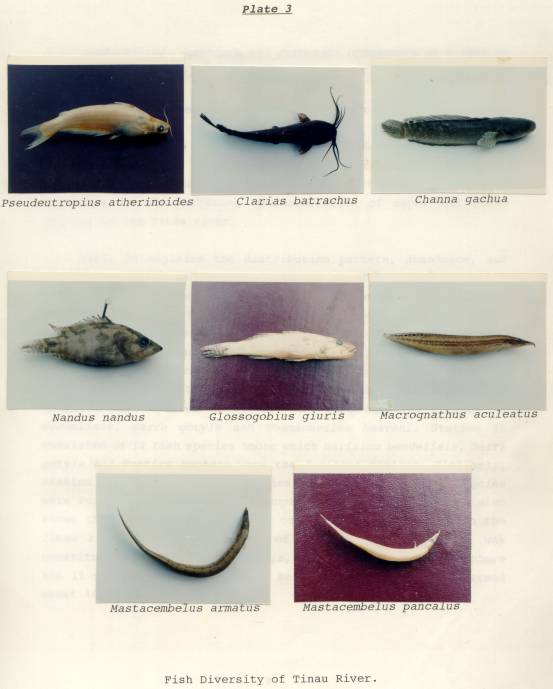
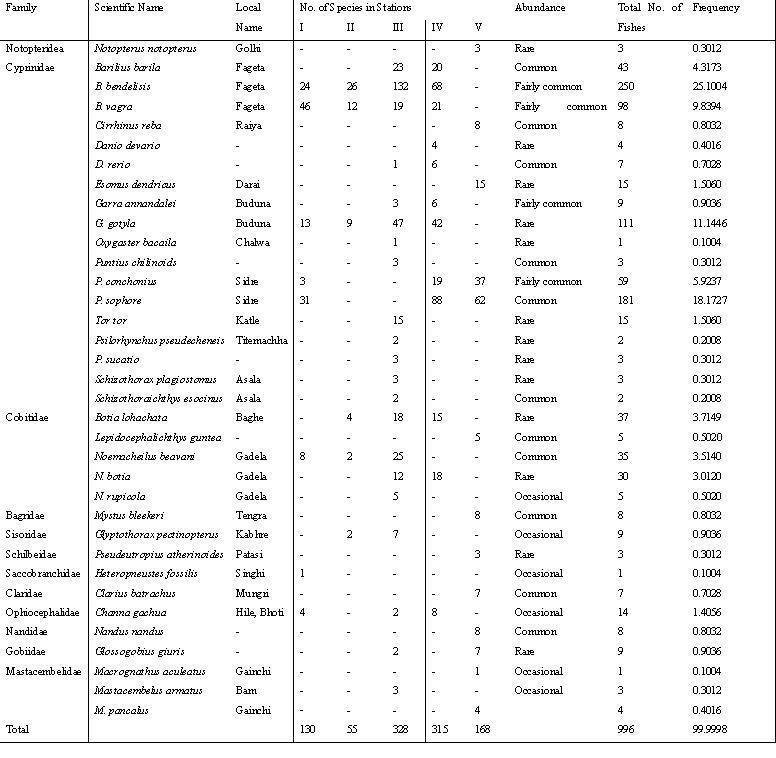
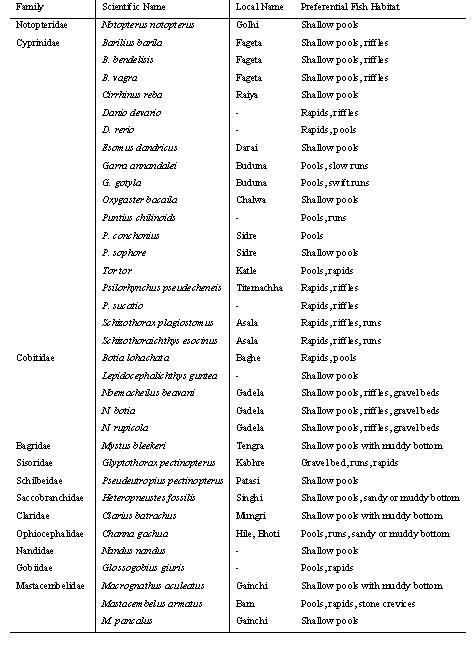
| 7. OBSERVATIONS AND RESULTS During the study period following observations were made and the results are cited below: 7.1 PHYSICAL ANALYSIS OF WATER During the present investigation period following physical parameters were analysed. 7.1.1 Water Velocity The water velocity of river is one of the main factors for determining the form and distribution pattern of fish fauna. Table 7 shows the velocity of water in the Tinau River at different stations in different months. Table 7: Water Velocity (m/sec) Variations of Tinau river at Different Stations in Different months. In the Tinau River the velocity of water ranged minimum from 0.20 m/s at station V in October to maximum 2.3 m/s at station III in July. 7.1.2 Temperature The temperature plays very important role in the species distribution of flora and fauna in the river. Table 8 explains the condition of surface water temperature at all stations in the Tinau River. The surface water temperature was recorded to be the lowest as 16.5oC in January at both the stations I and II. The highest surface water temperature recorded was 32.5oC in June at station V. Table 8: Surface Water Temperature (oC) Variations at Different Stations in Tinau River in different Months. Similarly, Table 9 shows the atmospheric temperature at all stations in the Tinau River. The highest atmospheric temperature recorded was 34oC in June at station V. The lowest atmospheric temperature recorded was 17.5oC in January at station I. Table 9: Air Temperature (oC) Variations at Different Stations of Tinau River in Different Months. 7.1.3 Transparency The transparency of the river water remained high throughout the year except during monsoon. In the monsoon the transparency decreased to the minimum level at all five stations. Table 10 explains the transparency value at different stations in the Tinau River during the present investigation period. The lowermost transparency value was recorded 3 cm at station V in July. The highest transparency value was recorded 79 cm at both the stations I and II in January. Table 10: Transparency (cm) Variations in Tinau River at Different Stations in Different Months. 7.1.4. Turbidity The turbidity of water directly varies with the transparency value. Table 11 explains the condition of turbidity value at all stations of Tinau River in different months. The highest turbidity value was 291.63 mg/l at station V in July. The lowest value of turbidity was recorded 8.16 mg/l at both the stations I and II in January. Table 11: turbidity (mg/l) Variations at Different Stations of Tinau River in Different Months. 7.2 CHEMICAL ANALYSES OF WATER The following chemical parameters were analysed during the present study. 7.2.1 Hydrogen Ion Concentration (pH) The pH value of surface water at all five station is shown in the Table 12. The highest value of pH was recorded 8.6 at stations IV and II in September and October respectively. The lowest pH value was recorded 7.8 in October at station V. The pH value fluctuated throughout the study period in all the stations but the variation range was not more than 0.8. Table 12: pH Value Variations in Tinau River at Different Stations in Different Months. 7.2.2 Dissolved Oxygen Table 13 explains the dissolved oxygen at different stations of the Tinau River. The highest dissolved oxygen value recorded was 8.92 mg/l at station I in May and at station IV in July and August. Similarly the lowest dissolved oxygen value recorded was 5.68 mg/l at station IV in May, and at both the stations III and V in February. Table 13: Dissolved Oxygen (mg/l) Variations at Different Station of Tinau River in Different Months. 7.2.3 Total Alkalinity Monthly measurement of the total alkalinity at different stations is given in the Table 14. The highest total alkalinity value recorded during the study period was 54.054 mg/l at station V in January. Similarly, the lowest value of the total alkalinity was recorded 12.012 mg/l at station I in May. Table 14: Total Alkalinity (mg/l) Variations at Different Station of Tinau River in Different Months. 7.2.4 Total Hardness Usually natural water resources of Nepal contain more than 100 mg/l of total hardness (Lind, 1974 cited in Karna, 1993). During the present investigation period the highest value of the total hardness was 204 mg/l in April at station V. The lowest recorded value was 54 mg/l at station I in May (Table 15). Table 15: Total Hardness (mg/l) Variations in Tinau River at Different Stations in Different Months. 7.2.5 Free Carbon dioxide Table 16 explains the monthly measurement of free carbon dioxide at all stations of the Tinau River. The highest value of free carbon dioxide observed was 13.99 mg/l in February at both the stations II and V. The lowest value was 3.99 in May at station I, II, III and in April at station IV. Table 16: Free Carbon dioxide (mg/l) Variations at Different Stations of Tinau River in Different Months. 7.3 BIOLOGICAL PARAMNETERS Planktons include the free-floating minute plant and animal organisms that have very feeble locomotory organs and simply drift with the water currents. According to Whitton et al. (1986), the phytoplankton, though confine to the sheltered areas and back waters in common with emergent, submerged or free floating plants and grasses which die or rot, constitute highly productive community even in the high altitude streams. The phytoplanktons are the primary producers in the water ecosystems which usually include chlorophyll-bearing organisms which are responsible for the photosynthesis. During the investigation period, few phytoplankton were reported, viz., Spirogyra, Lyngbya, Tabellaria, and Microcystis (Table 17). Table 17: Occurrence of Phytoplankton at Different Stations in Tinau River. ----------------------------------------------------------------------------------------------------- S.N. Name of Phytoplankton Stations ----------------------------------------------------------------------------------------------------- I II III IV V ----------------------------------------- 1. Spirogyra sp. + + + + + 2. Lyngbya sp. + - - - - 3. Tabellaria sp. - + + - - 4. Microcystis sp. - - + - - ----------------------------------------------------------------------------------------------------- Index: + = present, and - = absent. The zooplanktons are minute animals which form the secondary trophic level in the aquatic ecosystem. The zooplanktons feed on phytoplankton and which in turn are consumed by tertiary level in an aquatic ecosystem like larvae of fishes and fishes etc. During the study period, few zooplanktons were recorded, viz., Cyclopes, Monostyla and Daphnia (Table 18). Table 18: Occurrence of Zooplanktons at Different Stations in Tinau River. -------------------------------------------------------------------------------------------------------------------------- S.N. Name of Zooplanktons Stations -------------------------------------------------------------------------------------------------- I II III IV V -------------------------------------- 1. Cyclopes + + - - - 2. Monostyla + + - - + 3. Daphnia - - - - + -------------------------------------------------------------------------------------------------- Index: + = present, and - = absent. 7.4 FISH BIODIVERSITY OF THE TINAU RIVER The Tinau river provides a habitat for fresh water fishes of diverse types, viz., Snow trout, Catfishes, Stone loaches, Sucker heads, Barbs, Mahaseers, Eels etc. Thirty-five species are reported from the Tinau River during the present investigation (plate 1, 2 and 3). The fishes reported from the Tinau River consist of 5 orders, 12 families, 25 genera and 35 species. The classification and systematic positions of fish fauna are given as follows (Table 19). Table 19: Systematic Positions of Ichthyofauna Reported from Tinau River. I. ORDER � CLUPEIFORMES Sub-order � Clupeoidei Super �family � Clupeoidae Family � Notopteridae Genus � Notopterus Lacepede 1. N. notopterus II. ORDER � CYPRINIFORMES Division � Cyprini Sub-order � Cyprinoidei Family � Cyprinidae Sub-family � Cyprinini Genus � Barilius Hamilton 2. B. barila (Hamilton) 3. B. bendelisis Var. Chedra (Hamilton) 4. B. vagra (Hamilton) Genus � Cirrhinus Oken 5. C. reba (Hamilton) Genus � Danio Hamilton 6. D. devario (Hamilton) 7. D. rerio (Hamilton) Genus � Esomus Swainson 8. E. dandricus (Hamilton) Genus � Garra Hamilton 9. G. annandalei Hora 10. G. gotyla (Gray) Genus � Oxygaster Van Hesselt 11. O. bacaila (Hamilton) Genus � Puntius Hamilton 12. P. chilinoids 13. P. conchonius (Hamilton) 14. P. sophore (Hamilton) Genus � Tor Gray 15. T. tor (Hamilton) Sub-family � Psilorhynchini Genus - Psilorhynchus Mc Clelland 16. P. pseudecheneis Menon and Dutta 17. P. sucatio (Hamilton) Sub-family � Schizothoracini Genus � Schizothorax Heckel 18. S. plagiostomus Heckel Genus � Schizothoraichthys Mishra 19. S. esocinus Family � Cobitidae Sub-family � Botini Genus � Botia Gray 20. B. lohachata Chaudhuri Sub-family � Cobitini Genus � Lepidocephalichthys Bleeker 21. L. guntea (Hamilton) Sub-family � Noemacheilini Genus � Noemacheilus Van Hesselt 22. N. beavani Gunther 23. N. botia (Hamilton) 24. N. rupicola (Mc Clelland) Division � Siluri Sub-order � Siluroidei Super-family � Siluroidea Family � Bagridae Genus � Mystus Gronovis (Emend. Scopoli) 25. M. bleekeri (Day) Family � Sisoridae Genus � Glyptothorax Blyth 26. G. pectinopterus (Mc Clelland) Family � Schilbeidae Genus � Pseudeutropius Bleeker 27. P. atherinoides Bloch Family- Saccobranchidae Genus � Heteropneustes Muller 28. H. fossilis (Bloch) Family- Claridae Genus - Clarius Gronovius (Emend. Scopoli) 29. C. batrachus (Linnaeus) III. ORDER � OPHIOCEPHALIFORMES (CHANNIFORMES) Family- Ophiocephalidae Genus � Channa Gronovius 30. C. gachua (Hamilton) IV. ORDER � PERCIFORMES Sub-order � Percoidei Super-family � Percoidae Family � Nandidae Genus � Nandus Cuv. And Val. 31. N. nandus (Hamilton) Sub-order � Gobioidei Super-family � Gobioidae Family � Gobiidae Genus � Glossogobius Gill 32. G. giuris (Hamilton) V. ORDER � MASTACEMBELIFORMES Family � Mastacembelidae Genus � Macrognathus Lacepede 33. M. aculeatus (Bloch) Genus � Mastacembelus Gronovius 34. M. armatus (Lacepede) 35. M. pancalus (Hamilton) 7.5 DISTRIBUTION, ABUNDANCE AND FREQUENCY OCCURRENCE OF FISHES IN THE TINAU RIVER The upper reaches of Tinau river starts from Butwal to Damkada (Mariphant) with an altitudinal differences from 188 m to 684 m which includes Hilly region. Similarly the lower reach lies below Butwal (188 m) to Bethari (107 m) (Terai region) for the present investigation. The distribution patterns of fishes are according to the different characteristics of upper and lower reaches of the Tinau River. Table 20 explains the distribution pattern, abundance, and frequency occurrence of fish fauna of the Tinau River. Only 8 species of fishes were reported from station I among which the dominant species of fishes were Barilius bendelisis, B. vagra, and Puntius sophore. At station II, only six fish species were reported among which the dominant species were Barilius bendelisis, B. vagra and Garra gotyla. Greatest numbers of fish species were reported from the station III, i.e., 21 species were found. The most dominant fish species at station III were Barilius barila, B. bendelisis, Garra gotyla and Noemacheilus beavani. Station IV consisted of 12 fish species 12 fish species among which Barilius bendelisis, Garra gotyla and Puntius sophore were the dominant species. Similarly, station V contained 13 fish species and the dominant fish species were Puntius conchonius and P. sophore. Similarly, Table 20 also shows the species-wise frequency occurrence of the fishes in the Tinau River. About 25 percent of total catch composition was constituted by Barilius bendelisis, 18 percent by Puntius sophore and 11 percent by Garra gotyla. Rest of the fish species formed about 46 percent of total catch. Table 21 shows the family-wise fish species composition (no. of species in a family) in the Tinau river during the investigation period, according to which, 51.42 percent of reported species fall under the family Cyprinidae, 14.29 percent under family Cobitidae, 8.57 percent under Mastacembelidae and 25.71 percent under others. Table 22 shows the family-wise fish composition (in number) in the Tinau River during the present study period. Cyprinidae alone constituted about 81.73 percent of the total fish catch by number. Similarly, Cobitidae constituted about 11.24 percent of total fish catch. Others constituted about 7.03 percent of the total catch. Table 21: Family-wise Fish Species Composition in Tinau River (1994/1995). ------------------------------------------------------------------------------------------------------------- S. No. Family No. of Fish Species Species Composition (%) ------------------------------------------------------------------------------------------------------------- 1. Cyprinidae 18 51.42 2. Cobitidae 5 14.29 3. Mastacembelidae 3 8.57 4. Others 9 25.71 -------------------------------------------------------------------------------------------------------------- Table 22: Total Catch (in number) and Fish Composition (%) in Different Families in Tinau River (1994/1995). ------------------------------------------------------------------------------------------------------------------------------------------------------- S. No. Family Total Catch No. of Fish Species Fish Composition (%) ------------------------------------------------------------------------------------------------------------------------- 1. Cyprinidae 814 81.73 2. Cobitidae 112 11.24 3. Others 70 7.03 ------------------------------------------------------------------------------------------------------------------------- 7.6 MAJOR ICHTHYOFAUNA AND THEIR STATISTICAL ANALYSIS The two families of ichthyofauna, viz., Cyprinidae and Cobitidae formed about 92.97 percent of the total collected fish fauna while the rest families constituted only 7.03 percent which has been shown in the Table 22. Among the collected fish fauna family Cyprinidae predominated throughout the study period and alone constituted 81.73 percent of the total, Cobitidae was found as a second dominant family and constituted 11.24 percent of the total collected fish fauna. Correlation co-efficient between transparency and turbidity was highly negative (-0.9857). The co-efficient of correlation value between altitude and fish species composition was found to be highly negative (-0.6805). Similarly, fish species composition has positive correlation co-efficient value (0.383) with pH range and positive correlation (0.527) with dissolved oxygen. The fish species composition shown negative correlation value r = -0.803 with free carbon dioxide (Table 23). Table 23: Co-efficient Correlation Between Physico-chemical Parameters and Fish Species Composition in Tinau River (1994/1995). ---------------------------------------------------------------------------------------------------------------------------------- Parameters R P.Er. -------------------------------------------------------------------------------------------------------- Water velocity vs. dissolved oxygen 0.224 0.185 Altitude vs. fish sp. composition -0.68 0.105 Water temp. vs. fish sp. composition 0.555 0.135 pH vs. fish sp. composition 0.382 0.166 Dissolved oxygen vs. fish sp. composition 0.527 0.140 Free carbon dioxide vs. fish sp. composition -0.486 0.148 Transparency vs. turbidity -0.986 0.005 Dissolved oxygen vs. water temperature -0.783 0.117 Altitude vs. water temperature -0.448 0.241 -------------------------------------------------------------------------------------------------------- 7.7 PREFERENTIAL FISH HABITAT IN THE TINAU RIVER Habitat preferences of important species of fishes in Tinau River, based on present sampling and information from local fishermen, are described below (Table 24). Large games cum food fish such as Sahar (Tor tor) prefer stony rapids and pools and have ability to migrate from down-stream to up-stream. Small fishes such as Schizothorax plagiostomus, Glyptothorax pectinopterous have suction disc on their ventral side for clinging to stones and rocks and are found in rapids of upper reaches. Small fishes (loaches) like Noemacheilus beavani, Noemacheilus botia and Noemacheilus rupicola have restricted food habit in sandy bottoms hiding under stones. Some species of fishes partially bury themselves in sandy or muddy bottoms such as Cat fish (Heteropneustes fossilis) and Snake headed fish (Channa gachua) etc. These fishes also have their tendency to overland through wet vegetation during dry season. Some fishes school near mid-water column for the purpose of predation, e.g., Puntius sophore, Barilius bendelisis, Barilius vagra and Nandus nandus etc., while others like Esomus dandricus and Tor tor school near sub-surface water for feeding purpose. Fish like stone loach, (Noemacheilus rupicola) mimic with dead log and dead woody material in water. Generally, fish in Tinau river migrate upstream in early monsoon (May-June) and migrate downstream in September-October. Tinau river mainly consists of local migrants which includes snow trout (Schizothorax sps) and Mahaseer (Tor tor) etc. Table 24: Preferential Fish habitat in the Tinau River. |
 |
 |
 |
 |
 |
 |
 |
 |
 |
 |
 |
 |
 |
 |
 |
| Home | Family | Curriculum | Thesis TU | Thesis NLH | Publications | Term Papers | Recent Paper | Proposal | Nepali Poems |
 |
| You are here: Home>>>MSc Thesis TU>>>Observations and Results |