 |
 |
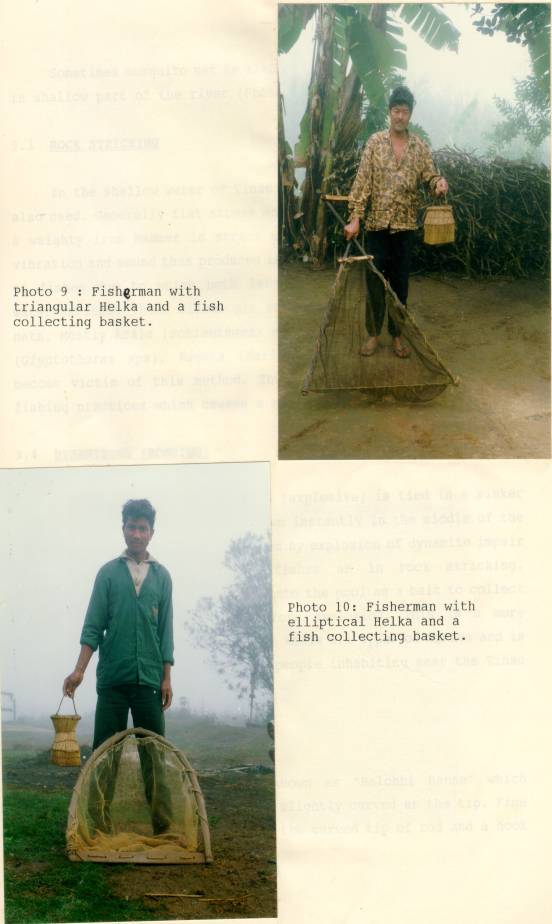
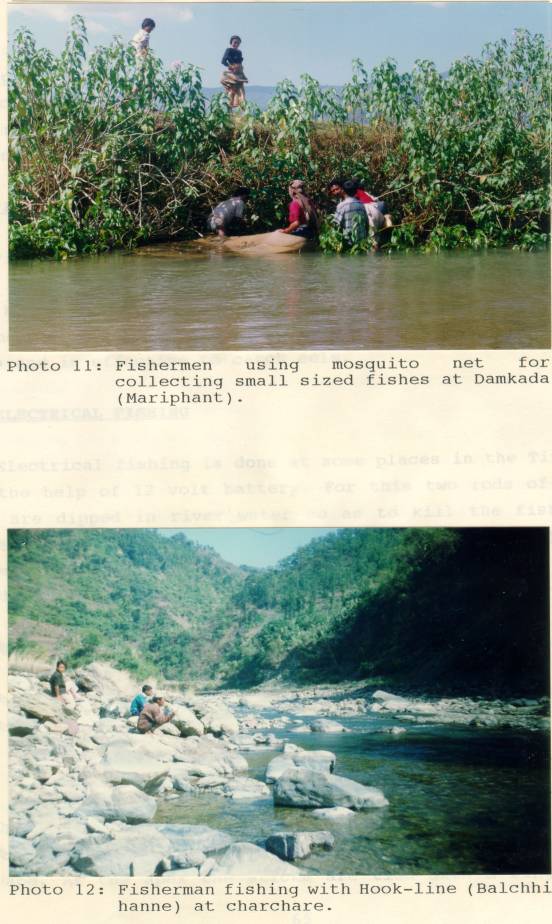
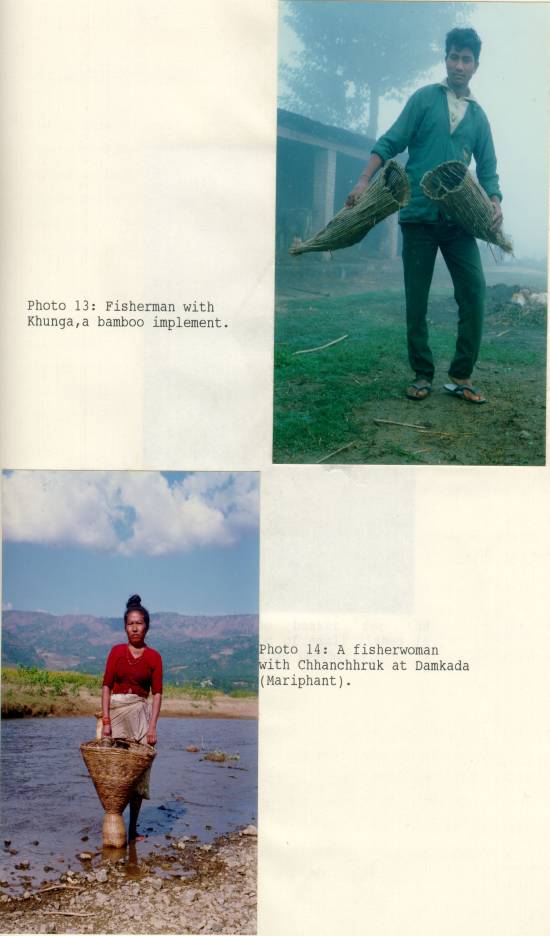
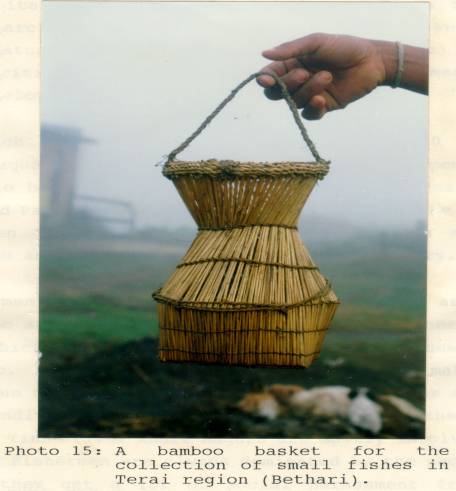
| 9. FISHING IMPLEMENTS OF TINAU RIVER In Tinau river varied kinds of fishing implements and methods are being used. The fish capturing methods in the Tinau river are similar to those of the other parts of Nepal. Most of the methods used in the Tinau river are seasonal which are described below. 9.1 DIVERSION OF RIVER CHANNEL, (DUWALO THUNNE) This method is occasionally used in Tinau River for which the river is made dry, deflecting the flow of water to one of the either side from the main riverbed by constructing a rough stone dam. At the distal end of diverted channel a bamboo fish trap (Dhadiya) is set so as to catch the fish escaped from the main river. The blocking is made by using stones, logs, sand, branches of trees and clay. The fish are caught with bare hands or with the help of scoop nets. But the pool regions and stone crevices, herb poisons Khirro (Sapium sps), bark of Kafal (Myrica esculanta), stem of Siudi (Cactus sps) or chemical poisons like Malathion and Metacid are also used. 9.2 NETS (JAL) Various kinds of nets are used in Tinau river for fishing, viz., Cast net, Bhureli jal (small type of Cast net), Scoop nets and Helka. 9.2.1 Cast net It is a large casting type of net which is used to catch large and medium sized fishes. It is made up of cotton or nylon thread and its body is bell shaped. The rim of the net is the widest part and it tapers gradually towards the apex. The rim is folded inside by 5-10 inches, the margin of which is tied with the body of the net at a regular distance of 3-4 inches to give bag like structure, each knot consisting of a pair of iron or lead beads. It is mostly used throughout the year in the Tinau river. The mesh size of the net ranges from 1.5 cm- 2.5 cm and catches Katle (Tor tor), Fageta (Barilius sps), Buduna (Garra sps) etc. 9.2.2 Bhureli Jal Shape and texture of Bhureli jal are like that of Cast net but it is smaller in size with smaller mesh size from 0.5 to 1.5 cm. It is generally used for catching smaller or juvenile fishes. The practice of this jal is harmful for the fishes which wipes our larvae of fishes and destructs fishery resources. 9.2.3 Scoop net It consists of a rectangular wooden or steel-frame which is supported by a short handle of wood. The rectangular frame carries an oval net which is made of jute or mosquito net. It is generally used in muddy water or in diverted channel of river to catch fishes like snake headed fish (Channa sps), Gadela (Noemacheilus sps), and Buduna (Garra sps) etc. but very few fishermen use this type of net in the tinau river. 9.2.4 Helka It is bag-like in structure with wooden frame of carious shapes such as elliptical, triangular etc. which is made up of small nets, e.g., mosquito net (Photo 9 and 10). It cannot be used in the rapid flow of water. It is mostly used in the Terai region where the shallow and stagnant water body is found near the bank of Tinau river (e.g. Bethari). Sometimes mosquito net is also used for capturing small fishes in shallow part of the river (Photo 11). 9.3 ROCK STRICKING In the shallow water of Tinau River, rock-striking method is also used. Generally flat stones are used for this purpose on which a weighty iron hammer is struck with full force. The intensity, vibration and sound thus produced impair acoustico-lateralis system of fishes due to which both large and small fishes float over water-surface. This fishes are scooped with bare hands or scoop nets. Mostly Asala (Schizothorax sps), Fageta (Barilius sps) and juvenile fishes becomes victim of this method. Thus this is one of the harmful fishing practices which cause a great loss of young fish. 9.4 DYNAMYTING (BOMBING) Appropriate size of dynamite (explosive) is tied in a sinker (stone) which is ignited and thrown instantly in the middle of the pool region. Violent sound produced by explosion of dynamite impair acoustico-lateralis system of fishes as in rock striking. Sometimes rice grains are thrown into the pool as a bait to collect fishes in a particular area before explosion. This is a more destructive fishing practice which kills all types of fishes and is practiced illegally by the local people inhabiting near the Tinau River. 9.5 FISHING-ROD (HOOK-LINE) Fishing rods are locally known as �Balchhi hanne� which consist of a lone and slender rod slightly curved at the tip. Fine cotton or nylon thread is tied at the curved tip of rod and a hook in the distal end of thread. Just above the hook there is a sinker made up of lead or stone (Photo 12). Bait generally consists of earthworms, small fishes, insects or maize etc. Stout rod with thick string and a bait of small fishes is generally used for catching fishes like Tor sps and Schizothorax sps etc. 9.6 FISH SPEARING Fish spearing method with the help of a spear is noticed in Tinau river especially during the summer season when the water level becomes low. Mostly it consists of a spear fixed at the tip of long bamboo or wooden pole which is used at the crevices of stones and is effective to catch eels. 9.7 ELECTRIC FISHING Electric fishing is done at some places in the Tinau River with the help of 12-volt battery. For this, two rods of opposite poles are dipped in river water so as to kill the fishes lying between these rods. Generally Asala (Schizothorax sps) becomes victim of this method, at the same time many other biota are also killed. Hence it is a destructive method to be banned totally. 9.8 BAMBOO IMPLEMENTS A number of bamboo implements are used in the Tinau river for fishing as well as collecting purposes. 9.8.1 Dhadiya It is made up of fine and smooth bamboo sticks which are tied side by side with a fine jute rope in a spiral way and is conical in shape. At the apex the sticks are tied into a single bundle while the mouth consists of a wooden rim. A small spiral trap of bamboo sticks is fitted at the wooden rim which is so constructed that the fishes can get inside the Dhadiya but cannot get out of it. Mostly Dhadiya is used in a diverted river channel, the rim of which touching the ground is covered wit stone pebbles, soils and herbs so as to confuse the fishes from riverbed. All kinds of large and small fishes get trapped into Dhadiya. 9.8.2 Khunga It is a conical and tapering container made up of coarse bamboo sticks (Photo 13). The open circular rim of Khunga while setting in fishing channel is tied side by side with a pair of ropes. Usually, it is used in fast water current descending from upper to lower level. The wall is set along the steep channel of the river so that fishes may be forced to enter in the Khunga which is set at the apex of the wall. Once the fishes pass into the Khunga, cannot get out of it because of the force of water current as well as the structure of the Khunga. Generally, this is used from February to May. 9.8.3 Chhanchhruk A different type of bamboo implement is also reported at Damkada (Mariphant) which is locally known as �Chhanchhruk�, and is used to trap fishes of small sizes. It is conical in shape and bears another conical pouch at the base (Photo 14). Fishermen also use many other bamboo implements which are used to store their catches while fishing which are tied on the sides of waist (Photo 15). |
 |
 |
 |
 |
| Home | Family | Curriculum | Thesis TU | Thesis NLH | Publications | Term Papers | Recent Paper | Proposal | Nepali Poems |
 |
| You are here: Home>>>MSc Thesis TU>>>Fishing implements ............... |