
|
|
THE RELATIONSHIPS AMONG THE ZANG - FU ORGANS
From this it can be seen that the functional activities, and internal - external relationships of the zang - fu organs, are based on the meridians system. Without the interconnecting pathways of the meridians, each of the zang - fu organs would become an isolated and static organ, unable to perform its functional activities. This interconnecting function of the meridians is reflected not only by the internal - external connection between the zang and the fu organs, but also by relationships within the zang and the fu organs themselves, thus forming an internal criss - crossing network. For example, the Liver Meridian of Foot - Jueyin has a branch which, " arising from the liver, passes through the diaphragm and flows into the lung, " furthers connecting with the Lung Meridian of Hand - Taiyin and thus forming a connection between the lung and the liver. A branch of the Spleen Meridian of Foot - Taiyin " arises from the stomach, passes through the diaphragm and flows into the heart, " where it connects with the Heart Meridian of Hand - Shaoyin, thus forming a connection between the spleen and heart. There are similar connections between the kidney, heart and lung ; stomach, large intestine and small intestine ; and between liver and stomach, etc. by means of the meridians and collaterals. The mutual interconnections between the meridians, zang and fu organs mean that when a particular meridian is diseased due to invasion of pathogenic factors, there may be a transmission of pathological changes to other meridians, and related zang - fu organs, particularly externally - internally related ones. For instance, when the Lung Meridian is invaded by pathogenic factors, it may affect the large intestine, leading to constipation and diarrhea. When dysfunction of the spleen in transportation and transformation occurs, it may affect the stomach and kidney, giving rise to poor appetite, fullness and distention in the epigastrium, and edema. In general, only by having a clear understanding of the connections between the meridians by which pathological changes are transmitted, can the practitioner grasp the relationships among the zang - fu organs and determine treatment. The following is a brief introduction to the relationships between the zang organs, between the zang and fu organs, and between the fu organs. The Relationships Between The Zang Organs
The Relationship Between the Zang and the Fu Organs This refers to the external - internal relationship between the zang and the fu. The zang are yin and the fu yang. Yang dominates the exterior and yin the interior. Via the channels, each zang is externally - internally related to one fu, as follows : |
|
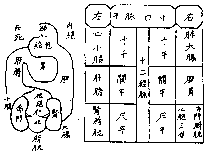 Although the zang and fu organs have different physiological functions, there is a very close relationship between them in maintaining the normal functions of the body. An understanding of the theory of the relationships between the zang and fu organs is of great significance in clinical differentiation of syndromes and treatment. Interconnected by the meridian system, the zang and fu organs have an internally - externally linked relationship. For example, the meridian of Hand - Taiyin enters the large intestine inferiority, and goes upward through the diaphragm to connect with the lung. The meridian of Hand - Yangming enters the lung and descends to connect with the large intestine. In this way a close internal relationship between the lung and large intestine is maintained. The heart and small intestine, spleen and stomach, liver and gallbladder and kidney and bladder are similarly closely related, physiologically and pathologically, by means of the yin and yang meridians. The sixty - second chapter of Plain Questions therefore says : " The zang organs are all connected with the meridians for the transmission of qi and blood. "